
Tianwen-3 is a multi-spacecraft, multi-phase Mars Sample Return (MSR) mission, designed to:
- Land on Mars
- Collect scientifically valuable surface samples
- Launch those samples into Mars orbit
- Capture them with an orbiter
- Return them to Earth for laboratory analysis
Tianwen-3 is less a rover and more a planetary logistics system—a tightly integrated chain designed to execute one of the hardest tasks in spaceflight: bringing pristine material from another planet safely to Earth.
This mission significantly elevates China’s planetary science, propulsion, autonomy, and deep-space systems capabilities.
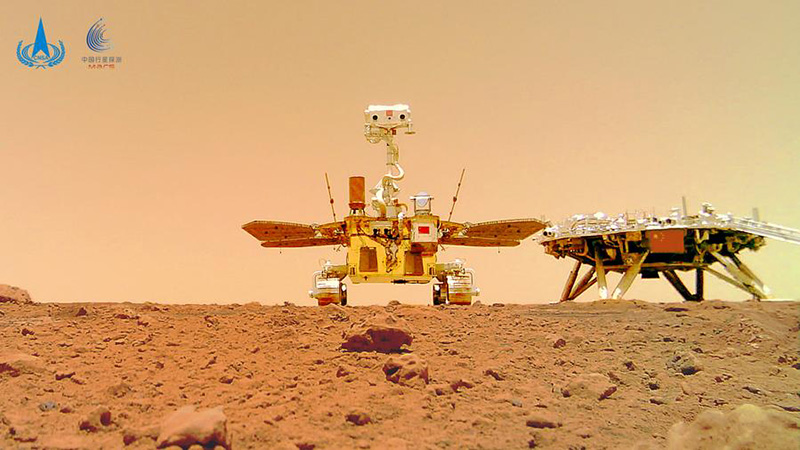
Mission Architecture
Tianwen-3 uses a two-launch architecture, reducing complexity compared to NASA’s multi-agency approach.
1. Earth Launch Phase
- Two Long March 5-class rockets
- One launch carries the lander + ascent vehicle
- Second launch carries the orbiter + Earth return capsule
2. Mars Orbit Insertion
- Orbiter enters Mars orbit
- Lander separates and descends to surface
3. Surface Operations
- Robotic systems collect samples
- Samples stored in sealed containers
- Samples loaded into a Mars Ascent Vehicle (MAV)
4. Mars Ascent & Orbital Rendezvous
- MAV launches from Mars surface
- Samples placed into Mars orbit
- Orbiter autonomously rendezvous and captures sample container
5. Earth Return
- Orbiter departs Mars orbit
- Earth re-entry capsule separates
- Samples land safely on Earth for analysis
Key Features of Tianwen-3
1. Mars Sample Return Capability
- Core mission objective
- Enables direct laboratory analysis, not possible with in-situ instruments
- Allows isotope dating, organic chemistry, and microstructural studies
Scientific impact: Orders of magnitude higher than rover-only missions.
2. Autonomous Rendezvous in Mars Orbit
- Orbital capture without human intervention
- Requires:
- Precision navigation
- Optical guidance
- Autonomous decision-making
This is one of the most technically challenging aspects of deep-space exploration.
3. Integrated Chinese End-to-End System
Unlike NASA–ESA MSR, Tianwen-3 is:
- Designed
- Built
- Launched
- Operated
entirely by China’s space ecosystem, improving coordination and reducing programmatic risk.
4. Advanced Surface Sampling System
Expected to include:
- Robotic arm with drilling capability
- Surface regolith scoop
- Potential shallow subsurface sampling (to avoid radiation-damaged material)
5. Mars Ascent Vehicle (MAV)
- First Chinese rocket to launch from another planet
- Ultra-lightweight
- Autonomous ignition and trajectory insertion
- Designed for Mars’ thin atmosphere and low gravity
6. High-Reliability Earth Re-entry Capsule
- Designed for planetary protection
- Sealed sample containment
- High-speed atmospheric re-entry
- Precision landing in designated recovery zone
Scientific Objectives
Primary Science Goals
- Search for biosignatures (past or present microbial life)
- Analyze organic molecules
- Study Mars climate evolution
- Understand surface–atmosphere interactions
- Determine geologic history and habitability
Secondary Objectives
- Mars environment characterization
- Orbital reconnaissance
- Technology validation for future crewed missions
Distinguishing Factors of Tianwen-3
| Factor | Tianwen-3 | NASA–ESA MSR |
|---|---|---|
| Program Control | Single-nation (China) | Multi-agency |
| Architecture | Two-launch | Multiple missions |
| Timeline | Late 2020s | 2030s+ (delayed) |
| Cost Control | Centralized | Highly complex |
| Autonomy | Very high | High but distributed |
| Strategic Goal | Sample return + tech dominance | Scientific collaboration |
Technological Breakthroughs Enabled
1. Deep-Space Autonomy
- AI-driven navigation
- Fault detection and recovery
- Autonomous rendezvous and docking
2. Precision Planetary Launch
- Mars ascent launch system
- Critical for future human Mars missions
3. Planetary Protection Engineering
- Prevent Earth contamination
- Sets foundation for interplanetary biosecurity protocols
4. Systems Integration Excellence
- End-to-end deep-space mission management
- Builds confidence for lunar bases and Mars infrastructure
Comparison of China’s Tianwen-3, NASA’s Perseverance, and ESA’s ExoMars (Rosalind Franklin rover)
Mars Mission Comparison: Tianwen-3 vs Perseverance vs ExoMars
1. Mission Overview
| Mission | Agency | Mission Type | Launch Era | Core Objective |
|---|---|---|---|---|
| Tianwen-3 | CNSA (China) | Mars Sample Return | ~2028 | Collect and return Mars samples to Earth |
| Perseverance | NASA (USA) | Rover (Sample Caching) | 2020 | Search for ancient life & cache samples |
| ExoMars (Rosalind Franklin) | ESA / Roscosmos* | Rover (In-situ science) | TBD (mid-late 2020s) | Subsurface life detection |
*Roscosmos partnership suspended; ESA re-architected mission.
2. Mission Architecture & Complexity
Tianwen-3 (Most Complex)
- Two Earth launches
- Lander + Mars Ascent Vehicle (MAV)
- Orbital rendezvous around Mars
- Earth return capsule
- Fully autonomous deep-space operations
Perseverance (Moderate Complexity)
- Single rover
- Sample collection and caching only
- No return to Earth (yet)
- Designed to support future MSR
ExoMars (Focused Complexity)
- Single rover
- No sample return
- Advanced drilling system
- Long-duration surface science
| Aspect | Tianwen-3 | Perseverance | ExoMars |
|---|---|---|---|
| Sample Return | ✅ Yes | ❌ No (cache only) | ❌ No |
| Mars Ascent | ✅ Yes | ❌ No | ❌ No |
| Orbital Docking | ✅ Yes | ❌ No | ❌ No |
| In-situ Science | Moderate | High | Very High |
3. Scientific Objectives Compared
| Objective | Tianwen-3 | Perseverance | ExoMars |
|---|---|---|---|
| Search for Past Life | ✅ | ✅ | ✅ |
| Organic Chemistry | ✅ (lab-grade on Earth) | ✅ (in-situ) | ✅ (subsurface) |
| Subsurface Access | Limited | Minimal | Up to 2 meters |
| Sample Return Science | Primary Goal | Supportive | ❌ |
Key Difference
- Tianwen-3: Science happens mainly on Earth
- Perseverance: Science happens on Mars
- ExoMars: Science happens below Mars’ surface
4. Instrumentation & Sampling
Tianwen-3
- Robotic arm + drill
- Sample sealing system
- Emphasis on sample integrity
- Limited in-situ instruments (mass & power prioritized for return)
Perseverance
- PIXL, SHERLOC, SuperCam
- Advanced imaging & spectroscopy
- Ingenuity helicopter support (technology demo)
ExoMars
- 2-meter subsurface drill
- MOMA organic molecule analyzer
- Designed to access radiation-shielded biosignatures
| Capability | Tianwen-3 | Perseverance | ExoMars |
|---|---|---|---|
| Drill Depth | Shallow | Shallow | Deep (2 m) |
| Life Detection | Indirect | Indirect | Direct subsurface focus |
| Lab-grade Analysis | Yes (Earth) | No | No |
5. Autonomy & AI
| Feature | Tianwen-3 | Perseverance | ExoMars |
|---|---|---|---|
| Autonomous Navigation | High | High | Moderate |
| Autonomous Sampling | High | High | Moderate |
| Autonomous Orbital Docking | Yes (unique) | No | No |
| Fault Recovery | Advanced | Advanced | Moderate |
Tianwen-3 leads in autonomy due to:
- Mars ascent
- Orbital rendezvous
- Earth re-entry precision
Tianwen-3: Design and Technology Details
1. Mission Design Philosophy
Tianwen-3 is designed around four core principles:
- End-to-end autonomy (minimal ground intervention)
- Mission simplification (two-launch architecture)
- Sample integrity first (science over in-situ instruments)
- Risk containment (planetary protection and redundancy)
Unlike exploratory rovers, Tianwen-3 is a precision logistics mission optimized to transport scientifically pristine material across interplanetary space.
2. Overall System Architecture
Two-Launch Architecture
| Launch | Payload Stack |
|---|---|
| Launch A | Mars Lander + Sampling System + Mars Ascent Vehicle (MAV) |
| Launch B | Mars Orbiter + Earth Return Capsule (ERC) |
This avoids the distributed multi-agency complexity seen in other MSR concepts.
3. Mars Lander System
Lander Design
- Mass class: Heavy lander (larger than Tianwen-1 rover)
- Power: Solar arrays + batteries
- Thermal control: Multi-layer insulation + heaters
- Landing system: Aeroshell + supersonic parachute + powered descent
Landing Precision
- Target landing ellipse: <10 km
- Terrain-relative navigation (TRN)
- Lidar + optical navigation for hazard avoidance
Key advancement: Higher landing precision than Tianwen-1, critical for sample quality selection.
4. Surface Sampling System
Sampling Hardware
- Robotic arm with:
- Scoop for regolith
- Rotary-percussive drill (shallow subsurface)
- Sample containers:
- Hermetically sealed
- Multi-layer contamination barriers
Sample Strategy
- Small number of high-value samples
- Preference for:
- Fine-grained sediments
- Ancient aqueous environments
- Subsurface materials shielded from radiation
Technology Highlights
- Autonomous sample selection
- Precision sealing without human intervention
- Contamination control at micrometer scale
5. Mars Ascent Vehicle (MAV)
Design Characteristics
- Ultra-light, two-stage solid rocket
- Height: ~3 meters
- Mass: <400 kg
- Payload: Sealed sample container (~few kg)
Key Technologies
- Cold-tolerant solid propellant
- Autonomous ignition
- Pre-programmed ascent trajectory
- No ground guidance after launch
Why MAV Is Critical
This is China’s first off-world rocket launch, a prerequisite technology for:
- Crewed Mars missions
- Planetary logistics
- Lunar-to-Mars transfer systems
6. Orbiter System
Orbital Capabilities
- High-precision Mars orbit insertion
- Long-duration loiter capability
- Autonomous rendezvous and capture
Capture Mechanism
- Non-contact or soft-capture system
- Optical navigation using beacon or reflective markers
- AI-assisted trajectory correction
This is one of the most complex autonomous maneuvers ever attempted in deep space.
7. Earth Return Capsule (ERC)
Design Goals
- Absolute sample containment
- Survivability under high-velocity re-entry
- Controlled landing for recovery
Key Technologies
- Ablative heat shield
- Double-layer pressure vessel
- Shock-absorbing landing system
- Passive system (no parachute deployment dependency)
Planetary Protection
- Category V (Restricted Earth Return)
- No sample exposure until secure lab entry
- Bio-containment comparable to BSL-4 facilities
8. Autonomy & AI Systems
Autonomous Functions
- Navigation and hazard avoidance
- Sampling site selection (rule-based + ML)
- Fault detection, isolation, and recovery (FDIR)
- Orbital rendezvous and capture
- Mission timeline execution
AI Role
- Not generative AI
- Deterministic autonomy + AI-assisted decision trees
- Optimized for reliability and explainability
9. Communications & Data Handling
Deep Space Communications
- X-band / Ka-band
- High-gain antenna on orbiter
- Store-and-forward architecture
Data Priority
- Engineering telemetry > navigation > science
- Science data mostly deferred to Earth labs
10. Power Systems
| Component | Power Source |
|---|---|
| Lander | Solar arrays + batteries |
| MAV | Chemical (rocket stages) |
| Orbiter | Large solar wings |
| ERC | Passive (no power after separation) |
RTGs are not expected, simplifying thermal and safety design.
11. Thermal & Environmental Engineering
Mars Surface Challenges
- Temperature swings: –120°C to +20°C
- Dust accumulation
- Low atmospheric pressure
Mitigations
- Dust-resistant coatings
- Redundant heaters
- Insulated sample vault
12. Redundancy & Risk Mitigation
Single-Point Failure Reduction
- Redundant sensors
- Parallel control paths
- Fail-safe sample sealing
Mission Risk Areas
- Landing precision
- MAV ignition
- Orbital rendezvous
- Earth re-entry
Each has independent contingency logic.
13. Technology Readiness Level (TRL) Summary
| Subsystem | TRL |
|---|---|
| Mars landing | High (heritage from Tianwen-1) |
| Sampling & sealing | Medium-High |
| Mars ascent vehicle | Medium |
| Autonomous rendezvous | Medium |
| Earth re-entry capsule | High (Shenzhou heritage) |
14. Key Design Distinguishing Factors
What Makes Tianwen-3 Unique
- Single-nation MSR mission
- Fewer spacecraft than NASA–ESA MSR
- High autonomy, low operational overhead
- Focus on bringing Mars home, not prolonged surface science
Chinese scientist details first planned Mars sample-return mission Tianwen-3