
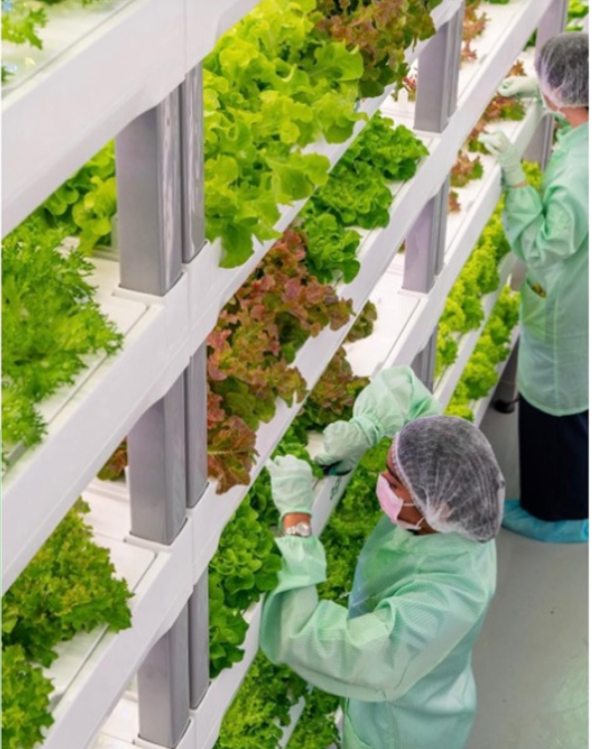
Agroz Inc. is an innovative, fully vertically integrated agricultural technology company designing, building, managing, and operating indoor and outdoor Controlled Environment Agriculture (“CEA”) vertical farms. Agroz also operates CEA vertical farms in local communities to grow and deliver clean, pesticide free, fresh and nutritious rich vegetables directly to consumers and businesses, and to educate the public on how its vegetables are grown. Agroz believes its competitive advantage stems from its proprietary Agroz OS system, a vertical farm operating system comprised of (i) digitally automated hardware systems enabling management of vertical farm conditions, and (ii) certain software solutions enabling email and communication systems for vertical farm organization.
Agroz Inc. (the Agroz brand active in CEA/vertical farming) announced Agroz Robotics in collaboration with UBTECH Robotics, a Hong Kong / China robotics company known for humanoid and service robots. As part of the announcement, UBTECH’s industrial humanoid platform Walker S is named as the first robot to be integrated into Agroz OS and deployed inside Agroz vertical-farm facilities.
As part of Agroz Robotics, UBTECH’s self-developed industrial humanoid robot, ‘Walker S’, will be the first robot introduced into Agroz’s controlled-environment farming facilities. Walker S will be integrated as a hardware platform into Agroz OS. This AI robotics technology is designed to automate key agricultural processes such as seeding, monitoring, harvesting, and crop optimization. This next-generation autonomous farming system will significantly boost productivity, reduce reliance on human labor, and ensure more precise and consistent crop quality.
“Through Agroz Robotics, we hope to make sustainable agriculture a reality,” said Gerard Lim, CEO of Agroz. “Our collaboration with UBTECH is a major milestone in our mission to redefine agriculture by using robots and artificial intelligence. This new collaboration enables us to combine cutting-edge humanoid robotics with data intelligence to build smart, self-optimizing farms to support the scalable production of cleaner, safer, and more sustainable food.”
“We also thank the Malaysian government for cultivating an environment where such deep-tech solutions can thrive, directly strengthening our nation’s food security, sustainability, and economic resilience,” Mr. Lim added.
Leon Li, General Manager of UBTECH’s Industrial Robotics Division, added, “We are delighted to collaborate with Agroz to apply our artificial intelligence and robotics technologies across a wider range of industries, contributing to the sustainable development of agriculture in Asia and around the world.”
Through deep integration with UBTECH’s automation systems, Agroz will be able to deploy modular robotic solutions tailored for vertical farms, smart greenhouses, and hybrid indoor-outdoor facilities across Southeast Asia. This innovation aligns with Malaysia’s vision for sustainable food security, reinforcing Agroz’s mission to improve reliability, efficiency, and resilience in the regional food supply chain. As Agroz looks forward to expanding across Southeast Asia, it aims to accelerate the global transition toward intelligent, sustainable, and climate-resilient food systems.
Agroz OS (farm operating system): central software that aggregates sensor data, manages schedules, runs optimization algorithms (light, nutrient, climate), and issues robotic tasks. Integration with robots allows orchestration across fleets and facilities.
Robotic platforms: the initial platform is UBTECH’s Walker S humanoid. Humanoid platforms can operate in human-oriented environments (racks, trays, vertical aisles) and perform dexterous tasks (handling trays, grasping plants). Future fleets may include wheeled/autonomous mobile robots, articulated arms, or specialty end-effectors for seeding and harvesting
Perception stack: computer vision (RGB + multispectral cameras), depth sensors, and plant-detection models for mapping crop state, detecting pests/disease, and guiding manipulation. This enables precise, plant-level interventions. (Inferred from typical CEA robotics approaches and the stated monitoring/optimization use cases.)
Control & orchestration: motion planning, collision avoidance, safety layers, and cloud/edge compute for model inference and fleet coordination. Tight latency requirements inside facilities likely push some inference to edge devices.
Data & ML layer: plant phenotyping, yield prediction, and closed-loop control models to convert sensor streams into robotic action plans and farm-level decisions.
Primary use cases demonstrated / announced
- Seeding and tray handling — automating preparation and moving trays between stations.
- Routine monitoring / inspection — visual checks for growth stage, disease, and nutrient stress using cameras and analytics.
- Selective harvesting — identifying ready-to-harvest plants and performing delicate picking operations (especially for leafy greens and herbs).
- Facility logistics and maintenance — restocking consumables, cleaning tasks, and other labor-intensive support functions
Courtesy: Agroz – Home – Agroz Group – leading AgTech company specialising in CEA vertical farming