
Avride is an autonomous mobility company focused on building Level 4 self-driving technology for both:
- Robotaxis (autonomous ride-hailing vehicles)
- Sidewalk delivery robots
Avride was founded in 2020 as a spin-off from Yandex’s autonomous driving division. Yandex had already invested years into self-driving research, logging millions of miles in testing across diverse environments such as Moscow, Tel Aviv, and U.S. cities. Avride inherited not just the codebase, but also a mature engineering culture and data-driven development pipeline.
This lineage gives Avride a significant advantage over many startups:
it did not start from scratch—it started from a production-grade autonomy stack.
Avride is building autonomy for two distinct but complementary domains:
1. Robotaxis
Autonomous vehicles designed for ride-hailing platforms like Uber.
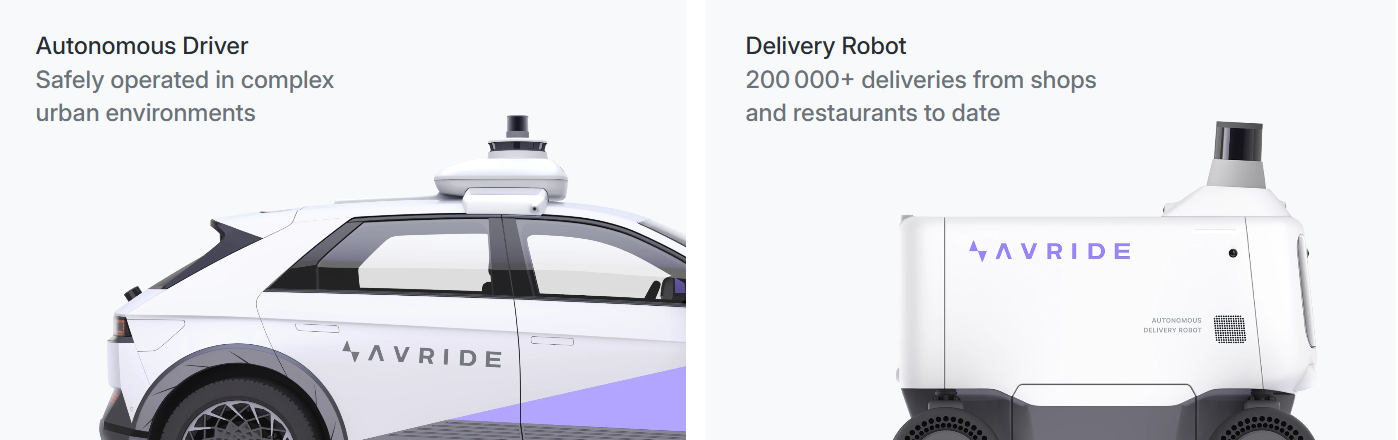
These vehicles are typically electric—often based on platforms such as the Hyundai Ioniq 5—and equipped with a full sensor suite enabling Level 4 autonomy, meaning they can operate without human drivers in predefined environments.
2. Delivery Robots
Compact, sidewalk-navigating robots designed for last-mile logistics.
These robots:
- Travel at pedestrian speeds
- Navigate sidewalks and crosswalks
- Deliver food and small packages securely
This dual approach allows Avride to address both:
- High-value mobility (passenger transport)
- High-frequency logistics (last-mile delivery)
A Unified Autonomy Stack
At the heart of Avride’s strategy is a shared AI and autonomy architecture. Instead of building separate systems for cars and robots, Avride uses a common stack with modular adaptations.
Key Components:
Perception
The system ingests data from:
- LiDAR (3D spatial mapping)
- Cameras (visual recognition)
- Radar (velocity and depth)
Using deep learning models, the system identifies:
- Vehicles
- Pedestrians
- Road signs
- Obstacles
Localization
Precise positioning is achieved through:
- HD maps
- GPS + inertial sensors
- Real-time corrections
Prediction
The system anticipates the behavior of surrounding agents—such as a pedestrian stepping into a crosswalk or a vehicle changing lanes.
Planning
This layer determines:
- Optimal routes
- Safe maneuvers
- Compliance with traffic rules
Control
Finally, commands are translated into physical actions:
- Steering
- Acceleration
- Braking
What makes this architecture powerful is its reusability. A sidewalk robot and a full-sized vehicle share the same “brain,” adapted to different speeds and environments.
Avride relies heavily on sensor fusion, combining multiple data sources to improve reliability and safety.
- LiDAR provides accurate 3D geometry
- Cameras provide semantic understanding
- Radar adds robustness in poor weather
These inputs are processed in real time using edge computing systems installed on the vehicle or robot. This minimizes latency and ensures decisions are made instantly—even without cloud connectivity.
A major milestone for Avride is its partnership with Uber.
This collaboration reflects a broader industry shift:
- AV companies focus on technology
- Platforms like Uber handle demand, dispatch, and user experience
Hardware Characteristics
- Speed: ~5 mph
- Range: ~30+ miles per charge
- Navigation:
- Sidewalk + crosswalk compliant
How the Integration Works
- Avride provides the autonomous system and vehicles
- Uber integrates them into its app ecosystem
- Users can request rides or deliveries without needing to know the underlying provider
This model allows Avride to scale quickly without building its own consumer platform.
Controlled Expansion
Avride operates within geofenced zones, also known as Operational Design Domains (ODDs). These are carefully mapped areas where the system is validated for safety.
Initial deployments focus on:
- Urban districts
- Favorable weather conditions
- Predictable traffic patterns
Safety is central to Avride’s design:
- Redundant sensors ensure no single point of failure
- Fail-safe systems allow controlled shutdown or safe stops
- Remote monitoring enables human intervention when necessary
This layered safety model is essential for regulatory approval and public trust.
Avride–Uber Partnership
The partnership between Avride and Uber represents a platform-centric approach to autonomous mobility, where:
- Avride provides autonomous driving systems (ADS) and robotic platforms
- Uber provides global demand aggregation, dispatch, and operational infrastructure
Announced in October 2024, this multi-year collaboration spans:
- Autonomous last-mile delivery (robots)
- Autonomous ride-hailing (robotaxis)
This partnership is part of Uber’s broader strategy to act as an “autonomy marketplace platform” rather than building its own AV stack.