
Mathematicians Uncover a New Class of Digitally Delicate Primes
Prime numbers — integers greater than 1 that are divisible only by 1 and themselves — are among the most foundational and mysterious objects in mathematics. From Euclid’s proof of their infinitude to modern cryptographic applications, primes have captivated thinkers for millennia. Now, number theorists are exploring a newly emphasized class of prime numbers that are extraordinarily sensitive to changes in their digits. These are called digitally delicate primes, and research in the last decade has revealed surprising and deep results about them.
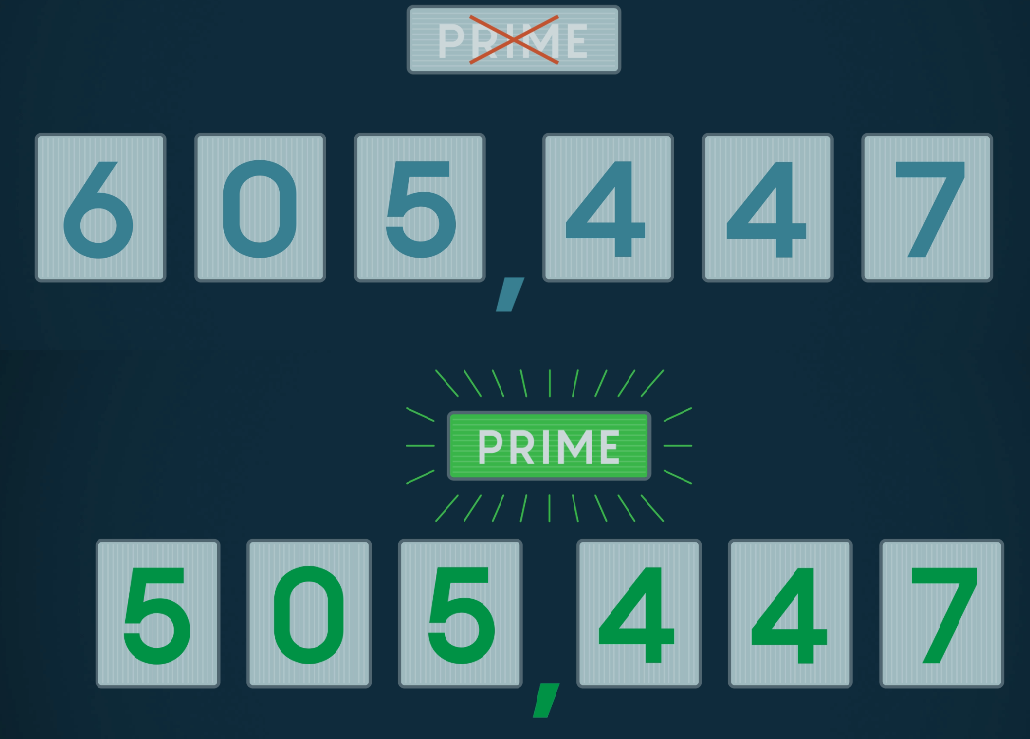
A digitally delicate prime is a prime so fragile that if you change any single digit anywhere in its decimal representation, the resulting number is always composite (i.e., non-prime). For example, the number 294001 is prime — but altering any of its digits yields a composite number like 394001 or 294011.
This notion of delicacy goes well beyond the ordinary definition of a prime: instead of just being indivisible by other integers, such primes are uniquely sensitive to digit modifications. They are also known as weakly prime numbers in the mathematics literature.
A Brief History of the Concept
The question of whether such primes exist was first posed in 1978 by the mathematician Murray S. Klamkin. Soon thereafter, the legendary Paul Erdős proved that not only do digitally delicate primes exist, but there are infinitely many of them — and in every base (not just decimal).
More than three decades later, Fields Medalist Terence Tao strengthened this by showing that these primes aren’t just infinitely many, but appear with positive density among all primes: roughly speaking, you’ll continue to find them infinitely often as numbers grow larger.
The New Frontier: Widely Digitally Delicate Primes
While digitally delicate primes consider only the actual digits of a number, mathematicians have now pushed the concept further by treating a prime as if it had infinitely many leading zeros. For example, rather than just viewing 53, one imagines it as:
...000000053
With this perspective, changing any of the infinitely many leading zeros — or any of the usual digits — should also make the number composite. Primes with this stronger property are called widely digitally delicate primes.
In a pair of theoretical papers by Michael Filaseta and his collaborators (including Jeremiah Southwick and later Jacob Juillerat), mathematicians proved something remarkable:
Key Theoretical Results
- Such widely digitally delicate primes do exist in base 10, even though no specific example has yet been explicitly found below extremely high thresholds.
- There are infinitely many of them.
- A positive proportion of all primes are widely digitally delicate — similar to the way Terence Tao showed for ordinary delicate primes.
- For every positive integer k, there exist kkk consecutive widely digitally delicate primes — meaning one can find arbitrarily long runs of such special primes in a row.
These results rely on advanced number-theoretic tools such as covering systems and sieve methods, including deep combinatorial arguments about how primes behave under infinitely many digit changes.
Why It’s So Surprising
At first glance, the idea may seem counterintuitive: infinite leading zeros are just placeholders with no value. But mathematically, adding these zeros effectively increases the number of “digits” one could alter — enormously magnifying the conditions under which a prime must cease to remain prime after a single change.
Despite this, the rigorous proofs show that such primes must exist and even in abundance — a striking blend of abstract theory and number-system ingenuity.
Status of Concrete Examples
o far, no explicit example of a widely digitally delicate prime has been found in base 10 below large numerical bounds (mathematicians have tested up to billions without success). However, later research has even produced specific constructions of extremely large such primes (e.g., a 4032-digit example identified by Jon Grantham), confirming that these aren’t mere logical curiosities.