
Omar M. Yaghi’s solar-powered atmospheric water harvester represents a significant leap in materials science and sustainable engineering. By leveraging metal-organic frameworks to extract moisture from extremely dry air, the system converts an abundant but overlooked resource—the atmosphere—into potable water.
With the ability to produce up to 1,000 liters of water per day from desert air, this container-sized system could provide a new model for decentralized, climate-resilient water infrastructure. While technical and economic challenges remain, the technology highlights how advanced chemistry can address one of humanity’s most urgent needs: reliable access to clean water.
Omar M. Yaghi, a UC Berkeley chemist and 2025 Nobel Prize in Chemistry laureate, has scaled a solar-powered water harvester from a lab prototype into a shipping-container-sized unit that his company says can pull up to 1,000 liters of clean water per day from desert air.
The technology relies on metal-organic frameworks, or MOFs, porous crystalline materials that Yaghi pioneered over decades of research.
Metal-Organic Frameworks (MOFs)
At the heart of Yaghi’s innovation lies a class of materials known as metal-organic frameworks.
MOFs are highly porous crystalline materials composed of metal ions connected by organic linkers, forming lattice structures with extraordinary internal surface area. In fact, a few grams of MOF can possess surface area comparable to that of a football field, enabling them to capture and store gases or liquids with remarkable efficiency.
Key properties of MOFs
- Ultra-high surface area
- Enables large quantities of molecules to be captured.
- Tunable pore chemistry
- Pores can be engineered to selectively capture specific molecules, such as water vapor.
- Reversible adsorption
- Captured molecules can be released using small amounts of heat.
These characteristics allow MOFs to behave like molecular sponges, absorbing water vapor from the air even in extremely dry environments.
Yaghi’s broader field of research—known as reticular chemistry—focuses on designing such molecular frameworks with predictable structures and properties.
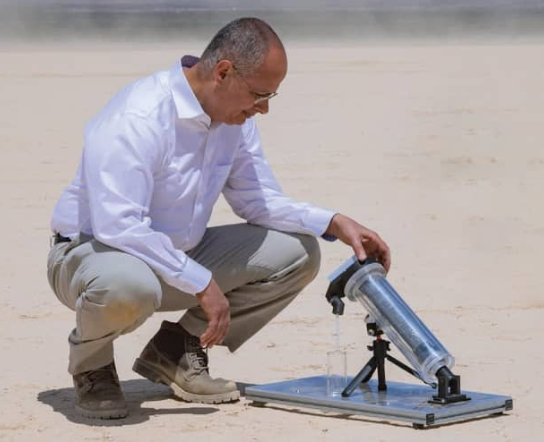
The journey toward the current system began with small experimental devices developed at UC Berkeley.
Early prototypes (2017–2019)
The earliest versions of the water harvester:
- Used MOF materials such as MOF-801
- Operated in a passive day-night cycle
- Produced only tens of milliliters of water per day in desert tests
These prototypes proved a critical concept: water could be extracted from extremely dry air using solar heat alone.
Subsequent iterations improved airflow, MOF composition, and condensation efficiency, gradually increasing output.
The Container-Scale Atmospheric Water Harvester
Yaghi’s company Atoco has now scaled the concept into a modular unit approximately the size of a 20-foot shipping container.
Core capabilities
- Water production: up to 1,000 liters per day
- Humidity requirement: works at ~20% humidity or lower
- Energy source: solar thermal energy
- Infrastructure: fully off-grid
- Deployment model: modular container units
This system can operate independently of traditional water infrastructure or power grids, making it suitable for remote deserts, disaster zones, or drought-stricken communities.
How the Technology Works
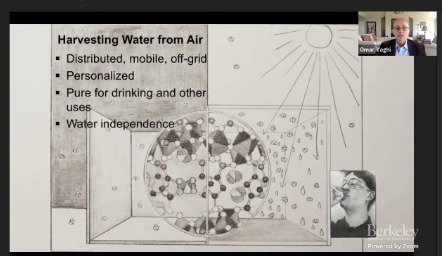
The device operates through a multi-stage process that combines adsorption, thermal release, and condensation.
1. Air intake and adsorption
Ambient air flows through cartridges packed with MOF material.
The MOFs capture water vapor molecules from the air.
2. Thermal activation
Solar heat raises the temperature of the MOF material slightly.
Because the water molecules are only weakly bound, this heat causes them to be released as vapor.
3. Condensation
The released vapor enters a cooled chamber where it condenses into liquid water.
4. Collection and purification
The condensed water is collected and filtered, producing clean drinking water.
The process repeats continuously as long as sunlight and airflow are available.
Why the System Works in Desert Conditions
Traditional atmospheric water generators rely on refrigeration and condensation, which becomes inefficient at low humidity.
Yaghi’s MOF-based approach works differently:
| Feature | Traditional Dehumidifiers | MOF Water Harvester |
|---|---|---|
| Minimum humidity | ~35–40% | ~20% or lower |
| Energy source | Electricity | Solar heat |
| Infrastructure | Grid required | Off-grid |
| Efficiency in deserts | Low | Designed for arid regions |
The key advantage is that MOFs chemically bind water molecules, allowing extraction even when the air contains very little moisture.
With drought conditions worsening across multiple continents and a recent United Nations report warning of chronic water insecurity in many basins, the jump from bench science to field-ready hardware carries real urgency for arid communities worldwide.