
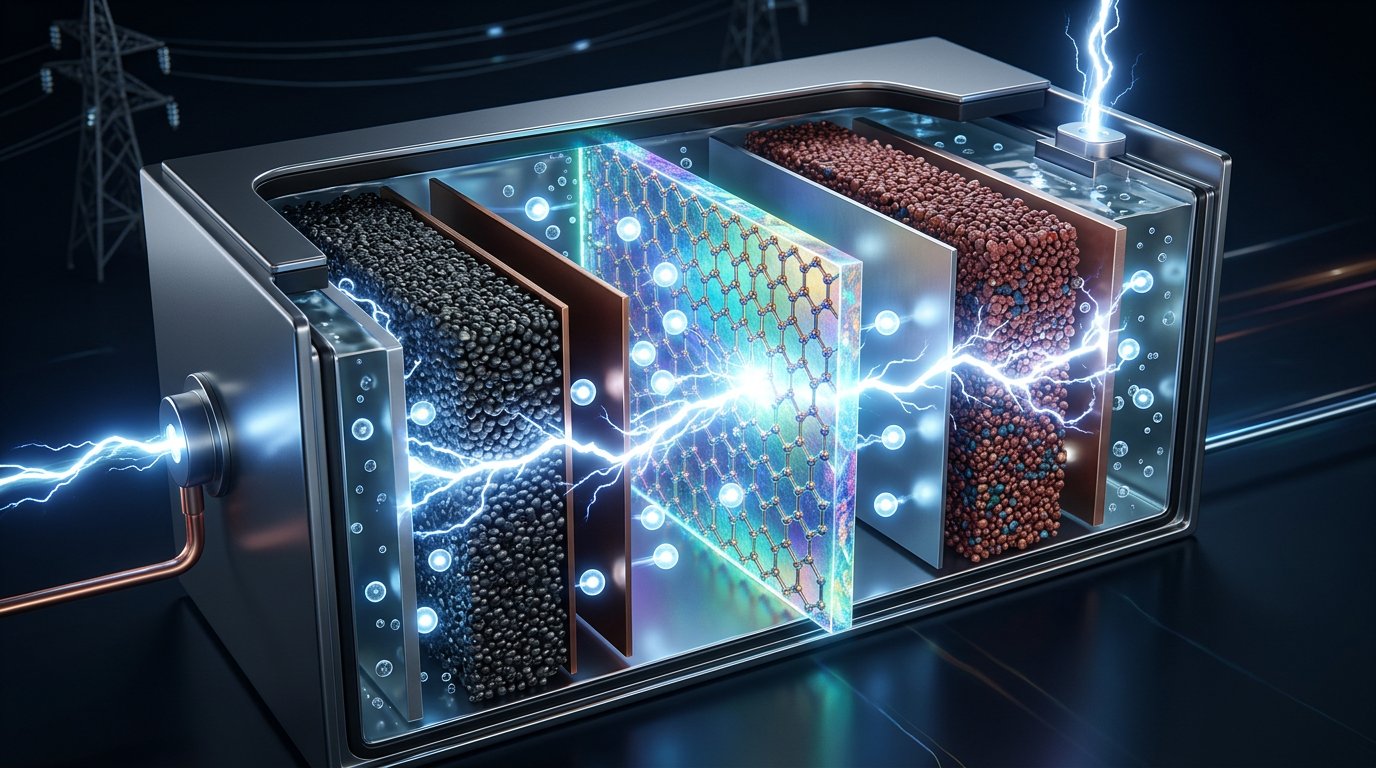
Fast charging and long battery life usually pull in opposite directions. Push lithium metal batteries to charge quickly and the lithium can grow into sharp, branch-like deposits that wear out the cell. A KAIST team now reports a separator design that gives lithium ions a straighter route, and it kept 94% of its capacity after 100 fast-charge cycles in the lab.
KAIST announced the work on November 9, 2026. It comes from a joint team led by Professors Dong Ki Yoon and Hye Ryung Byon of the Department of Chemistry.
The problem: dendrites in lithium metal cells
Lithium metal batteries can store more energy than conventional lithium-ion cells, which makes them attractive for long-range electric vehicles and compact electronics. During charging, though, lithium can build up as dendrites. KAIST notes this is a major cause of shortened life and can damage the internal separator, the thin layer that keeps the electrodes apart, which in the worst cases raises safety risks.
An approach built on liquid crystals
The researchers turned to liquid-crystalline polymers, materials that combine the ordered structure of a solid with the fluidity of a liquid. Because the orientation of liquid crystal molecules can be changed through surface treatment and other methods, the team used that property to line up the pathways that lithium ions travel along.
From this, they built a porous separator with nanoscale pores and added polyethylene glycol chains, which help lithium ions move. Crucially, they could set the molecules to align either vertically or horizontally, and then compare how each arrangement carried ions.
What the vertical alignment did
According to KAIST, the vertically aligned separator formed a kind of highway that let lithium ions move straight toward the electrodes. Compared with the horizontally aligned version, it reduced the tortuosity of the ion pathway, a measure of how winding the route is, by about 2.5 times. Ions moved faster and more evenly, which suppressed dendrite formation and improved stability.
The team then put the separator into a working lithium metal battery. At a 4C charging rate, which in theory fully charges a cell in about 15 minutes, the battery kept 94% of its initial capacity after 100 charge-discharge cycles. KAIST presents this as evidence that controlling molecular alignment can improve both charging speed and lifespan.
Who did the work and where it was published
Ph.D. student Geunjung Lee and Dr. Rak Hyeon Choi are co-first authors, with Professors Byon and Yoon as co-corresponding authors. The study, titled “Directional Li+ Flux Control via Liquid-Crystalline Polymer Separators for Fast-Charging Lithium Metal Batteries,” appeared in ACS Nano in September 2026 (DOI 10.1021/acsnano.6c09591). Support came from the Mid-Career Researcher Program of the Ministry of Science and ICT, the National Research Foundation of Korea, and the GIST InnoCORE Program.
What it means
Most battery headlines focus on new electrode chemistries. This work targets a quieter component, the separator, and shows that its internal structure can be tuned to steer ions. If the approach scales, it could offer a design lever for makers of high-energy cells who want faster charging without sacrificing durability.
It is worth keeping the stage in view. The reported results come from laboratory testing of a single cell design over 100 cycles, which is far short of the thousands of cycles a vehicle battery must survive, and the announcement gives no timeline for commercial use. Professor Yoon said in the release that he expects the approach to contribute to next-generation, high-energy-density batteries where long driving range and rapid charging are essential.
Bottom line
By aligning liquid-crystalline polymers into a vertical ion highway, KAIST’s team cut the winding of lithium’s path and kept 94% capacity through 100 fast-charge cycles. It is an early but clear example of materials design improving a battery without changing its core chemistry.