NEURA Plans a Robot Training Gym and Model Zone in Aragón

Bright robot training hall with industrial arms and a humanoid robot working at food-handling stations
AI-generated illustration Europe's industrial strength rests on know-how: how to handle materials, run machines and assemble products. What if that knowledge could be taught to robots and become an asset its owners could license? That is the idea behind a new project in Spain. On November 27, 2026, NEURA Robotics announced that it, the Government of Aragón and Costa Group have signed a Memorandum of Understanding to set up NEURA Gym Aragón and a surrounding Physical AI Model Zone. Wha...
More
Robbyant Open-Sources LingBot-Map 2.0 and LingBot-Navi

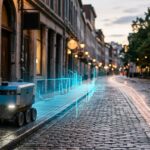
Small wheeled delivery robot on a cobblestone street with a glowing 3D map trailing behind it and a route ahead
AI-generated illustration A robot that wanders a city for several kilometers builds up small mistakes, and by the end its map no longer matches the street. Then, once the job is done, it forgets everything and starts from scratch next time. On November 27, 2026, Robbyant, the embodied AI company within Ant Group, announced the open-source release of two models aimed at exactly those two problems: LingBot-Map 2.0 and LingBot-Navi. Fixing the map from the inside LingBot-Map 2.0 is a str...
More

Human Data for Frontier AI and Recording Videos for Physical AI Training: Inside Mercor

Professionals at laptops send glowing threads of feedback into a luminous neural-network sphere while, on the right, a person wearing a small head camera wipes a cafe counter near a white robot arm
AI-generated illustration: experts feeding knowledge into AI models, and a worker recording hands-on tasks so robots can learn them Two years ago, Mercor was a recruiting startup that used AI interviews to match engineers with tech companies. Today it describes itself as “organizing human intelligence to power the AI economy,” and investors value it at US$20 billion. The pitch is simple: the more capable AI gets, the more it needs real experts to teach and test it. Now that s...
More

Recording Videos for Physical AI Training: Inside Objectways

A person wearing a head-mounted camera folds laundry in a home-style studio while a white faceless humanoid robot stands near the kitchen counter
AI-generated illustration: recording household tasks on camera so robots can learn them Large language models learned to write by reading the internet. Robots have no such library. To learn how to fold a shirt, screw on a bottle cap or stack plates without smashing them, they need to watch people do it, thousands of times, from angles that match a robot’s own eyes and hands. That has created a new kind of work: recording videos for physical AI training. One of the companies doing i...
More

XPENG Unveils IRON Humanoid and a Shared AI Stack for Cars

Silver humanoid robot standing beside a modern electric sedan in a bright showroom
AI-generated illustration Carmakers keep saying their cars are robots on wheels. XPENG is now trying to make the reverse true too: at its eighth AI Day on November 25, 2026, the company showed a humanoid robot, IRON, built on the same AI and hardware foundation as its vehicles. The details come from XPENG's press release. Three systems, one loop The centerpiece is the Turing Physical AI Architecture, also called VLA 3.0. XPENG says it links three systems working at different speeds. S...
More

SenseTime Robot Model Learns in Simulation, Works on Real Arms

Two white robotic arms stacking colorful blocks in a lab beside a glowing holographic digital twin of an arm
AI-generated illustration Teaching a robot arm to do something useful usually means collecting hours of demonstrations on that exact robot. SenseTime is testing a different route. On November 25, 2026, the company released the full version of SenseNova-RoboRSI-27B, an embodied AI model that learned its manipulation skills in simulation and then ran on two real robotic arms with the same weights and no real-robot training data, according to SenseTime's announcement. The results are early ...
More

ASU Builds Nanoscale DNA Structures From a Minimal Cube Kit

Translucent glowing blue cubes self-assembling into a large fractal lattice
AI-generated illustration Imagine designing a handful of tiny building blocks, dropping them in a container, shaking, and watching them assemble themselves into an intricate shape. Researchers at Arizona State University have done that with DNA, at a scale almost unimaginably small. Associate Professor Petr Sulc's team describes the approach in research published November 25, 2026 in Science Robotics, as reported in an ASU News story. Sulc sums it up this way: "It's like playing Minecraf...
More

YYForce’s “Six Seven” Humanoid Joins a Singapore Hotel Lobby

Humanoid concierge robot at a hotel lobby desk gesturing to a guest
AI-generated illustration A new face is about to greet guests in a Singapore hotel lobby, and it runs on GPUs. Singapore-based YYForce Inc. (NASDAQ: YFOR) has launched a humanoid robot trained for live hotel concierge work. The hotel team has named it "Six Seven" (67), and its first deployment will be at Novotel Singapore on Stevens, where it will handle guest interactions in the lobby, according to YYForce's November 24, 2026 announcement. The robot pairs two pieces of NVIDIA technology...
More

WHOI’s Deep Venture AUV Is Built for Full-Ocean-Depth Science

Orange autonomous underwater vehicle with a spotlight above a dark deep seafloor beside a pale chimera fish
AI-generated illustration The deepest parts of the ocean are still among the least observed places on Earth, partly because reaching them has meant big ships, specialized crews and one-purpose machines. On November 20, 2026, the Woods Hole Oceanographic Institution (WHOI) announced a different approach: Deep Venture, a compact autonomous underwater vehicle (AUV) built with NASA's Jet Propulsion Laboratory (JPL) that is rated for full ocean depth. What Deep Venture isAccording to WHOI'...
More

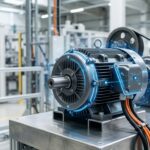
ABB Intelleqt: A Factory-Built Motor With Intelligence Inside

Industrial electric motor in a bright factory with soft blue glowing lines suggesting built-in data sensing
AI-generated illustration Most of the motors that keep factories, pumps and fans turning have one thing in common: they say nothing. They spin, they wear, and often the first sign of trouble is a stoppage. On November 24, 2026, ABB announced a motor built to change that. Intelleqt, which the company calls the world's first low-voltage motor with intelligence integrated at the factory, is designed to deliver operational insight from its very first rotation. The launch came at the SPS trad...
More

Inbolt 3D Vision Now Runs Natively on UR’s Gen 7 Cobots

Inbolt 3D Vision Now Runs Natively on UR's Gen 7 Cobots
AI-generated illustration Factory robots are good at repeating a motion and bad at noticing that the part moved. For years, fixing that has meant custom jigs and fixtures for every part, or adding a separate vision system with its own computer. On November 24, 2026, Universal Robots (UR) and French vision company Inbolt announced a different approach: AI-powered 3D vision guidance that runs natively on the robot itself. Per the companies' joint announcement, made at the SPS show in Nurem...
More

Yokogawa CENTUM R7.02 Makes AI Control Standard in Plants

Industrial control room with curved screens showing AI neural network graphics facing a refinery at dusk
AI-generated illustration For decades, industrial control systems have followed rules that engineers wrote by hand. Yokogawa now says the next step is to let AI models take part in the control loop itself. On November 17, 2026, the company announced CENTUM R7.02, a new version of its flagship control platform that ships with AI capabilities built in. The details below come from Yokogawa's press release. The release said the software would become available on November 19. Two AI functi...
More

XPENG WorldGPT: One Model for Cars, Robots and Drones

A car, boat, drone, robot arm and humanoid robot connected by glowing threads to a luminous sphere containing a brain
AI-generated illustration Most machines that think for themselves are trained as loners. A self-driving car learns from road footage, a robot arm learns from grasping trials, and a drone learns from flight logs, each with its own data and its own model. XPENG argues that this is wasteful, because a car judging the gap to the vehicle ahead and an arm judging the distance to a cup are solving versions of the same problem. On November 24, 2026, the company unveiled WorldGPT, a single model ...
More

Terabase Construct Adds an AI Agent to Solar Construction Sites

Aerial view of a solar farm under construction with a drone and a glowing digital-twin grid
AI-generated illustration A single 300 MW solar site can sprawl across 1,500 to 2,500 acres, roughly two to three times the size of Central Park. Keeping a build that large on schedule is hard, and progress is often still stitched together from daily reports and spreadsheets. On November 16, 2026, Terabase Energy announced a next-generation release of its Construct software that tries to change this, calling it the first AI construction execution system for utility-scale solar. The detai...
More

Beatbot AquaSense 3 Pool Robot Checks Its Own Cleaning Work

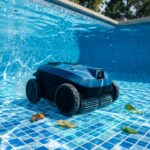
Cordless robotic pool cleaner with a camera lens moving across a tiled pool floor beside fallen leaves
AI-generated illustration Most robotic pool cleaners do one thing well: crawl around and suck up what they meet. Beatbot wants its newest model to also notice what it missed. On November 18, 2026, the company unveiled the AquaSense 3 and the Sora Neo R at Piscine Global Europe in Lyon and the Pool Spa Patio Expo in New Orleans. Details below come from Beatbot's press release. AquaSense 3: map, see, decide, check Beatbot calls the AquaSense 3 the world's first in-pool "Sense-to-Act" cl...
More

X Square Robot’s WALL-OSS-1.0 Teaches Robots New Tasks Zero-Shot

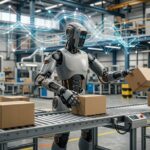
Two-armed robot sorting cardboard parcels on a conveyor with glowing network lines overhead
AI-generated illustration What if a robot could walk into an unfamiliar room, hear a new instruction and simply get to work, with no task-specific training first? That is the question X Square Robot says it is moving toward with WALL-OSS-1.0, a robot foundation model it unveiled on November 23, 2026. According to the company's press release, the model reached a 55.1% zero-shot success rate across 312 unique real-robot tasks chosen freely by evaluators. A different way to train a robot...
More

Nestlé Opens Deep Tech Center to Scale AI and Robotics

Nestlé Opens Deep Tech Center to Scale AI and Robotics - editorial illustration
AI-generated illustration Food giants are not usually the first name that comes to mind for robotics and sensor research, yet Nestlé just gave that work a dedicated home. On November 20, 2026, the company inaugurated its Deep Tech Center in Orbe, Switzerland, a site meant to develop, test and scale advanced technologies for the whole group. What Nestlé opened According to Nestlé's announcement, the Center will bring together experts in advanced technologies and engineering. Its state...
More

Siemens Eigen Engineering Agent Writes PLC Code Autonomously

Siemens Eigen Engineering Agent Writes PLC Code Autonomously - editorial illustration
AI-generated illustration Most AI tools in engineering stop at a suggestion: they draft a snippet and leave a person to check it, paste it and fix it. Siemens is betting on something different for factory automation. On November 18, 2026, the company announced the launch of its Eigen Engineering Agent in India, describing it as a purpose-built AI that carries out automation engineering tasks from start to finish rather than just proposing them. What Siemens announced According to Sie...
More

Spot and Atlas Head Deeper Into GlobalFoundries Chip Fabs

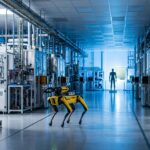
A yellow quadruped inspection robot walking down a bright semiconductor fab corridor with a humanoid silhouette in the distance
AI-generated illustration Semiconductor fabs are some of the cleanest, most tightly controlled workplaces on earth, and also some of the hardest to inspect. On November 17, 2026, Boston Dynamics and GlobalFoundries (GF) announced that they are widening a robotics partnership that has already run for more than four years. Spot, the yellow quadruped, will spread across GF's manufacturing network, and GF will become the first semiconductor maker to test the Atlas humanoid. What was annou...
More

NVIDIA Omniverse and Cosmos: The Engine Behind Physical AI

A robot arm on a factory floor merging into a glowing wireframe digital twin with simulated sensor data and lidar point clouds
AI-generated illustration Teaching a robot to pick up a part, or a car to handle a child running into the road, used to mean one of two things: collect mountains of real-world footage, or build a simulator and hope it looked real enough. NVIDIA is betting that the answer is now both at once. Its Omniverse libraries build physically accurate virtual worlds, and its Cosmos world foundation models learn how those worlds behave, fill them with endless variations and help machines decide what...
More

Stratasys H550 Scales Powder Bed Fusion for Production Parts

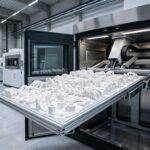
Large industrial 3D printer in a clean factory lifting a tray of white printed parts
AI-generated illustration Industrial 3D printing keeps moving from prototypes to production parts, and the machines have to keep up. At Formnext 2026 in Frankfurt, Stratasys unveiled the H550, a larger powder bed fusion printer, along with an automated powder handling system called PowderEase T2. Here is what the company says it delivers, and what is still a claim. A bigger build volume for bigger parts According to the Stratasys press release, the H550 offers a 34.2-liter build volum...
More

OMRON LD-150 and LD-300: Heavier AMRs for Tight Aisles

Compact autonomous mobile robot carrying stacked crates down a narrow warehouse aisle past a glowing floor charging pad
AI-generated illustration Factory floors rarely have room to spare, yet the loads that move across them keep getting heavier. On November 19, 2026, OMRON Robotics opened orders for two new autonomous mobile robots, the LD-150 and LD-300, that try to square that circle: more payload, same or smaller footprint, and a charging routine that barely interrupts the shift. What OMRON announced According to OMRON Robotics' announcement, the LD-150 and LD-300 are the next generation of its flag...
More

EleTac: A 50-Pence Elephant-Trunk Gripper That Feels Objects

Soft translucent trunk-shaped robotic gripper with a small camera in its tip lifting a green grape in a lab
AI-generated illustration Ask a robot to pick up a grape and then a metal pipe, and most grippers treat both the same way. Researchers at King's College London now report a soft, trunk-shaped gripper that feels its way through the job, and it was inspired by an elephant's trunk. According to the King's College London announcement, the device, called EleTac, can handle grapes and pick up playing cards, and it costs under £75 to build. A trunk with a camera in its tip EleTac was designe...
More

SiMa.ai Palette 3.0 Targets 3.5x Faster Edge AI for Robots

Glowing AI chip module on a workbench sending light streams to a small drone and a wheeled robot arm
AI-generated illustration Robots and drones increasingly want to run language and vision models on board, but the chips inside them have strict limits on power and memory. On November 17, 2026, edge AI company SiMa.ai announced Palette 3.0, a software release it says squeezes more out of a single low-power chip, with speculative decoding that lifts generation speed by up to 3.5x. Everything below is drawn from SiMa.ai's own press release, so the performance claims are the company's and h...
More

Siemens Links Agentic AI to Adaptive 3D-Printing Production

Holographic gripper design beside a lattice 3D-printed robotic gripper in a bright automated factory
AI-generated illustration Designing a custom robot gripper normally means a human engineer tweaking geometry, running simulations and preparing files for a 3D printer, step by step, for every new job. Siemens now says an AI agent can orchestrate much of that chain from a plain description of the task. In a November 16, 2026 press release, the company laid out an end-to-end digital thread that links prompt-based engineering to an adaptive additive manufacturing production cell. The detail...
More

MIT’s Flapping Microrobot Now Flies With Its Own Sensors

Tiny winged robot with a miniature circuit board hovering next to a sunflower
AI-generated illustration For a decade, MIT's tiny flying robots have been remarkably athletic, with bumblebee-like speed, agility and durability. They had one big limitation: they were tethered to a laboratory motion-capture system because they could not carry the electronics needed to know where they were. According to MIT News, that has changed. A new version carries its own sensors and computer and still flies precisely. Why weight was the obstacle The robot is roughly the size an...
More

Gemini 4 Hydrogen Gives Robot Arms a Faster, Cheaper Brain

Robot arm sorting snack packages from a conveyor beside a laptop showing a simulation
AI-generated illustration Building a robot application has long meant stitching together drivers, calibration scripts, simulators and perception code before a single useful task runs. On November 17, 2026, Google's Gemini Robotics team described a way to compress that work: a fast general model, Gemini 4 Hydrogen, paired with a new Robotics plugin for Google Antigravity. The company says a developer can go from a robot in a box to a working application in an afternoon. A faster model ...
More

Nikon MACHX Metal 3D Printers Chase Output Per Square Meter

Industrial metal 3D printer with several blue laser beams fusing powder beside a finished metal part
AI-generated illustration Metal 3D printing has long been sold on speed: how fast can a machine lay down layers? As the technology moves from prototypes into real production lines, manufacturers care about something else, namely how much they can make in a given patch of factory floor. On November 18, 2026, Nikon announced a new printer family built around exactly that idea. This article draws on Nikon's announcement of the MACHX series, developed by its subsidiary Nikon SLM Solutions AG...
More

Penn’s Self-Sensing Artificial Muscles Give Soft Robots Fine Control

Robotic hand wrapped in blue and copper coiled fibers pressing piano keys next to a small mechanical eye module on a lab bench
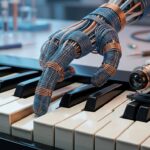
AI-generated illustration A robotic finger presses a piano key, pauses, and moves on to the next note. Nearby, an artificial eye shifts its gaze through a series of small, controlled steps. According to Penn Engineering, both demonstrations rely on a new kind of artificial muscle that can sense its own state, hold intermediate positions, and coordinate with other muscles. The work, announced on November 12, 2026, comes from teams led by Shu Yang and Cynthia Sung. It is a small-scale stor...
More

KAIST Battery Electrode Turns Curved Drone Legs Into Storage

A quadcopter drone on a lab bench with one curved carbon-fiber leg cut away to show a glowing woven battery layer
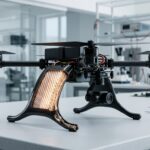
AI-generated illustration Most drones and robots carry their energy the way a hiker carries a water bottle: as a separate load strapped onto a frame that does its own job. A new electrode from KAIST points to a different idea, where a landing leg or a robot limb is also part of the battery. The catch has always been shape, because real frames are curved and hollow. On November 18, 2026, KAIST announced an electrode built to work in exactly those places. What KAIST built According to K...
More