
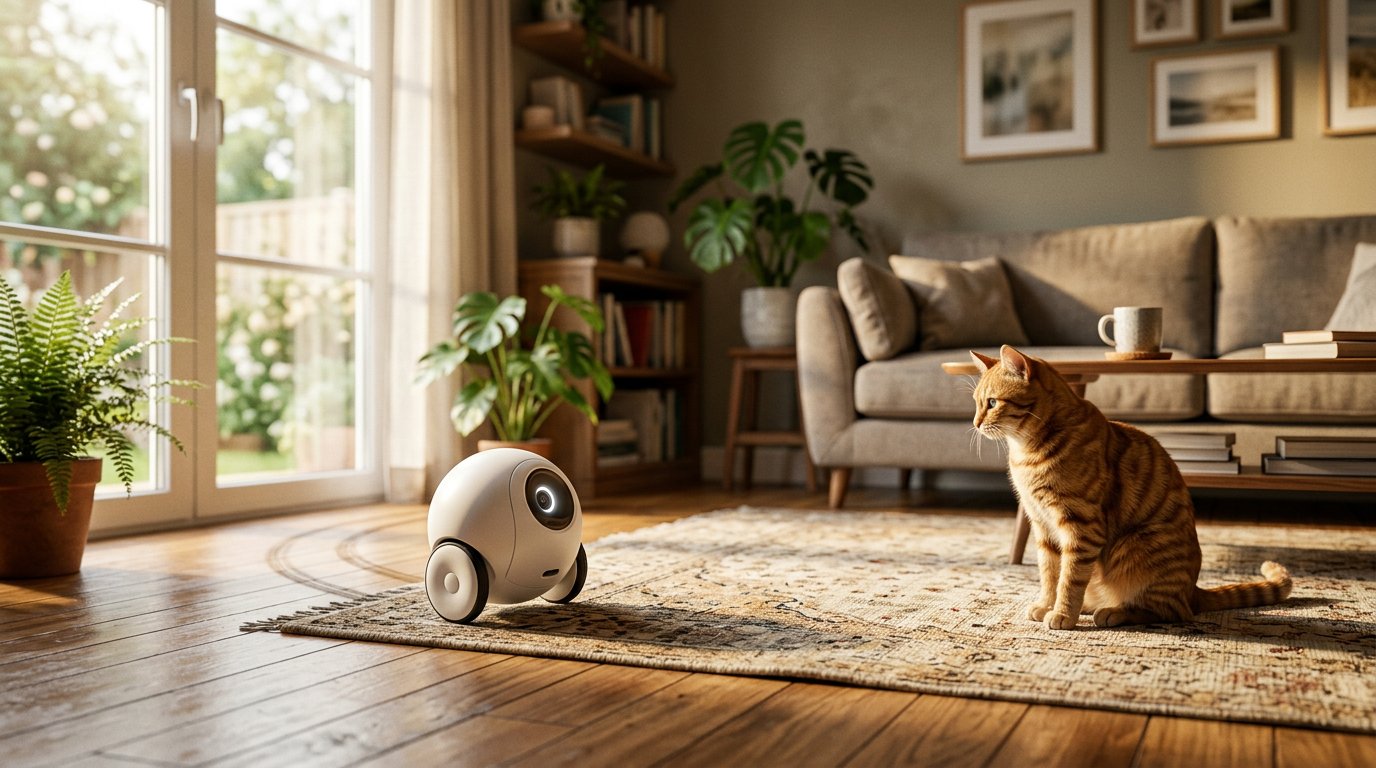
Most home cameras stare at one corner of one room. Enabot’s bet is that the camera should be able to drive itself to the kitchen, find the dog, and ask grandma whether she is all right. Over seven years the Shenzhen company has turned that idea into a family of rolling, softball-to-grapefruit-sized robots called EBO, and in 2026 it pushed the line firmly into AI territory: a flagship that claims long-term memory, a cheaper refresh of its bestseller, and, this month, a way for outside AI agents to take the wheel.
Who Enabot is
According to its About page, Enabot was founded in Shenzhen, China, in 2018 to research, develop and promote “family robots,” which it brands FamilyBots under the slogan “Always Together.” The company says it now serves more than 1.5 million users worldwide, that research and development makes up 70 percent of its team, and that it holds over 150 patents. Those figures are company claims and have not been independently verified. Enabot also names Sam’s Club and B&H among its retail partners.
Its product timeline on the same page starts with the EBO S in November 2019, which Enabot describes as the first mobile camera robot, followed by the pet-aware EBO Pro, the entry-level EBO SE and EBO Air, and the premium EBO X. A separate ROLA sub-brand now covers pet gear, including a treat-dispensing PetPal robot, a GPS pet tracker and a smart water fountain.
The EBO lineup in 2026
EBO X remains the premium “smart guardian.” Reviews at launch listed it at $999 with an 8MP 4K camera, V-SLAM mapping, built-in Alexa and Harman audio, and Enabot’s timeline says it later gained ChatGPT integration (TechRadar; Digital Trends).
EBO Max, announced on March 31, 2026, is what Enabot calls its most advanced home robot to date. The launch release describes an “embodied AI brain” with multimodal perception, contextual understanding and long-term memory, plus multi-step and condition-based tasks, two-way video and alerts for possible falls. Enabot’s product blog adds a 4K, 8MP camera, a four-microphone array that turns the robot toward the speaker, V-SLAM route following, tap-to-navigate in the app, and inactivity alerts. US pre-orders opened at $549.99, TWICE reported; Enabot’s store listed it at $599.99 on November 15, 2026.
EBO Air 2 Plus ($399 on Enabot’s store) is the mid-range model with a 3K camera, eye screens that show the caller’s face during video calls, up to 10 saved patrol routes and an AI chat assistant that Enabot says is powered by ChatGPT and other models (product page). The cheaper EBO Air 2S drops the assistant, per the About page.
EBO Mini and Mini Sport, launched May 19, 2026 at UK pre-order prices of £139.99 and £159.99, are compact models with a 2K camera, night vision, obstacle avoidance and auto-docking; the Sport adds a quieter brushless motor and AI human and pet recognition (Enabot’s launch announcement; features per the EBO Mini Sport page).
EBO SE 2, introduced in August 2026, refreshes the long-running SE with a 2K camera, Wi-Fi 6, animated eyes, a built-in laser pointer for pet play and auto-recharge that combines infrared docking with route memory (Enabot blog). Its store price was $179.99 on November 15, 2026, making it the cheapest current EBO (Enabot store).
The technology under the shell
Three threads run through the range. The first is navigation: higher-end models use V-SLAM, mapping a home with the camera so the robot can follow saved routes and avoid obstacles, while cheaper models rely on remote driving, infrared docking and simple route memory. The second is recognition: depending on the model, Enabot claims face, person and pet recognition, auto-tracking, crying detection and fall detection, with EBO Max asking a fallen person whether they are okay before alerting family.
The third, and newest, is openness to outside AI. In early November 2026 Enabot said Model Context Protocol (MCP) support was available on EBO Max and EBO Air 2 Plus. According to the Air 2 Plus product page, a compatible, authorized AI agent can access images and control movement, navigation and the camera, for example by scheduling patrols and emailing the owner when a person is detected. Enabot notes that images and video streams require manual authorization and that data is then shared with the third-party agent.
On privacy, the company points to one-tap camera and microphone shut-off, guest permissions with time limits, and local microSD storage with optional cloud plans. Reviewers have credited the EBO X’s physical controls: it can retract its camera into the body and mute its microphone with a button (TechRadar).
What reviewers say
Hardware tends to win praise; software has been the sticking point. TechRadar called the EBO X “endearing” with an impressive 4K night-vision camera, but rated its app 3 out of 5 and described the user experience as often frustrating. Digital Trends praised the design and privacy shutter yet concluded that the $999 robot “doesn’t excel at anything in particular,” noting that several fixed cameras and a smart speaker could cost less.
The newer mid-range model has fared better. In a June 2026 hands-on, AndroidGuys said the EBO Air 2 Plus “effectively creates its own category,” citing clear video, reliable auto-tracking and docking, a full day of moderate use from its 5,000mAh battery, and subscription-free local storage. Its main gap: no advertised Alexa, Google Home or Apple Home integration.
What it means
Enabot shows one practical path for consumer robots: skip arms and legs, put a good camera on wheels, and let software carry the value. Its 2026 moves follow the wider industry pattern of bolting language models and memory onto existing hardware, then opening that hardware to AI agents through standards such as MCP. If that works, a $400 to $600 robot becomes a physical endpoint for whatever assistant a family already uses.
The open questions are the familiar ones. Long-term memory and agent access raise the stakes on consent and data sharing inside the home, which Enabot itself flags. Claims such as “think, learn and adapt” still need independent testing, and the company’s history suggests app polish matters as much as specs. For eldercare and pet care, though, a robot that can go and look is a meaningful step beyond a fixed camera.
The bottom line
Enabot has quietly built one of the broadest lineups of consumer home robots, from a sub-$200 pet camera to an AI flagship. The 2026 releases make the direction clear: less remote-control toy, more AI companion that moves. Whether families embrace a robot that remembers them will depend on trust as much as technology.
Sources
- About Enabot, Enabot
- Enabot Introduces EBO Max, an AI-Powered Family Robot Designed to Think, Learn, and Care, PR Newswire (Enabot)
- What’s New on EBO Max FamilyBot: Smarter AI, Real Companionship, Enabot
- Preorders Open For Enabot’s EBO Max, TWICE
- EBO Mini Sport FamilyBot, Enabot
- EBO Air 2 Plus FamilyBot, Enabot
- EBO SE 2 vs. EBO SE: What’s New in 60 Seconds, Enabot Store
- EBO SE 2 FamilyBot, Enabot Store
- Enabot Ebo X review, TechRadar
- Enabot EBO X review: A smart, but flawed robot companion, Digital Trends
- Hands-On: Enabot EBO Air 2 Plus FamilyBot, AndroidGuys