
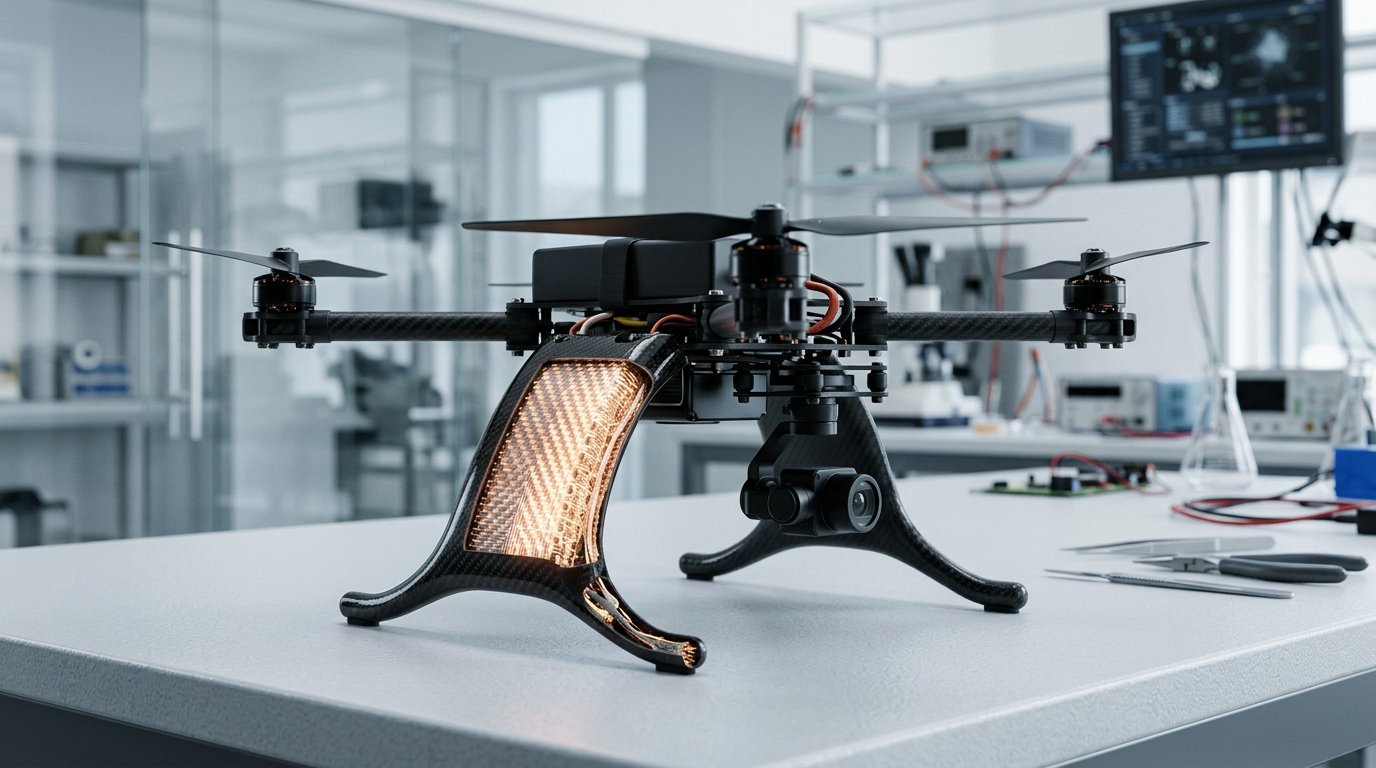
Most drones and robots carry their energy the way a hiker carries a water bottle: as a separate load strapped onto a frame that does its own job. A new electrode from KAIST points to a different idea, where a landing leg or a robot limb is also part of the battery. The catch has always been shape, because real frames are curved and hollow. On November 18, 2026, KAIST announced an electrode built to work in exactly those places.
What KAIST built
According to KAIST’s announcement, a team led by Professor Il-Kwon Oh of the Department of Mechanical Engineering developed a monolithically integrated lithium-sulfur (Li-S) battery cathode. The researchers grew nickel cobalt selenide (NiCo2Se4) nanowires directly on woven carbon cloth, a fabric of interlaced carbon fibers that is mechanically tough, flexible and electrically conductive.
The key word is “directly.” Conventional electrodes are usually made by coating active material onto a conductive base, and that coating can flake away when the part is bent or stressed. Growing the nanowires on the fibers anchors them in place, which helps keep the electrical pathways continuous while the electrode flexes.
Why lithium-sulfur, and why the nanowires
Lithium-sulfur cells use sulfur as the cathode material and offer the potential for high energy storage at relatively low weight, which is attractive for anything that has to fly or move. KAIST notes two well-known problems. Sulfur conducts electricity poorly, and intermediate compounds called lithium polysulfides can dissolve and drift away from the electrode, which disrupts the reactions that store energy.
The nickel cobalt selenide nanowires address both issues according to the team. The compound helps drive the sulfur-related electrochemical reactions and helps capture lithium polysulfides, limiting their migration. Because the wires sit on a conductive fabric, they also give the electrode a built-in electrical network.
What the tests showed
KAIST reports several results from the paper:
- Bending durability: after 1,000 bending cycles at a radius of only 2.5 mm, the nanowires stayed attached to the carbon fibers with no visible damage or structural collapse.
- Odd shapes: the team built the electrode into a lithium-sulfur pouch cell and placed it in oval and square structures and in a drone-leg component, where it powered a light-emitting diode (LED).
- Load test: inside a cylindrical structure, the battery kept 99.8% of its initial voltage even under a load large enough to fracture the surrounding frame, and an LED it powered stayed lit without flickering.
These are proof-of-concept demonstrations. Powering an LED shows the cell can deliver electricity in these geometries, not that it can run a drone.
What it means
Structural batteries matter because weight and space are the main limits on drones and mobile robots. If a frame member can store energy as well as carry load, designers may be able to drop some of the separate battery pack. KAIST says the electrode could eventually be combined with load-bearing composites, typically carbon fibers and resins, to make drone legs and robot frames that do both jobs.
The institute is also candid about what is unknown. Further research is needed to determine how much weight could actually be saved and how much flight or operating time could be gained in practical applications. That is the number engineers and buyers will care about most, and it has not been published yet.
For readers following energy storage, the work is a reminder that progress is not only about higher capacity numbers. Shape, durability and integration decide whether a chemistry leaves the lab. A battery that survives bending and crushing loads in a tube-shaped part addresses a real design barrier that flat-cell research has largely sidestepped.
Who was involved and where it was published
Jawon Ha, a Ph.D. candidate in KAIST’s Department of Mechanical Engineering, is the first author. Professor Oh and Professor Leif E. Asp of Chalmers University of Technology in Sweden are co-corresponding authors. The study was published online in Advanced Composites and Hybrid Materials (Volume 9) on October 1, 2026, under the title “Monolithically integrated NiCo2Se4 nanowire-carbon cloth cathode scaffolds for non-planar lithium-sulfur structural-battery integration” (DOI 10.1007/s42114-026-02093-y). Funding came from the National Research Foundation of Korea, the Korea Institute for Advancement of Technology and related Korean government programs.
As Professor Oh put it, drones and robots contain many curved and hollow components, so batteries must work reliably when built into them, and the study shows frames can serve as energy storage as well as structure.
Bottom line
KAIST’s nanowire-on-carbon-cloth cathode is an early but concrete step toward batteries that live inside a machine’s body. The next questions are how much weight it saves and how long it lasts in a complete structural composite. Until those answers arrive, treat it as a promising research result rather than a product.