
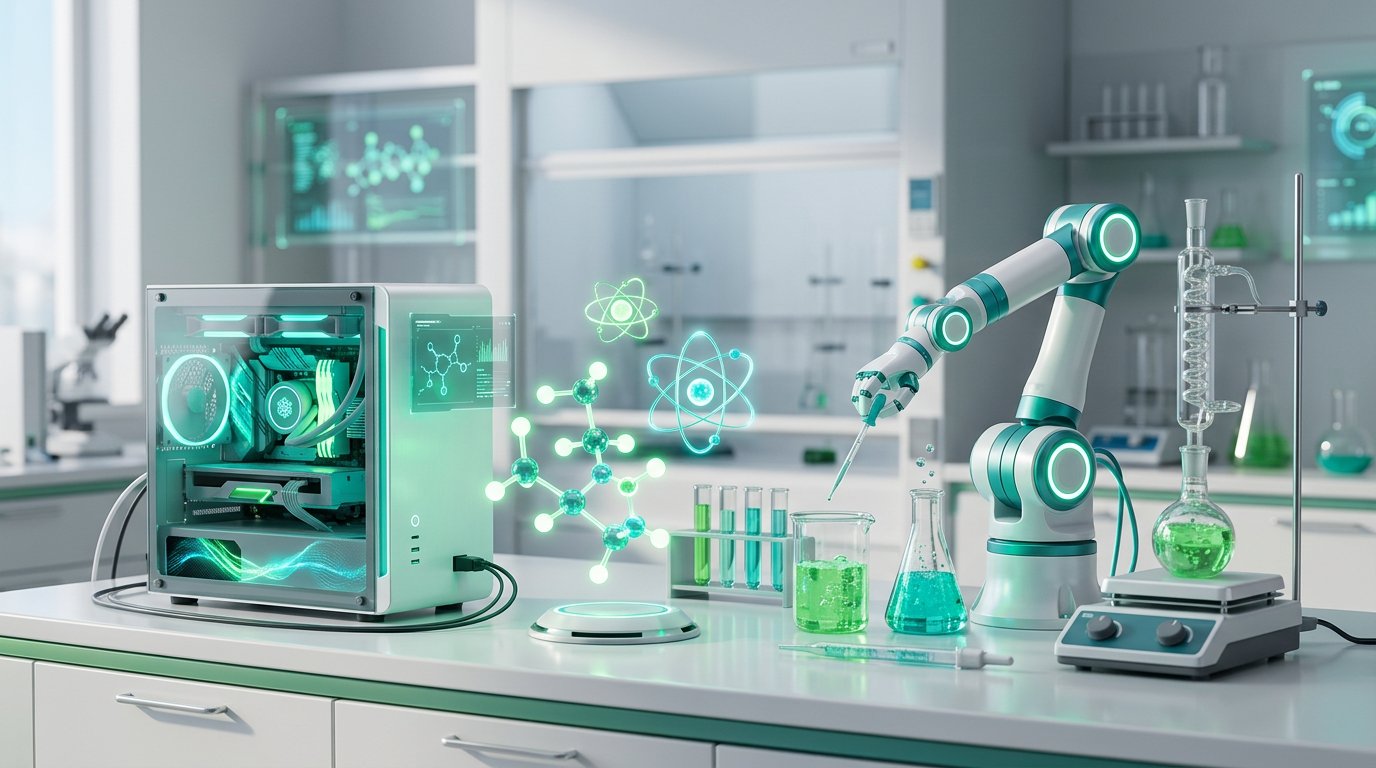
Scientific work is full of tasks that are tedious for people and awkward for general chatbots: reading reaction diagrams, planning lab protocols, repairing a broken simulation setup. On November 16, 2026, NVIDIA introduced Nemotron for Science, a bundle of an open model, a new chemistry dataset and post-training recipes aimed at helping researchers build agents for those jobs.
What is in the package
As described in NVIDIA’s announcement, Nemotron for Science brings together scientific applications of the Nemotron 3.5 Super VL open model, scientific evaluations, post-training recipes and a new open dataset. The idea is that researchers adapt the model with their own domain data, then place it inside agent workflows that interpret scientific information, write code and call computational tools, including NVIDIA CUDA-X accelerated libraries.
The dataset, LitmusBench v0.2, holds nearly 50,000 questions for training and evaluating language models on chemistry reasoning. It draws on molecular properties and experimental drug discovery data, and it is meant to help models predict how molecules behave, including how soluble they are and how the human body processes them.
Early results from partners
NVIDIA names several organizations that tuned the model for their own work. The figures below are the company’s reports of partner results:
- Terray Therapeutics post-trained Nemotron to extract reactants, products and reaction conditions from scientific diagrams, recovering about 76% of annotated reactions on the RxnScribe test under that benchmark’s matching criteria.
- Lila Sciences used it to design execution-ready lab protocols for automated labs. Post-training with lab feedback nearly doubled accuracy on making quantum dots to 61%, against 54% for GPT-6 Astra, at 10 to 20 times lower inference cost.
- Therna worked with NVIDIA on agentic mRNA therapeutic design, nearly doubling accuracy in predicting protein-expression ranges over frontier models, and scientists preferred its explanations over the base model’s in 96% of comparisons.
Research centers putting it to work
Larger institutions are integrating the models too. Argonne National Laboratory is building Nemotron into its StructBioReasoner multi-agent system to design and evaluate protein-based therapeutic candidates. KTH Royal Institute of Technology built an agent that repairs broken GROMACS molecular dynamics setups by itself; in one overnight run on a single NVIDIA DGX Spark system it fixed 81% of test cases with reasoning enabled, and GROMACS itself independently checked every fix. RIKEN has made Nemotron, including Nemotron 3.5 Super VL, available on its RIKYU AI supercomputing platform through its RiVault inference gateway, and Jülich Supercomputing Centre is also folding it into discovery agents.
Availability
NVIDIA says Nemotron 3.5 Super VL and the LitmusBench v0.2 dataset are available now on Hugging Face. The model is also optimized to run locally on a 128GB NVIDIA DGX Spark system, and the company positions the same stack as scaling from a researcher’s desk to supercomputing centers, with workflows kept on infrastructure an organization controls.
What it means
The notable part is the packaging. Open weights alone leave a lab to find its own data, benchmarks and training method. Pairing the model with an evaluation set and recipes lowers the effort of building a specialized scientific assistant, and the open dataset gives groups a common yardstick for chemistry reasoning.
It is worth reading the numbers with care. They come from NVIDIA’s own release and from partners using the company’s tools, on specific tasks and benchmarks. A 61% quantum-dot success rate or 81% repaired simulations are strong signs for narrow jobs, not proof that agents can run a lab unsupervised. The KTH example is instructive for exactly that reason: the agent’s fixes were verified by the simulation software rather than trusted on their own.
For research teams, the practical questions are whether their data is good enough to post-train on, whether they have the hardware to run a model locally, and how they will check an agent’s output. Those are workflow decisions, and this release makes them easier to start on rather than easier to skip.
Bottom line
Nemotron for Science is less a single breakthrough than a toolkit: an open model, a 50,000-question chemistry dataset and recipes for adapting both. Early partner results are promising, and independent testing by the wider community will show how well they hold up.