
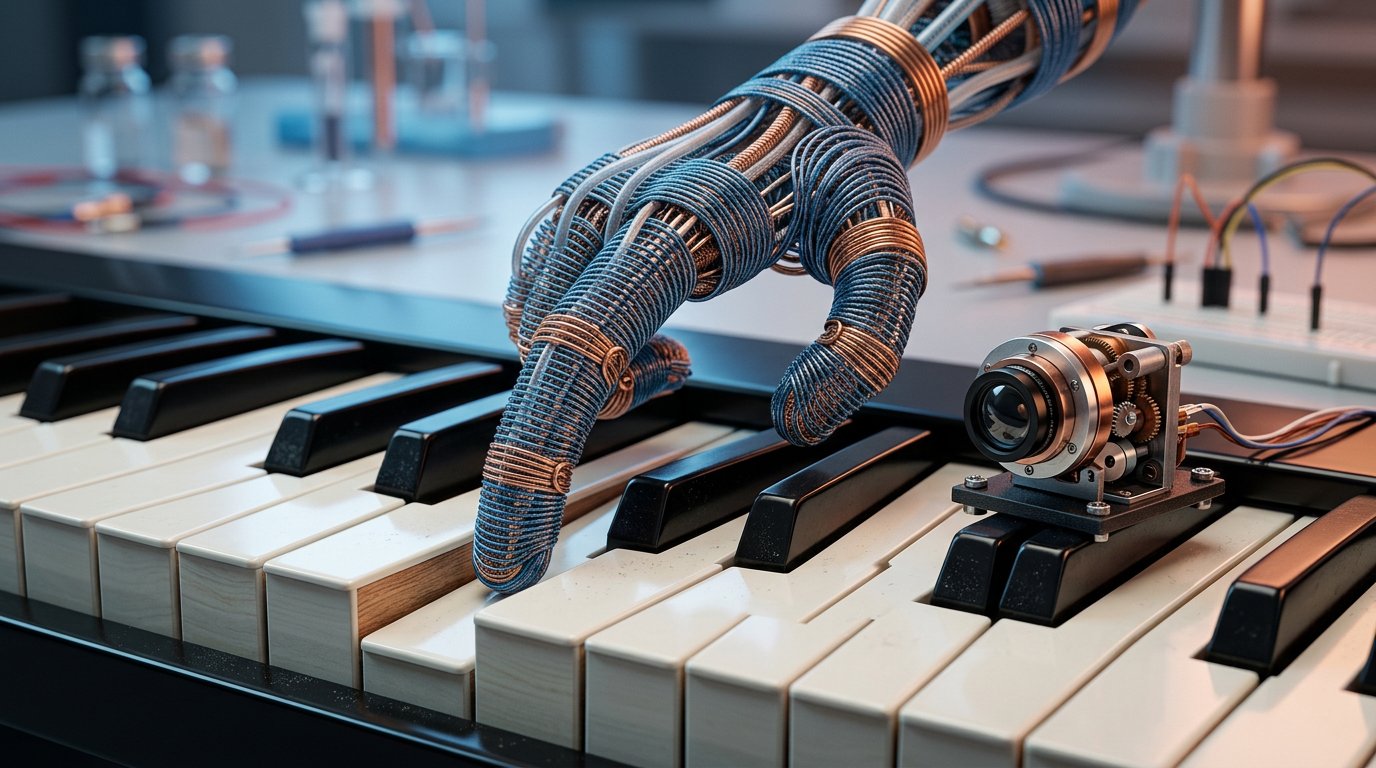
A robotic finger presses a piano key, pauses, and moves on to the next note. Nearby, an artificial eye shifts its gaze through a series of small, controlled steps. According to Penn Engineering, both demonstrations rely on a new kind of artificial muscle that can sense its own state, hold intermediate positions, and coordinate with other muscles. The work, announced on November 12, 2026, comes from teams led by Shu Yang and Cynthia Sung.
It is a small-scale story with a large ambition: giving soft robots the fine, delicate control that human hands and eyes take for granted.
What the researchers built
The muscles are fibers called CoilLCE. Each one combines three ingredients: a liquid crystal elastomer (LCE), a flexible material that changes shape when heated; graphene; and an ultrathin copper coil embedded inside. Penn says the team, which includes Ziyun Zhang and Xuelin Wu, published the research in Advanced Functional Materials.
Each ingredient has a job. The LCE supplies the contraction. Graphene makes the material softer yet tougher, so it can stretch and still withstand the forces that arise when muscles work against one another. The copper coil does two things at once: it heats the fiber to trigger contraction and it reports how the fiber is behaving.
Why holding still is the hard part
Making a material move is the easy half. Heated LCEs tend to keep contracting, or drift back toward their original shape as they cool, which makes it difficult to hold a position partway through a motion. Precision needs a muscle that knows how far it has moved and when to stop.
The Penn team solved this by treating the embedded coil as a sensor. As the muscle moves, the coil’s electrical resistance changes. The researchers used that resistance as a feedback signal and adjusted the heating power in real time to keep it near a target value. As Wu explained in the release, the coil served as both heater and sensor, so no separate sensor was needed.
This closed-loop control lets the muscle hold intermediate contraction levels for extended periods. Sung described it as the first time feedback control has been demonstrated on an LCE actuator, calling it a necessary step before such muscles can be used in future robots.
Working in opposing pairs
The design copies a trick from biology. Muscles in the body work in opposing pairs: when one contracts, its partner stretches. The Penn demonstrations follow that pattern, including an artificial eye driven by four pairs of opposing actuators and fingers that play piano keys. Penn notes that this arrangement can reduce the number of control inputs needed, because not every muscle has to be driven actively at once.
The researchers drew inspiration from the smaller muscles of the hand and around the eye. Those are built for delicate tasks and for shifting and maintaining gaze, rather than for generating large force. Replicating that dexterity with conventional motors can require bulky components and complicated mechanical designs. Artificial tendon-like muscles, Sung said, match the form factor of biological muscles and could potentially reach biology-level complexity.
What it means
For robotics, the near-term value is in a different design option rather than a product. Soft, lightweight muscles that carry their own sensing could suit places where motors are too bulky, such as the tightly packed expressions of a robotic face. Penn points to humanoid faces, where dozens of small, coordinated muscles must fit into a confined space, as a possible eventual application.
For materials science, the result shows what happens when material design and control design are done together. Sung noted that useful function requires bringing together constraints from both the robotics side and the materials side.
It is also early. The demonstrations are laboratory systems, and the team says the next challenge is bringing more muscles together into integrated systems that perform increasingly complex movements. The researchers are interested in exploring artificial intelligence and computer vision to coordinate those larger systems. Penn did not publish performance figures such as force, speed, or lifetime in its release, so those details are best checked in the paper itself.
Bottom line
Penn’s CoilLCE muscle shows that a single fiber can contract, sense, and hold a position, which is a prerequisite for fine control in soft robots. Whether it scales from a piano-playing finger to a full expressive face is the open question, and the researchers say that is where they are heading next. This is a research result, and funding came from the Army Research Office through its MURI program, the National Science Foundation, the NSF Graduate Research Fellowship Program, and the National GEM Consortium.