
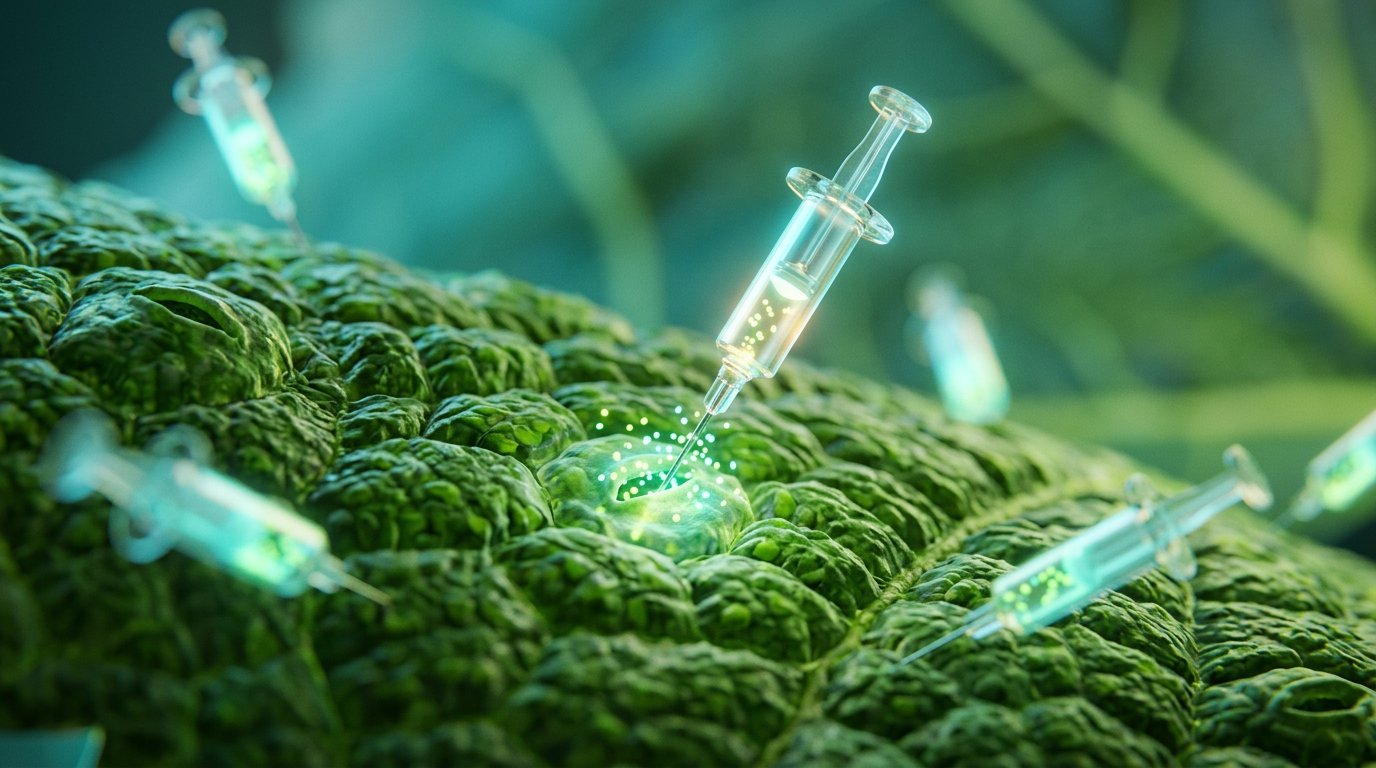
Getting a useful protein into a plant cell is surprisingly hard. Every cell is wrapped in a rigid wall and a membrane, and most delivery tricks either rely on inserting DNA or struggle to get past those barriers. On November 18, 2026, Caltech announced a different route: bacterial “nanosyringes” that have been re-aimed at plant cells and loaded with working molecular tools.
The work, led by Gozde Demirer’s lab in chemical engineering, appears in Nature Nanotechnology. This article is based on Caltech’s announcement and the paper it links.
A bacterial injector, redirected
The team started with an injection system found in bacteria of the genus Photorhabdus. In nature, these microbes release tiny syringe-like particles that deliver toxins into insect cells. Tail fibers recognize and attach to a target cell, then a surrounding sheath contracts and drives an inner tube through the membrane.
To change the target, the researchers replaced the natural binding region of those tail fibers with a short chain of amino acids called flg22. Many plants carry an immune receptor named FLS2 on their cell surfaces that recognizes flg22 as a sign of bacterial infection. Displaying flg22 on the syringes therefore gave them a molecular handle on plant cells. The engineered particles were produced in laboratory bacteria, purified and applied to plant tissue.
Proof that the cargo actually works
Early tests used Arabidopsis thaliana, a small mustard-family plant, with cell walls removed, and confirmed delivery of fluorescent proteins and native toxin cargoes. The harder test came in intact leaf tissue, where the wall remains in the way.
There the team loaded the syringes with Cre recombinase, an enzyme that rearranges DNA. A specially designed reporter lit up only when Cre acted on it, so fluorescence showed the enzyme was active inside cells rather than stuck to their surfaces.
Delivery depended on the receptor. In Arabidopsis plants lacking FLS2, Cre delivery did not happen. In plants with normal receptor levels, delivery reached up to 16 percent under the tested conditions. When the scientists engineered plants to make extra FLS2, about 75 percent of leaf cells lit up. That suggests receptor abundance helps set how efficiently a protein reaches the interior.
Writing a gene into a leaf
The system also carried R2, a more complex genome-engineering protein that inserts genetic material at a defined location. Delivered into leaf cells of Nicotiana benthamiana, a tobacco relative, R2 used an RNA copy of supplied instructions as a template, cut the plant’s DNA at the target spot and wrote a fluorescent reporter gene into it. The team detected reporter expression and confirmed the insertion site with molecular measurements and DNA sequencing.
Delivering the protein itself, rather than DNA that tells the cell to make it, bypasses a step. According to Caltech, that reduces the chance of unwanted DNA ending up in the plant’s genome, and it could allow finer control over when and where a tool acts.
What it means
For plant biologists, the near-term value is a research tool. Today, testing how a protein affects growth, immunity or stress response often means building a new genetically modified plant for each experiment. If syringes can be tuned to recognize other receptors and reach specific cell types, a scientist could test a protein in one part of a plant without altering every cell, as Demirer describes it.
Longer term, the researchers see applications in crop improvement. Lead author Mark Legendre says the platform still needs more development before field use, but the team is confident it can eventually become a plant transformation system with cell-targeting and multifunctional capabilities.
It is worth keeping expectations measured. The experiments were done in two common laboratory plants, delivery in normal plants was far lower than in receptor-boosted ones, and nothing here has been tested in crops or outside the lab.
Conclusion
Caltech’s nanosyringes turn a bacterial weapon into a programmable delivery vehicle for plant cells. It is early, lab-scale work, but it points toward more precise, protein-based tools for studying and eventually improving plants.