
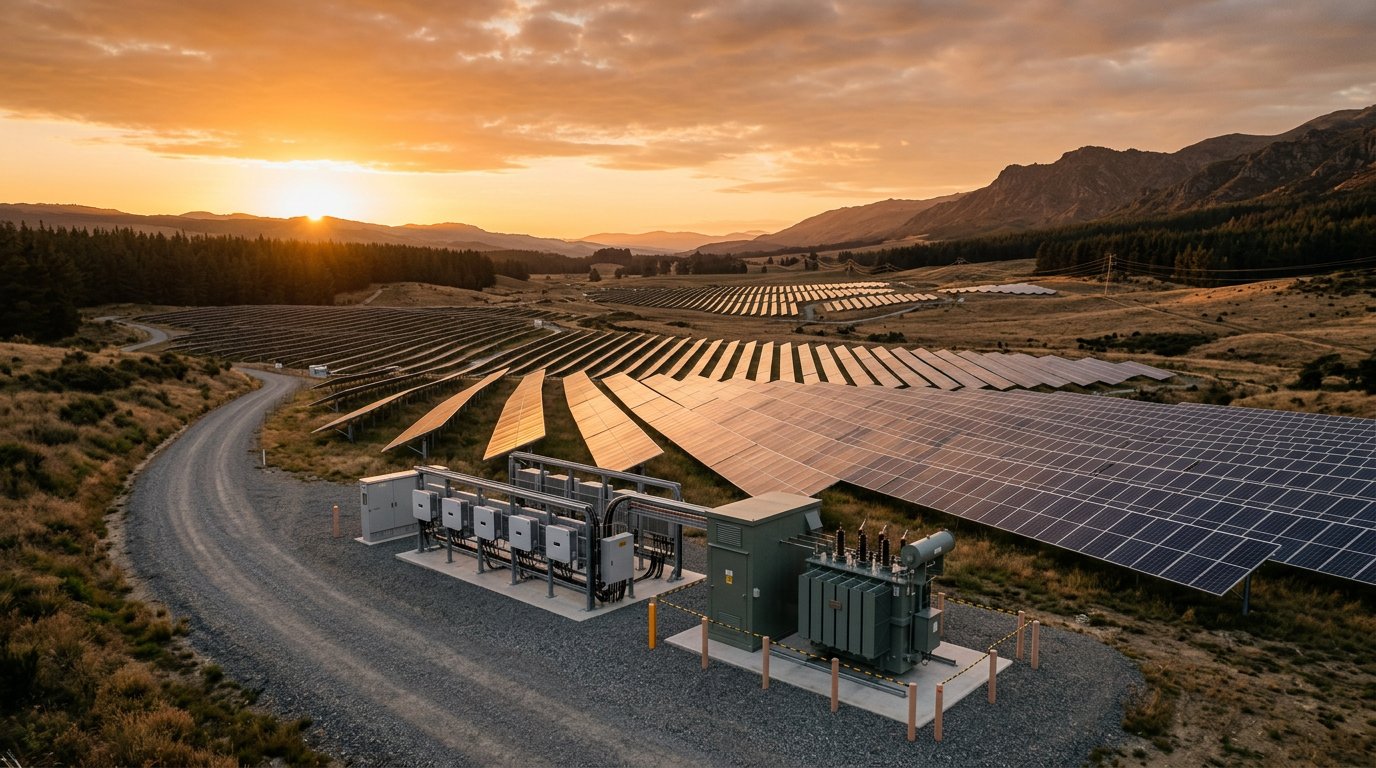
Utility-scale solar plants are getting bigger, and the equipment that turns their direct current into grid-ready power is under pressure to be more flexible, easier to service and quicker to expand. On November 16, 2026, Siemens answered with WATTBLOC, a U.S.-assembled platform that rethinks how a solar plant converts power by building it from small, independent blocks.
This article draws on Siemens’ press release from Las Vegas. Performance figures below are the company’s own, and the products are scheduled for 2027, so no field results exist yet.
Two pieces, one platform
According to Siemens, WATTBLOC combines two things: the WATTBLOC 500 string inverter and the WATTBLOC Virtual Central Station architecture. The inverter is the building block. The Virtual Central Station is the way many of those blocks are combined with switchgear and medium-voltage transformation into a repeatable power block.
Siemens describes the WATTBLOC 500 as a single-maximum power point tracking string inverter designed for large photovoltaic projects. It supports AC voltage configurations from 370 V to 800 V, with ratings from 227 kVA to 500 kVA depending on the voltage chosen. The design uses silicon carbide technology, active cooling and a single-stage topology, and Siemens states a maximum efficiency of up to 99.2 percent. The inverter is NEMA 4X and IEEE 2800 compliant and can run stand-alone or inside a Virtual Central Station.
Why distribute the conversion?
Traditional central inverters concentrate power conversion into one large machine. Siemens takes the opposite approach: the Virtual Central Station spreads conversion across multiple independent inverter modules. The company says individual modules can be isolated and serviced while the rest of the capacity keeps producing, which reduces downtime exposure and supports higher plant availability.
Because controls and conversion are distributed, Siemens calls the architecture inherently resilient. A fault in one module does not have to take the whole block offline, which is a different failure profile from a single large inverter.
Blocks that scale from 1 MW to 5 MWac
The architecture combines several string inverter modules with AC switchgear and medium-voltage transformation to form power blocks. Depending on configuration, Siemens says these blocks can scale from smaller project sizes of 1 MW up to 5 MWac. Modular building blocks, the company adds, support cost-effective expansion, simplified serviceability and long-term fleet standardization.
Standardization is a quiet but important point. Developers and owners of many sites often juggle different equipment on each one. A repeatable block lets a plant be designed, built and later expanded from the same parts, which can simplify spare-parts planning and operations.
What it means
For developers, utilities and engineering firms, the pitch is a shift from choosing an individual inverter to choosing an integrated power block. Siemens executive Dave Pisano said the aim is to avoid forcing customers to choose between flexibility, scalability and reliability, by making the conversion building block smaller and independent and letting customers deploy it in the configuration that fits the site.
The U.S. assembly angle also matters for projects that value domestic supply chains, though the press release does not detail sourcing or pricing. Those are open questions to watch, along with real-world availability numbers once plants are running.
It is also one of several power-conversion announcements around the RE+ 2026 show, a sign that the industry is racing to make solar and storage plants simpler to build and maintain.
Availability
Siemens says the WATTBLOC 500 string inverter and the Virtual Central Station architecture will be available in 2027. They are on display at the Siemens booth N3150 at RE+ from November 16 to 19, 2026.
Bottom line
WATTBLOC is a bet that smaller, independent power-conversion modules can make big solar plants more available and easier to grow. The efficiency and availability benefits are Siemens’ claims for now; 2027 deployments will show whether the modular approach delivers.