
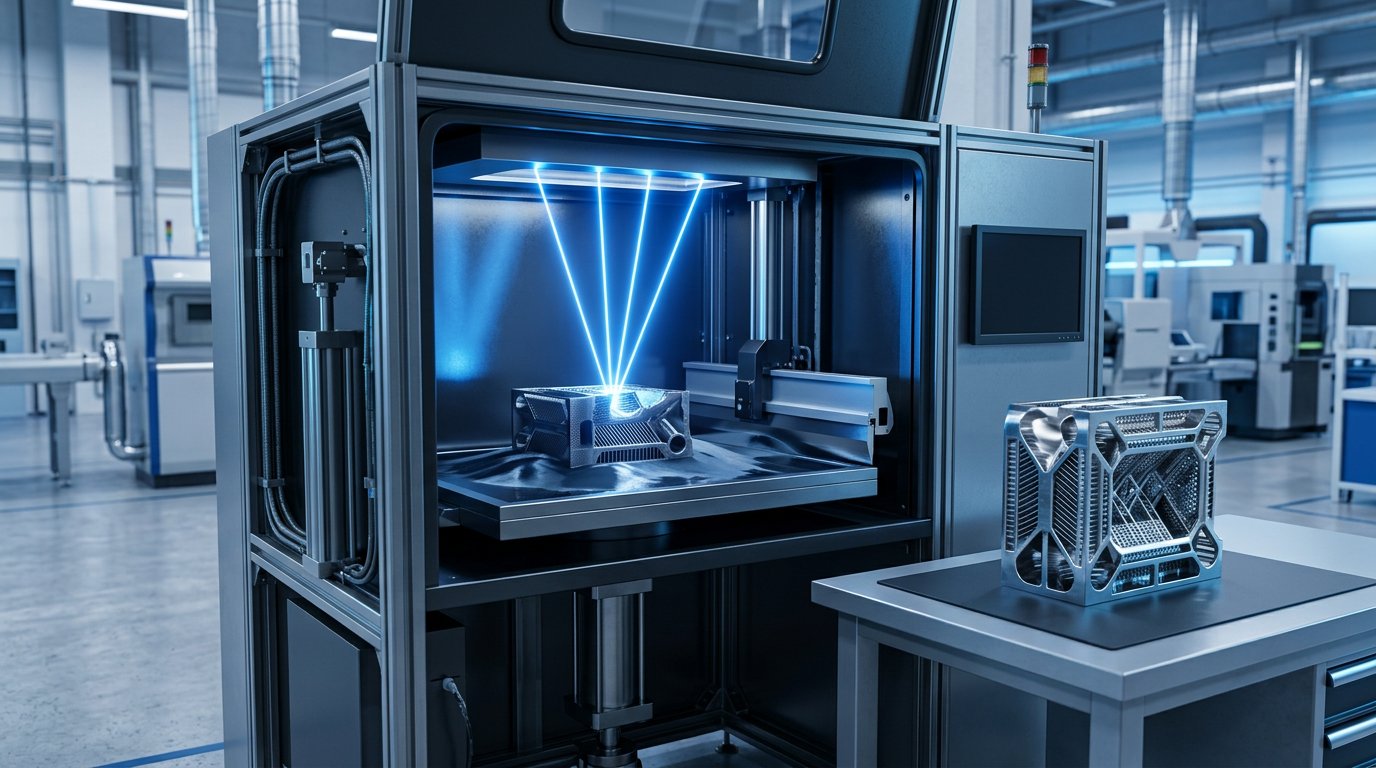
Metal 3D printing has long been sold on speed: how fast can a machine lay down layers? As the technology moves from prototypes into real production lines, manufacturers care about something else, namely how much they can make in a given patch of factory floor. On November 18, 2026, Nikon announced a new printer family built around exactly that idea.
This article draws on Nikon’s announcement of the MACHX series, developed by its subsidiary Nikon SLM Solutions AG (NSLM). Specifications are Nikon’s own, and sales begin in 2027.
Throughput density
NSLM built the MACHX series around a concept it calls “throughput density”: how much production a machine achieves per unit of footprint. Nikon says that as metal additive manufacturing enters mass production, buyers weigh production volume per area, stability and the ability to expand equipment, not just print speed.
The series uses laser powder bed fusion (L-PBF), in which lasers melt thin layers of metal powder into solid parts. It targets general industry, automotive and aerospace, and is meant for continuous production of metal parts.
Three sizes on one platform
The family has three models that share a common modular design: the MACHX 450, 450C and 450E. The 450 has a 450 x 450 x 450 mm build size for general industrial mass production. The 450C stretches to 450 x 600 x 450 mm for long, flat parts such as automotive components. The 450E reaches 450 x 450 x 1,000 mm for tall parts such as rocket engine chambers.
Because the platform, software and processes are common, Nikon says application parameters can be reused across models. A process proven on one machine can move to another without starting over.
Lasers, heat and uptime
Total laser output reaches up to 8 kW. Nikon describes two configurations: four or eight 1 kW Gaussian-beam modules that adjust beam diameter from 80 to 500 micrometers, or four 2 kW beam-shaping modules covering 80 to 760 micrometers. The optical system was developed jointly with Nikon.
More laser power means more heat, so the printers use interchangeable build plate packages for different temperature ranges. The low-temperature package adds water cooling for the 80 to 200 degrees Celsius range and delivers roughly eight times the cooling performance of the earlier NXG series, according to Nikon. A medium-temperature package for 200 to 450 degrees Celsius is planned. Sensors under the build plate and a liquid-cooled process chamber aim to give every part on the plate the same thermal history.
To cut idle time, an optional automatic cylinder exchange preheats the next build cylinder while the current job runs. With optional build-surface monitoring that controls first-layer thickness, the next build can start just 25 minutes after the previous one ends. A 230 liter universal powder tank supports long runs, and standardized powder interfaces let several machines share one powder removal system.
Compact by design
The MACHX 450E offers roughly 200 liters of build volume in an installation area of about 13 square meters. Nikon notes that delivery and installation by crane need about 42 square meters of working space. The pitch is that factories can add capacity without building a new plant.
What it means
For manufacturers, the message is that metal 3D printing is being engineered like production equipment: modular, upgradable after installation, and managed by software. Nikon’s SLMX process system ties together thermal control, simulation, layer monitoring and process management to keep quality consistent from first print to mass production.
The announcement also fits Nikon’s stated strategy. Its medium-term plan names large-format metal 3D printers as a key focus, building on its optics heritage.
Real-world throughput, pricing and customer results are not yet published, so the throughput claims remain to be proven in 2027.
Availability
Nikon says sales begin in June 2027 in Europe and the US, with Japan following sequentially.
Bottom line
MACHX shifts the metal printing conversation from raw speed to output per square meter. If the modular upgrades and fast turnaround work as described, it could make additive manufacturing easier to scale in existing factories.