
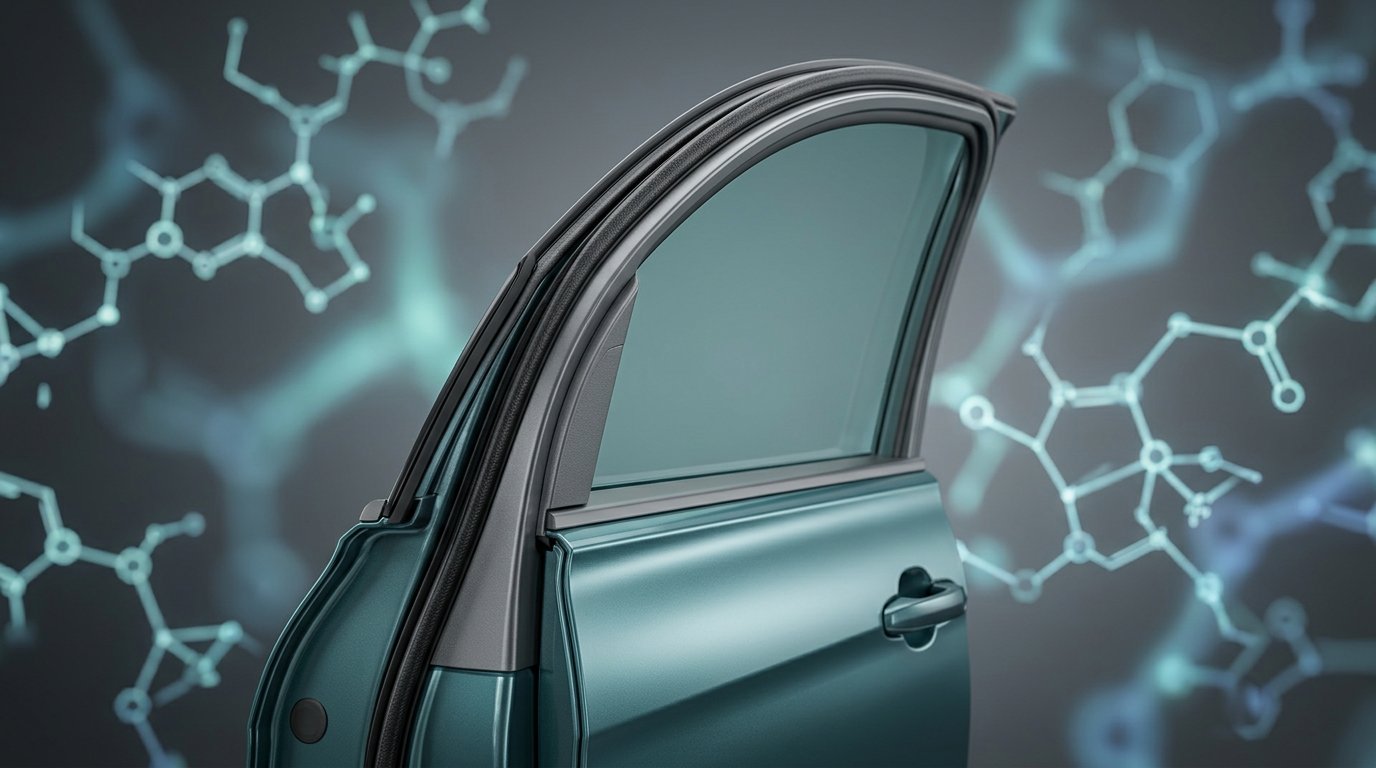
Weatherseals are the unglamorous rubber strips that keep water, dust and noise out of a car cabin. On November 17, 2026, Dow introduced a new family of EPDM rubber designed to make those parts faster to produce without giving up quality. The series is called NORDEL NGT, and its first grade is aimed squarely at automotive sealing.
What Dow launched
As described in Dow’s press release, NORDEL NGT (Next Generation Technology) EPDM is a new series of grades for rubber compounders and manufacturers. The goal is to improve processing efficiency while maintaining the performance needed in automotive, infrastructure, consumer goods and other applications.
The series is enabled by Dow’s proprietary Advanced Molecular Catalyst (AMC) technology. Dow says AMC produces a distinct molecular architecture that addresses the traditional trade-off between processing and performance, a long-standing tension in rubber compounding where easier-to-process materials often give up some finished-part properties.
The first grade: NORDEL NGT 6670
The first grade, NORDEL NGT 6670 EPDM, is available globally for automotive dry sponge weatherseal applications. Dow says it can be used across dry sponge, fast-extrusion dense, microdense and TPV weatherseal profiles, so a manufacturer could cover several profile types with one material.
In dry sponge applications, Dow reports that the grade cures faster and delivers improved compression set performance compared with competing EPDM. Those two properties map to concrete factory outcomes. Faster curing can support higher line speeds. Better compression set means a seal is more likely to keep its shape and sealing function over time. Dow adds that these benefits create room to optimize formulations, material use and overall compound cost.
Low gel and a lower-carbon process
Dow says AMC gives precise control over polymer structure, which delivers very low gel levels for more consistent processing and surface quality. For most products a Certificate of Analysis with gel-content information is available, giving customers added visibility into material quality.
The same technology enables a highly efficient production process. Dow states an up to 29% lower carbon footprint compared with functionally equivalent EPDM made with conventional production technology. The release notes that a product carbon footprint (PCF) analysis is available on request, which is the document buyers would need to check how that figure applies to their own grade and supply chain.
What it means
For compounders, the appeal is throughput. A material that cures faster can lift output on an existing extrusion line, which is often cheaper than adding equipment. For automakers, weatherseals are tied to cabin quietness and water tightness, qualities buyers notice, so durability under compression matters.
The sustainability angle is notable but should be read carefully. The 29% figure is Dow’s comparison for functionally equivalent EPDM and is marked as a footprint advantage “up to”, so real-world savings depend on grade and method. Customers who report supply-chain emissions can request the PCF analysis to confirm.
Also worth noting: the release compares the grade with unnamed competing EPDM and does not publish test data, so performance claims are Dow’s own. The company says this is the start of a broader series, with more grades expected for other industries where EPDM plays a role, though it gives no timetable.
Conclusion
Materials news rarely makes headlines, yet small changes in a polymer can ripple through factory output and product life. NORDEL NGT shows how catalyst design can target both productivity and emissions at once. Watch for additional grades and customer qualification results as Dow expands the series beyond car door seals.