
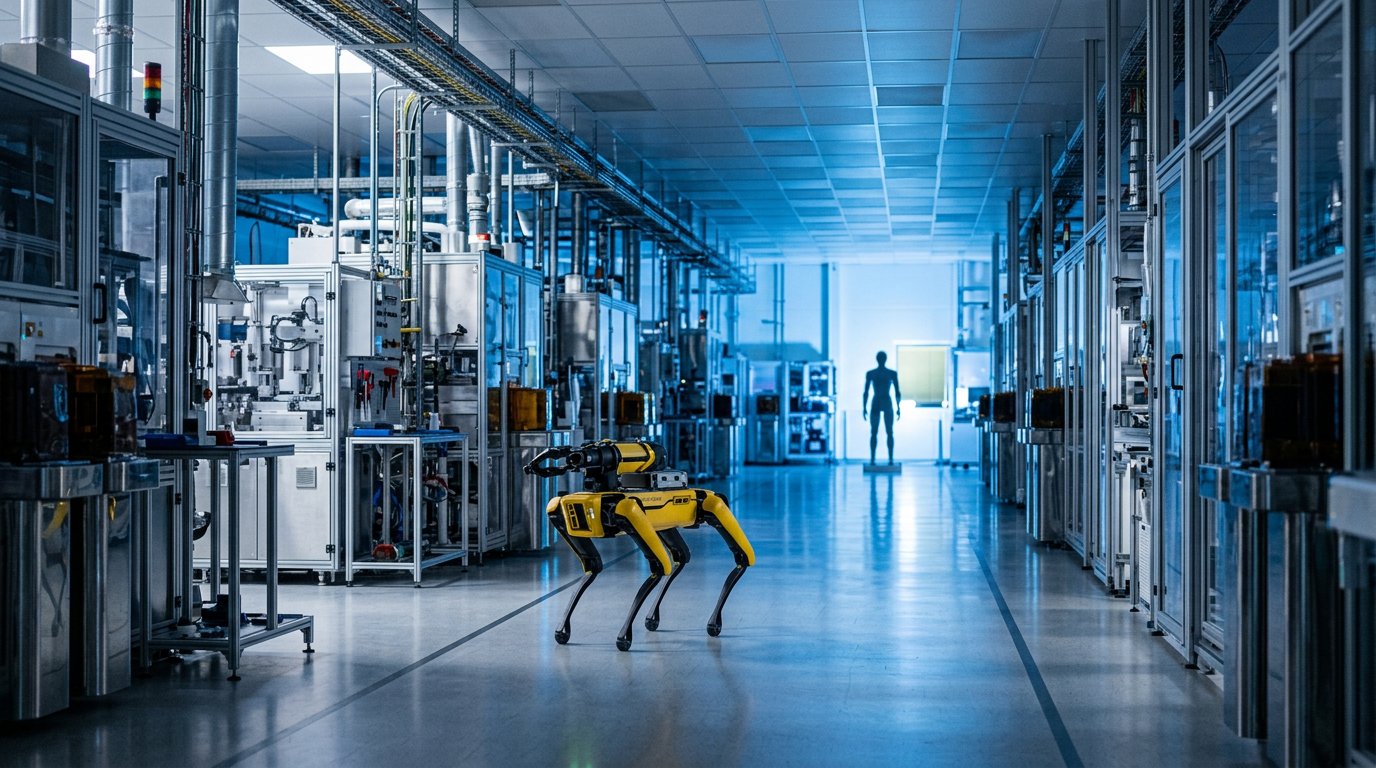
Semiconductor fabs are some of the cleanest, most tightly controlled workplaces on earth, and also some of the hardest to inspect. On November 17, 2026, Boston Dynamics and GlobalFoundries (GF) announced that they are widening a robotics partnership that has already run for more than four years. Spot, the yellow quadruped, will spread across GF’s manufacturing network, and GF will become the first semiconductor maker to test the Atlas humanoid.
What was announced
According to the Boston Dynamics press release, the agreement expands Spot deployments for autonomous enterprise asset management across GF’s global fabs. The named sites are Malta, New York; Burlington, Vermont; Dresden, Germany; and Singapore. That puts the robot in the United States, Europe and Asia under one program.
The second part is about humanoids. GF will be the first customer outside the automotive industry to join the Atlas early adopter program and its skills development workshop. Boston Dynamics describes it as the first program of its kind for semiconductor manufacturing.
What Spot has already done
GF has run Spot at its Burlington, Vermont site for more than four years. More recently it extended the program to Singapore, where, per the release, two Spot robots have traveled nearly 900 kilometers and completed more than 90,000 inspections in sub-fab areas since April. The companies report a 99% mission success rate.
Using the latest hardware and software, GF also redeployed 875 routine inspections in just two weeks. The company says it has an immediate road map to more than double that number using Spot’s advanced visual inspection capabilities. These figures are company-reported, and the release does not break down what the inspections found.
Pradip Singh, GF’s chief manufacturing officer, said Spot has helped the company shift from reactive to predictive maintenance by collecting data across thousands of inspection points to prevent downtime. Zack Jackowski, Boston Dynamics’ Chief Product and Technology Officer, said GF was one of the earliest Spot adopters and that customers like it are collecting data that will be useful for future manufacturing innovation.
Atlas arrives in 2027
Atlas testing is scheduled to begin onsite at GF facilities in early 2027. The stated goals of the skills development workshop are to evaluate potential humanoid use cases, assess customer readiness and integration needs, and begin early testing and training for specific task execution.
That wording matters. This is an evaluation and training stage, not a deployment announcement. Neither company says which tasks Atlas will attempt, how many units will be involved, or when any humanoid would move into regular production work. The release also says the effort complements GF’s global program to upskill its employees in AI, which frames the humanoid as something people will learn to work alongside.
What it means
For fab operators, the Spot story is about data as much as walking. Sub-fab spaces hold pumps, abatement systems and utilities that keep production running, and routine rounds there are repetitive. A robot that repeats the same route and captures consistent readings gives maintenance teams a steady record to spot drift before it becomes downtime. GF’s own words about moving from reactive to predictive maintenance point at exactly that.
For the robotics industry, the Atlas piece shows humanoid pilots moving past car plants. Boston Dynamics had so far described its early adopter program with automotive customers, and GF extends it to a sector with very different cleanliness, safety and process rules. Those constraints will shape which tasks are realistic.
For other manufacturers, the pattern is worth noting: start with a mobile inspection robot that delivers measurable value, build trust and data over several years, then test a more ambitious platform with the same partner. GF followed that path from one site to four, and now to a humanoid trial.
What to watch next
Three things will tell how far this goes. First, whether GF publishes inspection findings or downtime results that show what the 90,000-plus Singapore inspections actually prevented. Second, which Atlas tasks are chosen when testing starts in early 2027. Third, whether other chipmakers copy the model and ask for their own humanoid workshops. Until then, the clearest takeaway is modest and concrete: inspection robots are becoming routine infrastructure in advanced factories, and humanoids are being measured against that standard.
Conclusion
Boston Dynamics and GlobalFoundries are scaling a proven inspection program and opening a careful humanoid trial. The numbers so far are company-reported, but the scope, from four fab sites to a first-of-its-kind Atlas workshop, makes this a useful marker for physical AI in manufacturing.