AI data centers do not just need more electricity; they need electricity that behaves. Training clusters swing their power draw quickly, and a brief outage can ruin hours of work. That is the backdrop for Samsung SDI’s showing at RE+ 2026 in Las Vegas, where the battery maker laid out a lineup built around AI data center power needs.
What Samsung SDI showed
In its November 18, 2026 announcement, Samsung SDI said it was presenting next-generation battery solutions under the theme “AI Thinks, Battery Enables.” RE+ is North America’s largest energy industry exhibition, with more than 1,300 companies and over 40,000 visitors expected. The company’s booth in the Las Vegas Convention Center main hall was split into three zones: energy storage systems (ESS), uninterruptible power supply (UPS) systems and battery backup units (BBUs).
Storage: SBB 2.0 and PrismStack
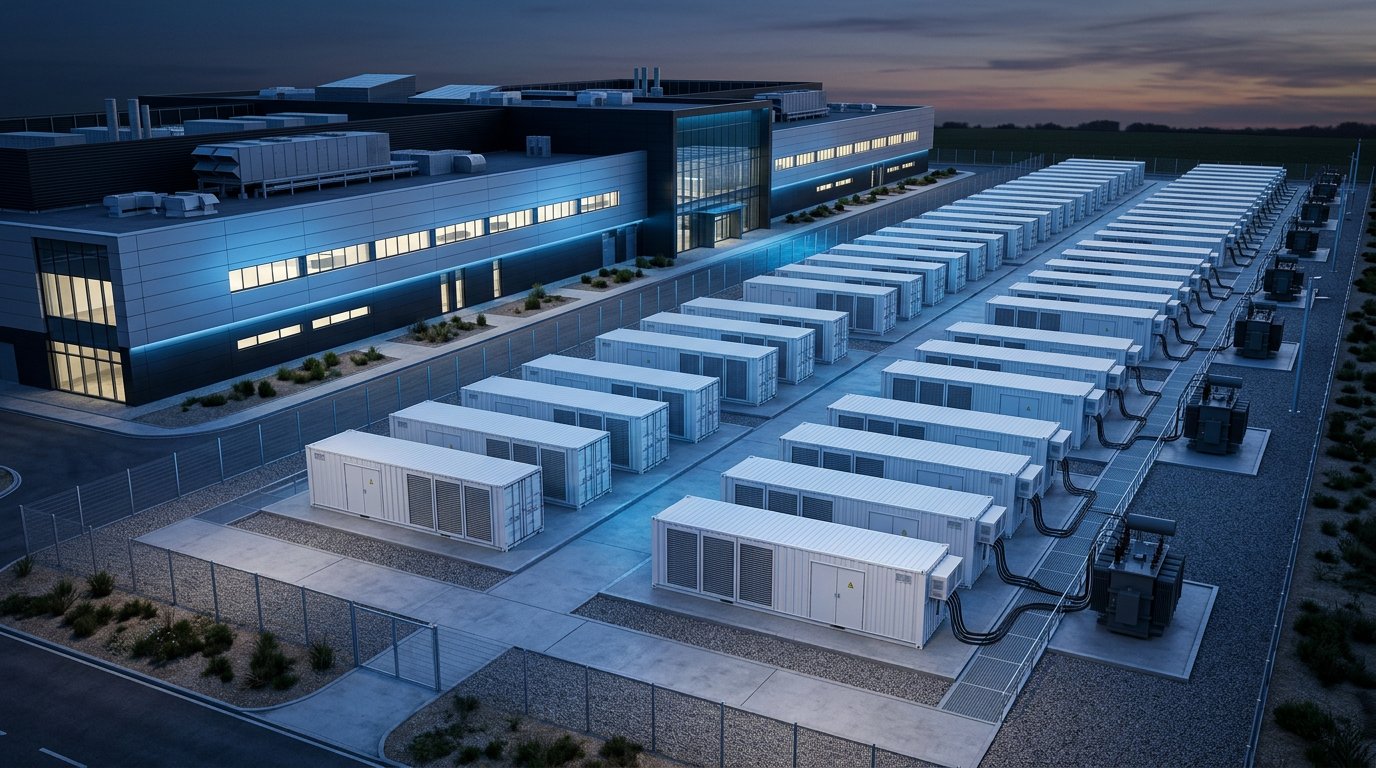
The ESS zone centers on the Samsung Battery Box (SBB), a fully integrated storage product using locally manufactured prismatic cells in both NCA and LFP chemistries. A model of SBB 2.0 let visitors open its front and side doors to see its safety features. Samsung SDI says SBB 2.0 recently entered mass production at the StarPlus Energy plant in the United States.
The company also introduced its prismatic battery brand, PrismStack, to the North American market for the first time. PrismStack was first unveiled earlier in 2026 at InterBattery 2026, Korea’s largest battery exhibition.
UPS and backup power
The UPS zone showed U8A3, a prismatic battery solution for UPS use that, according to Samsung SDI, became the first in the world in July to meet all requirements of the Indoor Large Scale Fire Test. Prismatic cells using lithium manganese oxide chemistry were on display beside it.
The BBU zone covered batteries meant to keep servers running during an outage or a sudden dip in supply. The lineup spans chemistries from high-nickel NCA to LFP and includes 21700 cylindrical cells that Samsung SDI describes as offering both high capacity and high power.
Turnkey packaging, warranty and AI monitoring
SBB 2.0 is available with an AC Wrap turnkey solution that bundles a power conversion system and an energy management system with the battery. Samsung SDI is also offering a 25-year warranty, which it calls industry-leading, arguing it lets customers plan long-term operation while limiting maintenance and replacement costs.
On display too was Samsung Battery Intelligence, an AI-powered safety system that the company says is Korea’s first AI-based ESS fire prevention software. It assesses battery condition and lifespan and tries to detect and predict abnormalities before they occur. Visitors could also use touch screens to configure an SBB 2.0 site and trace how energy flows from a BBU to an AI data center.
What it means
Battery makers are repositioning around data centers because that is where demand and urgency are. Three things stand out here. First, the emphasis on local US manufacturing, which matters to buyers sensitive to supply chains and incentives. Second, safety evidence, such as the large-scale fire test claim, which is becoming a purchasing criterion for storage near critical facilities. Third, the pairing of hardware with software that predicts faults.
The announcement is a trade show showcase, so it gives no prices, capacities for specific deployments or named customers. Operators will need quotes and independent test data before comparing it with rival systems.
Bottom line
Samsung SDI’s RE+ lineup shows how the battery industry is retooling for AI infrastructure: integrated storage, UPS and backup cells, a long warranty and software to watch battery health. The test for these products is not the booth but how they perform when a real cluster surges.