Most assessment software is good at one thing: collecting scores. The harder job comes later, when a promotion committee, an accreditor or a learner filing an appeal asks a simple question: what evidence led to this decision? On November 18, 2026, Elentra announced Masterymark, a new standalone assessment platform for health professions programs that is built around answering exactly that.
According to Elentra’s announcement, Masterymark is set for initial availability in January 2027. It is meant to handle every form of assessment, from quizzes and exams to OSCEs, workplace-based assessment, portfolios and credentialing, on a single configurable platform with opt-in AI throughout.
The problem: evidence scattered across tools
Elentra describes a familiar pain point. As health professions programs shift toward competency-based progression, the evidence behind each decision tends to live in separate tools. Before every progress review, staff rebuild each learner’s picture by hand in spreadsheets. When a learner appeals or an accreditor asks how a decision was reached, the trail can be hard to reconstruct.
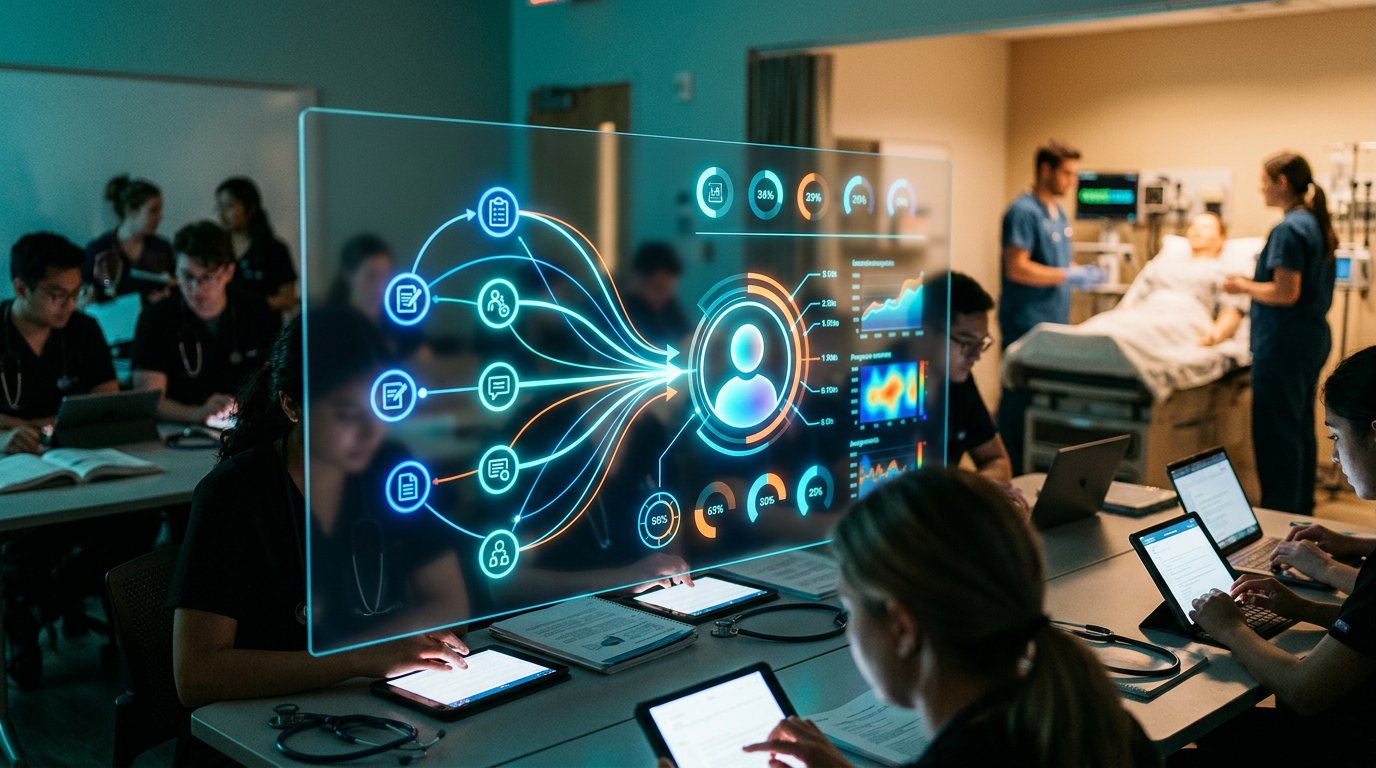
The company’s argument is that running every assessment on one platform lets the system compute each learner’s progress from the evidence, and record how every judgment of mastery was made, instead of leaving that work to people assembling reports after the fact.
Every modality on one engine
Under the hood, Elentra says quizzes, exams, coursework, OSCEs and workplace-based assessment will share one item model and one scoring and psychometrics engine. A response from a live poll in class and an answer on a final exam both become curriculum-tagged evidence in the same learner record.
Authors are promised more than 75 question types and shared item banks with staged review, version history and blueprints. Workplace-based assessment requests are triggered by the clinical encounter itself, so they reach the supervisor who was on the case rather than arriving as a schedule-based reminder. That detail matters because feedback collected close to the moment of care is usually more specific than feedback requested weeks later.
Progression managed, not just recorded
The second half of the pitch is about decisions. Each assessment is classed by its stakes and feeds one learner dossier, and the sufficiency of the evidence is computed rather than assembled manually. According to Elentra:
- Progression gates and remediation loops are set as rules that learners can see.
- Early warnings fire when evidence falls short under the committee’s own rule.
- Progress testing tracks each learner’s growth against an expected trajectory, so gaps surface while there is still time to act.
- Committees receive panel packs drawn from the whole record, decide on that evidence and record their rationale.
The stated outcome is that a program can show the evidence, the rule and the approver behind every progression decision.
Feedback and practice shaped by the evidence
Masterymark also uses each learner’s results to shape what comes next. Per the announcement, ungraded spaced practice brings questions back on a schedule set by each answer. A study tutor answers only from the program’s own curriculum and cites its sources. An AI reflection coach asks questions but never writes the reflection for the learner, and learners can rehearse with AI patients that answer only from the authored case.
Elentra states that every AI feature is opt-in and never trains on an institution’s data, and that AI-assisted decisions are logged with a named reviewer. Those guardrails are worth noting in a field where trust in how AI is used can matter as much as the feature itself.
What it means
For medical, nursing and other health professions schools, Masterymark is a bet that assessment is becoming a continuous evidence system rather than a series of exams. If the platform delivers what is described, program leaders could spend less time reconciling spreadsheets and more time acting on early warnings. Learners get visible rules for progression, which can make high-stakes decisions easier to understand.
There are open questions. The platform is not yet generally available, and the claims come from the vendor’s own announcement. Programs will want to see how rules are configured, how data moves in from existing systems, and how the logging of AI-assisted decisions works in practice. Elentra has opened an early access program for colleges and universities across North America with health professions programs. Selected institutions get access ahead of launch, a hand in shaping capabilities and priority onboarding in return for regular feedback.
Conclusion
Masterymark is an announcement, not yet a shipped product, but its direction is clear: unify the assessment record, compute progression from evidence, and keep AI optional and auditable. For health professions education, that is an idea worth watching as the January 2027 availability date approaches.