
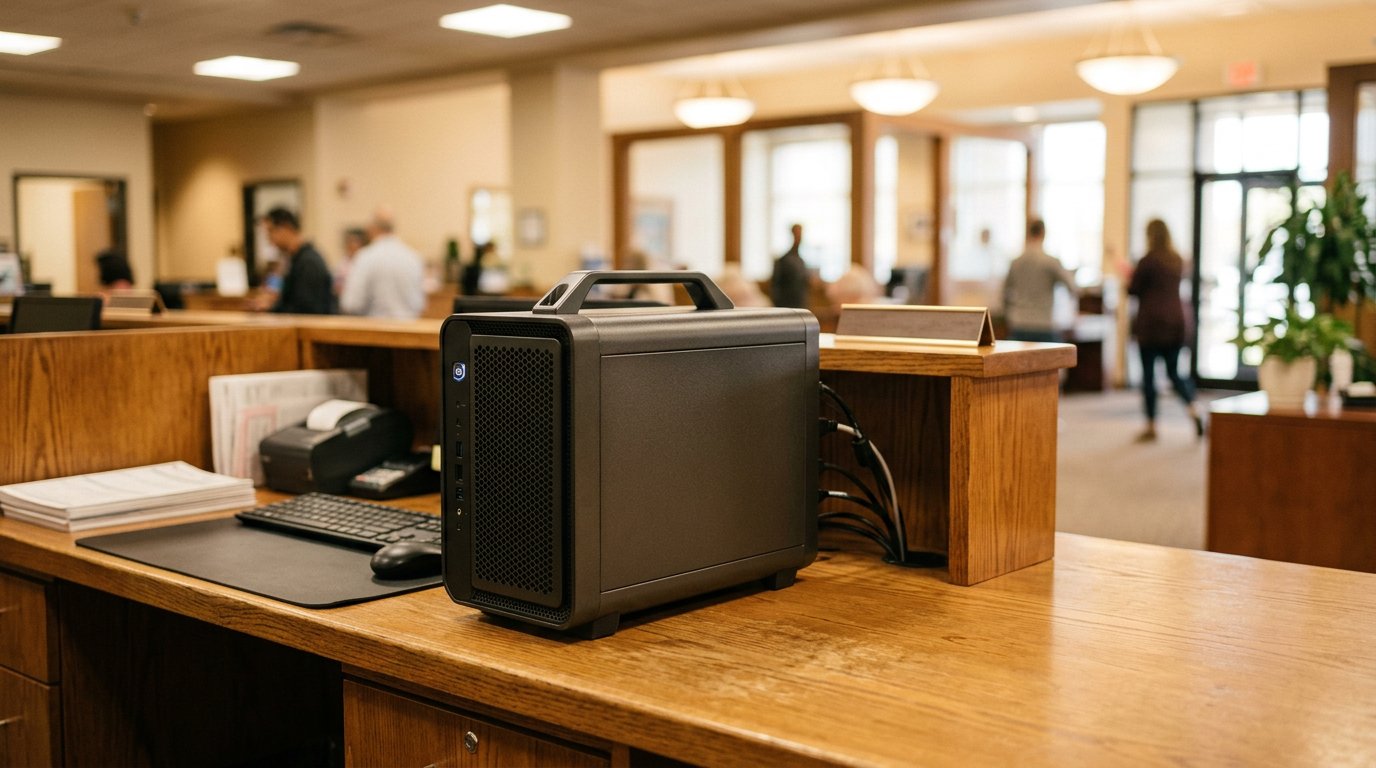
Most conversations about enterprise AI assume a data center, a cloud contract or at least a server closet. Go.AI is betting there is a large market for the opposite: a single box you can carry with one hand and set under a teller counter. On November 19, 2026, the Chicago company announced the Go1 mini, the smallest appliance in its Go1 line.
What the Go1 mini is
According to Go.AI’s press release, the Go1 mini serves up to 200 concurrent users from one appliance, at a fixed price with unlimited usage and tokens. It runs Go.OS, the company’s purpose-built operating system for managing models, indexing and data, and carries the same custom firmware and memory acceleration as the larger Go1 models, tuned for a single GPU.
The company says setup takes 15 minutes and needs no on-site IT staff or dedicated server room. The chassis has a carry handle and is meant to fit on a desk or under a counter.
Specifications
The release lists one NVIDIA RTX 6000 Blackwell GPU with Go.AI memory acceleration, and up to 2 TB of accelerated memory. Capacity is up to 200 concurrent users per unit, or up to 800 in a four-unit cluster. Storage is two NVMe PCIe 5.0 drives in RAID 1, with up to 4 TB raw and AES-256 encryption. Networking is 10GbE plus 2.5GbE, with Wi-Fi and Bluetooth hardware-disabled, and cooling is described as whisper-quiet. Go.AI quotes response speeds under 50 milliseconds per query, a figure the company states without detailing test conditions.
The company’s comparison page places the mini beside the Go1, which serves up to 2,000 users with up to three GPUs, and the Go1 MAX, which serves up to 8,000. Go.AI frames the difference as firmware rather than silicon: scheduling, batching and kernels tuned for serving many people at once.
Who it is for
The target buyers are branch offices, community banks and credit unions, dental offices, small healthcare practices, insurance brokers and small financial services teams. The pitch is that a small institution faces the same data protection and examination requirements as a large one, without the same IT team. Data stays inside the branch, and Go.AI says the appliance is examiner-ready from day one, backed by SOC 2 Type II and ISO 27001 certification.
As a deployment example, the company describes a federally qualified health center in California that used the mini to automate administrative workflows and manage patient records, which it says gave back hundreds of hours of staff time. That is a company-reported result.
What it means
Private AI has often meant a trade-off: cloud tools that are easy but send data out, or on-premises systems that demand expertise. A fixed-price appliance with unlimited usage tries to remove both worries at once, since small teams can budget without watching token meters. If the 200-user claim holds under real workloads, it could make local AI practical for organizations that never planned for a server room.
Buyers should still ask for workload details: which models run, how latency changes with load, and how updates reach a box configured with wireless disabled. Go.AI says the appliance is available to order now.
Bottom line
The Go1 mini shows AI infrastructure shrinking to desk size. For community institutions that need AI but must keep data in-house, a plug-in appliance with predictable pricing is an appealing idea, and one worth testing against real workloads.