
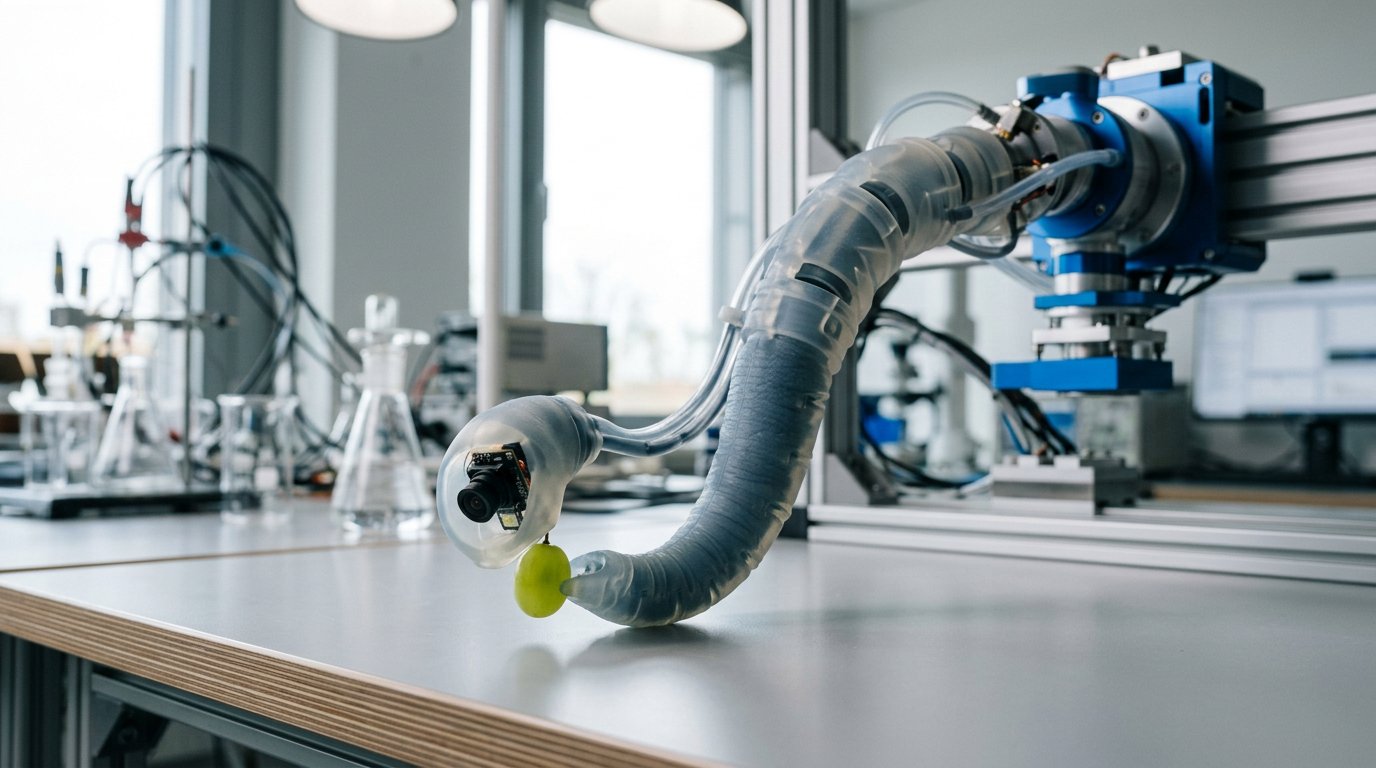
Ask a robot to pick up a grape and then a metal pipe, and most grippers treat both the same way. Researchers at King’s College London now report a soft, trunk-shaped gripper that feels its way through the job, and it was inspired by an elephant’s trunk. According to the King’s College London announcement, the device, called EleTac, can handle grapes and pick up playing cards, and it costs under £75 to build.
A trunk with a camera in its tip
EleTac was designed at King’s in collaboration with researchers at the Japan Advanced Institute of Science and Technology. It borrows from one of nature’s best-designed appendages. An elephant’s trunk acts as a hand for an animal with poor eyesight, and its soft tip can explore surroundings by touch while handling objects without damaging them.
The robotic version uses a “vision-based” sensor in the soft tip. A camera sits inside a rubber-like silicone shell. When the gripper touches an object, the object imprints itself on the silicone and deforms it. The camera records those deformations, and AI uses them to estimate the object’s size, shape and the force needed to manipulate it. That information feeds back to guide how the gripper moves next.
How sensitive is it?
The team says the camera can sense forces as small as 0.25 newtons, which King’s compares to the weight of roughly half a chocolate bar, and which it likens to what the 400,000 nerve endings in an elephant’s trunk can feel. The release describes the robot as having even more sensitivity to shape, size and texture than its natural counterpart.
Professor Shan Luo, Professor of Robotics and AI at King’s and author of the paper, explained the core problem: a human brain knows to use different force for a grape than for a metal pipe, while a typical robot does not. That gap can cause trouble when a machine deals with objects of different shapes and sizes. Xuyang Zhang, the PhD student on the project, said the design lets the gripper handle objects safely with enough tactile feedback for a wide range of shapes, weights and sizes.
The cost story
Price may be the most striking detail. King’s says current tactile prototypes often rely on several high-accuracy or torque sensors that can cost upwards of £10,000, molded into the shape of a human hand. By comparison, the soft tip of EleTac’s shell costs 50 pence to produce, and the whole device comes in under £75. The university puts that at, on average, 99% cheaper than similar industry models.
The work builds on the team’s earlier SimTac, a simulation environment that applied lessons from natural sensors such as cats’ paws and elephant trunks to cut the time and cost of creating new tactile sensors and robots.
What it means
Dexterity is a bottleneck for robots outside controlled factory settings. A low-cost touch sensor that tells a machine how hard it is squeezing could make careful handling more accessible to labs and developers. The team points to future grippers for manufacturing, search and rescue, and even fossil digging. These are goals, not products: EleTac is a research prototype, and the release does not describe commercial availability.
Conclusion
EleTac shows how a camera, a silicone tip and some AI can approximate a delicate sense of touch for very little money. If the cost and sensitivity figures hold up as the work matures, soft tactile grippers could become a far more common tool in robotics research.