
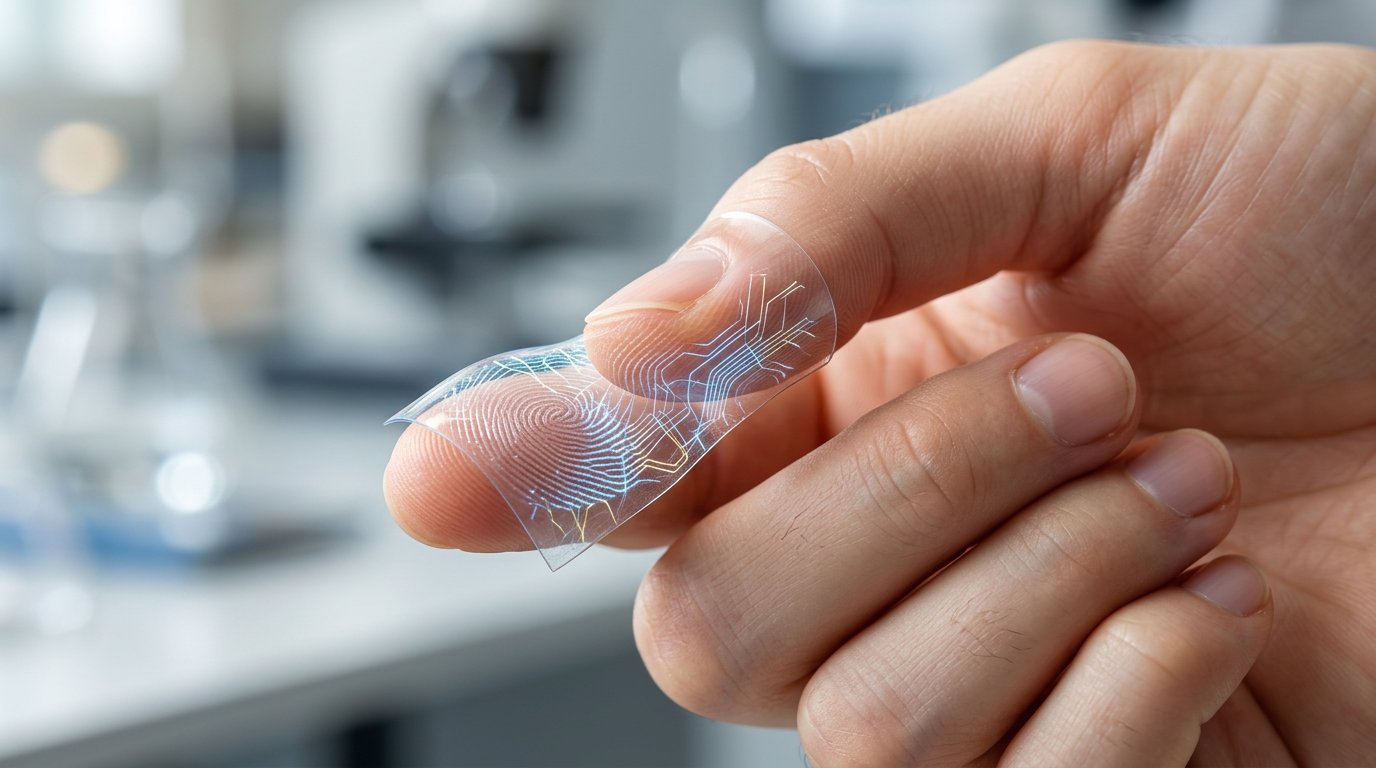
Most wearable sensors are built flat and then pressed onto the body, which is why they wrinkle, peel or feel uncomfortable on curved skin. A team led by Professor Takao Someya and Associate Professor Tomoyuki Yokota at the University of Tokyo, with RIKEN, has flipped the process. According to the University of Tokyo press release, they spin conductive nanofibres directly onto the skin so the sensor takes the shape of whatever it lands on.
Fabricating the sensor on the skin
The approach uses in-situ electrospinning. Instead of making a sensor on a flat surface and transferring it, the method produces conductive nanofibres directly on the skin, forming an ultrathin, flexible nanomesh that adapts to a wide range of surface geometries. The goal is a sensor that keeps close contact with curved and irregular skin without wrinkling, peeling or causing discomfort.
The material behind it
The key is a carbon nanotube-based hybrid material that allows direct fabrication of intrinsically conductive nanofibres with diameters smaller than one micrometre. The university says the resulting nanomesh combines flexibility, electrical conductivity, biocompatibility and environmental stability with high gas permeability and efficient heat dissipation. In practical terms, the sensors can stay in intimate contact with skin while remaining breathable and thermally comfortable.
What the team built
To show versatility, the researchers developed several types of epidermal sensors: electrophysiological sensors, electrodermal activity sensors and fingertip pressure sensors. They also made a multichannel sensor array that recognizes hand gestures using a deep learning algorithm, pointing to potential for human-computer interfaces. The work was published in Nature Communications under the title “In-situ fabrication of ultra-conformal nanomesh epidermal sensors on arbitrary skin surface.”
What it means
Comfort and contact quality decide whether skin-worn electronics are useful in daily life. A sensor that is made to fit each surface, and that lets skin breathe, addresses a long-standing complaint about wearables. The researchers anticipate contributions to personalized healthcare, continuous physiological monitoring and human-machine interfaces. This is laboratory research: the release does not describe a commercial product or clinical use, and nothing here is medical advice.
Conclusion
By making the sensor on the body instead of transferring it, the Tokyo team offers a different route to wearable electronics that feel less like gadgets and more like a second skin. How well the method scales beyond the lab is the next thing to watch.