
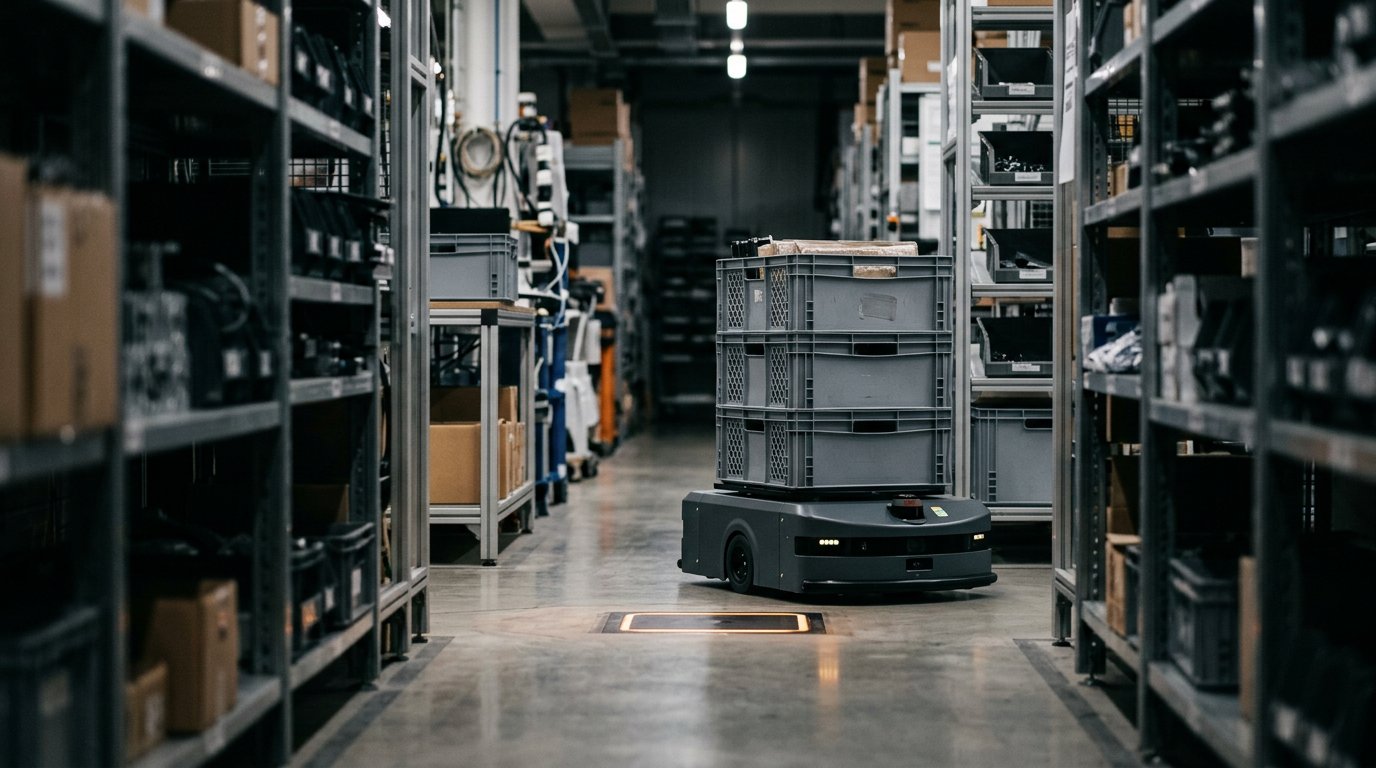
Factory floors rarely have room to spare, yet the loads that move across them keep getting heavier. On November 19, 2026, OMRON Robotics opened orders for two new autonomous mobile robots, the LD-150 and LD-300, that try to square that circle: more payload, same or smaller footprint, and a charging routine that barely interrupts the shift.
What OMRON announced
According to OMRON Robotics’ announcement, the LD-150 and LD-300 are the next generation of its flagship LD Series. The company says they carry up to 2.5 times the payload of the previous LD generation in the same or a smaller footprint. The LD-150 handles up to 150 kg in a 500 mm-wide body, while the LD-300 carries up to 300 kg in a 580 mm-wide body.
Both models can travel at up to 2.1 m/s and navigate aisles as narrow as 1 meter. They can also climb ramps with grades up to 5 degrees. Orders are open in the Americas and Europe, with other regions to follow, and shipments begin in January 2027. Availability may vary by country depending on local regulatory requirements.
Charging and navigation without fixed infrastructure
Downtime is the quiet cost of any mobile robot fleet. OMRON says the new robots use wireless inductive charging that takes as little as 18 minutes, with charge-to-runtime ratios of 1:17 for the LD-150 and 1:16 for the LD-300. In practical terms, that means a robot can top up during natural pauses and keep supporting multi-shift operation.
Navigation follows the same flexible philosophy. The robots use dynamic routing and real-time path planning, so they respond to people, equipment and workflow changes rather than following fixed guide paths, floor markers or magnetic tape. Teams can change material routes as production evolves without re-laying infrastructure.
Built for shared spaces
Robots that share aisles with people and forklifts need a safety story. The announcement lists safety scanner configurations, obstacle detection, and compliance with ISO 3691-4:2023 and Regulation (EU) 2023/1230. Standard electrostatic discharge protection and ISO Class 5 cleanroom compatibility widen the range of sites, with OMRON naming automotive, semiconductor, electronics assembly and medical device manufacturing.
The robots are designed to work with top modules and accessories, including cart toppers, conveyors, mobile manipulators and lifts. That modularity lets one base platform serve several material-handling jobs, from moving carts to feeding a line with crates.
Fleet management at scale
The software side matters as much as the hardware. The LD-150 and LD-300 run in the same fleet management environment, OMRON FLOW Core, as existing LD Series robots and the company’s MD, OL and HD platforms. FLOW Core handles configuration management, routing, traffic control and job assignment, with diagnostics and visibility across mixed fleets of up to 100 AMRs.
OMRON’s vice president of product management, Justin King, framed the goal in terms of material flow across the whole operation rather than isolated transport tasks. The release also notes that an October 30, 2026 FCC public notice (DA 26-1181) said the LD-150 and LD-300 are exempt from the FCC Covered List under a Conditional Approval.
What it means
For manufacturers, the headline is density: heavier loads without wider aisles can mean fewer robots per task or the ability to automate routes that were previously too tight. Mixed-fleet management also lowers the cost of expanding gradually, since new models join an existing software environment instead of starting a separate system.
There are caveats. The specifications are the manufacturer’s own, shipments do not start until January 2027, and real-world performance will depend on layout, floor conditions and workflow design. Buyers will want to validate payload, charging and traffic behavior in their own facilities.
Conclusion
The LD-150 and LD-300 are an incremental but practical step: more capacity in less space, quick wireless top-ups and one fleet brain across several robot sizes. If the numbers hold up on the floor, they could make AMR automation easier to scale in tight, high-throughput plants.