
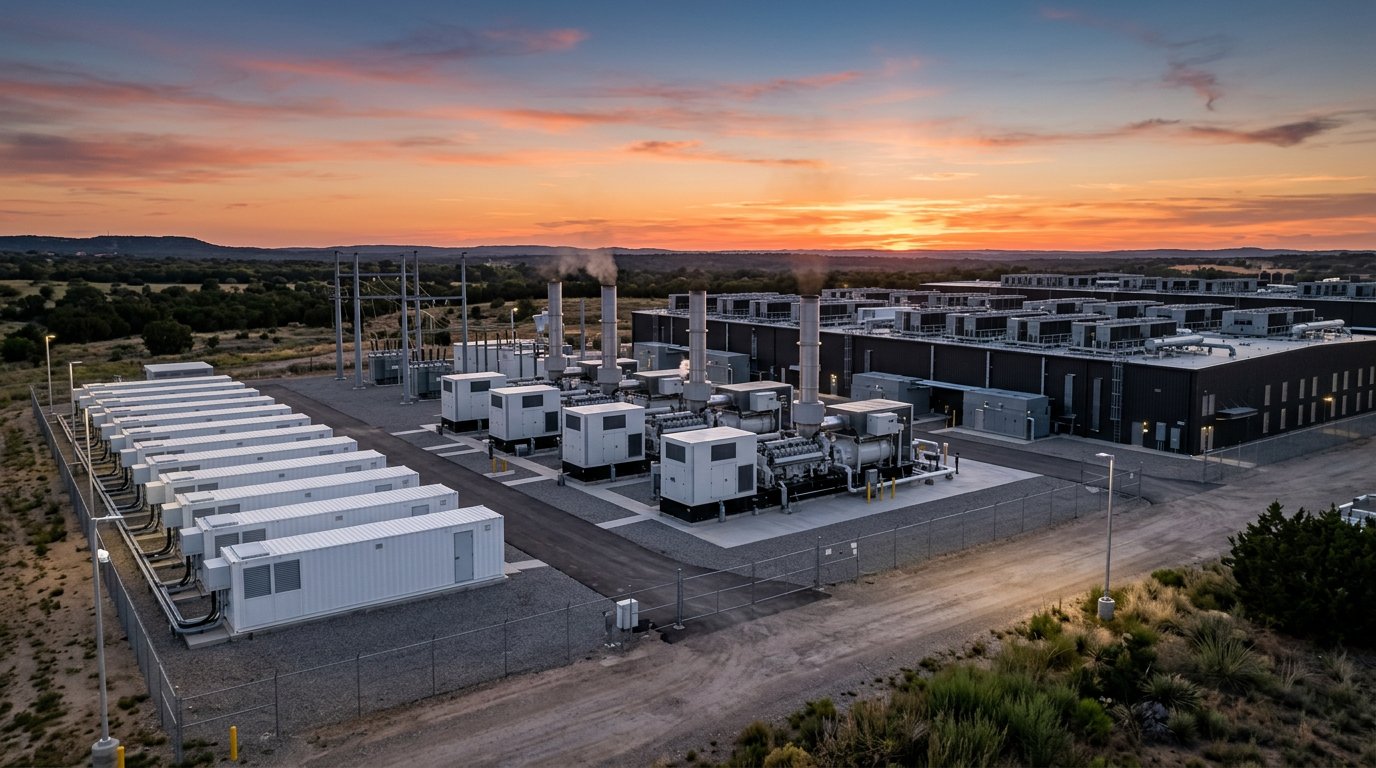
Data center developers have a timing problem. AI demand is arriving faster than grid connections, and waiting years for an interconnection is not an option for many projects. On November 19, 2026, Trina Storage unveiled a possible bridge: Elementa Hybrid Genset, a modular power plant that pairs gas generation with battery storage and a shared controller.
The launch took place at RE+ 2026 in Las Vegas, and the details below come from Trina Storage’s press release. The company says it follows a preview at Data Center World Power in September 2026.
The problem it targets
Trina Storage says AI workloads can cause rapid and substantial swings in power demand that gas generators alone may struggle to follow. Batteries react quickly to those swings, but they are not designed to carry a site through long outages on their own. The Elementa Hybrid Genset is built around that division of labor: engines for sustained power, batteries for speed.
Three building blocks
The system combines three main parts. Gas generation provides sustained power, using reciprocating engines rated up to 2.5 MW in modular configurations. Trina Storage acts as system integrator, while qualified turbine partners supply the generation equipment.
The second part is the Elementa plus Electra cell-to-grid solution, which provides fast power response and grid-forming capability. Reference configurations are based on 5 MW and 10 MW building blocks. The third is a hybrid plant controller that coordinates every source in real time, with a control architecture the company says can scale from 5 MW to 1 GW.
How the controls work
Trina Storage highlights three control technologies. Load Transient Sensing lets the plant controller predict changes in demand and trigger a rapid battery response before slower sources can adjust. Hybrid Power Coordination has the battery respond instantly to sudden load increases while the gas generators ramp up gradually, then rebalances as demand settles.
The third, Fault Isolation and Resilient Power Supply, identifies and isolates affected equipment after a fault, while the battery and remaining generators support critical loads and help restore power across the site. The company notes that the exact operating strategy depends on each project’s configuration.
Four scenarios, two architectures
Trina Storage lists four reference scenarios: grid-connected with backup generation, grid-constrained, bridge-to-grid, and off-grid. Solar PV can be added where appropriate. Two architectures are offered. Load Sensing prioritizes cost efficiency and system performance, while Double Conversion provides full electrical isolation and enhanced power quality. The right choice depends on the IT load profile and grid conditions.
Still in validation
The release is candid that development continues. Trina Storage says it is validating the system through simulation, hardware-in-the-loop testing and an integrated validation platform that uses real generation, conversion and storage equipment. Testing of grid-forming functionality and hybrid control strategies, along with certification activities, remain ongoing, and final specifications will be set per project. The company says it is engaging with data center developers and partners on project-specific configurations.
What it means
The announcement reflects a broader shift: for some AI campuses, on-site generation is becoming the first power source rather than the backup. Pairing gas with batteries is an attempt to get both stability and speed without waiting on the grid. Vice President Eric Cao framed it as bringing gas, storage and hybrid controls together in one architecture, designed to coordinate resources around project needs.
Because gas generation is central to the design, buyers will weigh emissions, permitting and fuel supply alongside performance. And since validation and certification are unfinished, no performance figures, pricing or delivery dates have been published.
Conclusion
Elementa Hybrid Genset is best seen as a preview of how storage vendors want to sit inside data center power plants, not just beside them. The next milestones to watch are completed grid-forming tests, certifications and the first named customer projects.