
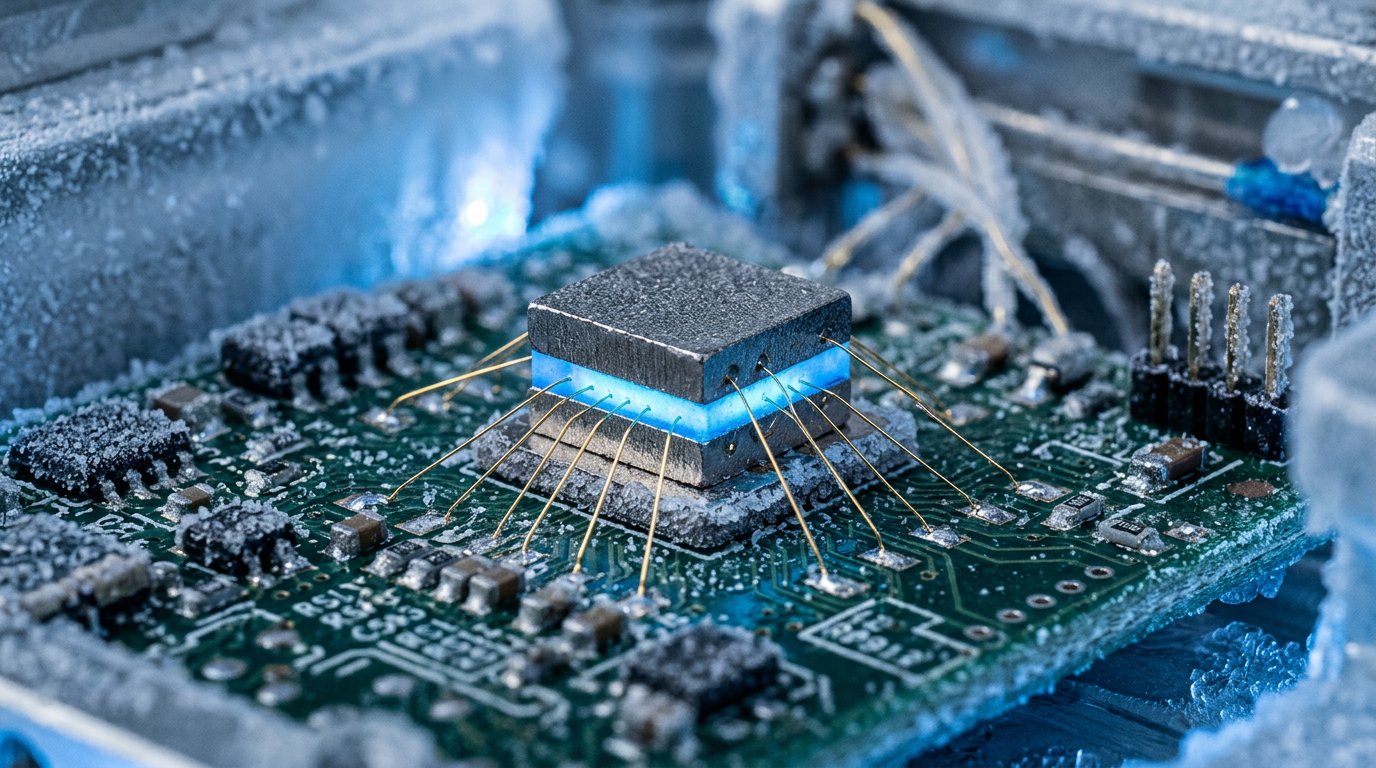
Computers are hungry. Data centers, supercomputers and AI clusters keep asking for more power, more capacity and more speed, and a big part of the challenge is simply feeding processors with data fast enough. This week, researchers at the MIT Plasma Science and Fusion Center (PSFC) described a tiny device that tackles one corner of that problem: a layered “sandwich” that can remember a bit of information and also steer electrical signals, in a form meant for superconducting computers.
According to MIT News, published November 20, 2026, the work appears in Physical Review Letters and comes from senior research scientist Jagadeesh Moodera, first author and postdoc Josep Ingla-Aynés, and colleagues. It is early-stage lab research, but the idea is worth understanding.
Why memory is the bottleneck
RAM is a computer’s working space. It keeps the information needed for current tasks close at hand, and without enough of it a machine slows down while it fetches data from slower storage. Familiar RAM is volatile, so its contents vanish when power is cut. Nonvolatile memory, like the kind in a flash drive, keeps data without power, but MIT notes the trade-offs: flash is slower to write than conventional RAM and wears out after repeated writing and erasing.
Researchers have been exploring superconducting computers as a path to faster, cooler processing. Superconductors, when cold enough, show no electrical resistance, so in theory they can process information quickly while emitting far less heat. But a processor is only as good as the memory feeding it, and fast, high-capacity memory that also works at the extremely low temperatures superconducting machines need has been hard to build.
How the sandwich works
The PSFC device is an ultrathin superconducting film placed between two magnetic layers. The magnets determine whether the film’s superconductivity is switched on or off. At the memory cell’s operating temperature, whether current can pass through or not lets a computer read the cell as a 0 or a 1.
Writing a bit means changing the magnetic alignment of the layers. If the magnetization points in opposite directions, current can pass; if it points the same way, the film becomes resistive. The team changes the alignment with a small magnetic field plus an electrical pulse that briefly heats the selected cell, making its magnetization easier to switch. Once set, the alignment stays put without a continuing pulse or field, so each cell remembers on its own. MIT says it takes less energy to change that alignment than to encode a bit in traditional semiconductor cells.
The device still has to stay extremely cold to operate, but each bit does not need a continuous electrical supply to hold its state.
Switching one cell at a time, and a diode too
A memory only becomes useful if you can rewrite one bit without disturbing its neighbors. The researchers showed they could switch a single cell without changing the state of a neighboring cell. “Any useful memory must have the ability to change one bit without disturbing all the information around it,” Ingla-Aynés said, calling the result an important step toward a practical memory technology.
The sandwich has a second talent. At a lower temperature, the same structure acts as a superconducting diode. Within a certain range of currents, it lets current flow without resistance in one direction while resisting it in the other. Changing the magnetic alignment can reverse the preferred direction or create a resistive “off” state. Those settings could be used to direct or block the electrical pulses that carry information through superconducting circuits.
What it means
Having memory and signal control in the same layered structure opens the door to combining both on one superconducting chip. MIT says that could make superconducting computers a practical, energy-efficient alternative for energy-intensive work such as AI. Moodera put it this way: integrating these devices could lead to processors operating at high speed and low energy, and the work addresses the current lack of suitable cryogenic memory and control components.
Quantum computing is a possible beneficiary too, with a caveat. These devices store regular bits, not qubits. But both quantum and conventional computers need reliable ways to hold information and move signals, and MIT suggests the devices could supply memory and signal control for the supporting electronics around quantum machines. Placing them near the cryogenic systems could help reduce heat and electromagnetic interference that can disturb fragile qubits.
It is important to keep expectations realistic. The work demonstrates an individually switchable, nonvolatile memory cell as a potential building block. The next challenges named by the team are making the devices smaller, combining them into arrays that store large amounts of information, and quantifying how much energy a system built from them would actually save. Those numbers are not yet available, so claims of dramatic efficiency gains remain a goal rather than a result.
Practical takeaways
For readers following computing hardware, this is a research milestone, not a product. Watch for array-scale demonstrations and measured energy comparisons, which will show whether cryogenic memory can keep pace with the processors it is meant to serve. For infrastructure planners, the long-term story is the same one driving many chip projects: moving more computation per unit of energy.
Bottom line
A superconducting film between two magnets can store a bit without constant power and also act as a programmable diode. MIT’s PSFC team has shown single-cell switching, and the road ahead is shrinking the cells and building arrays. It is a small sandwich with a big ambition: memory that belongs in the cold world of superconducting computers.