
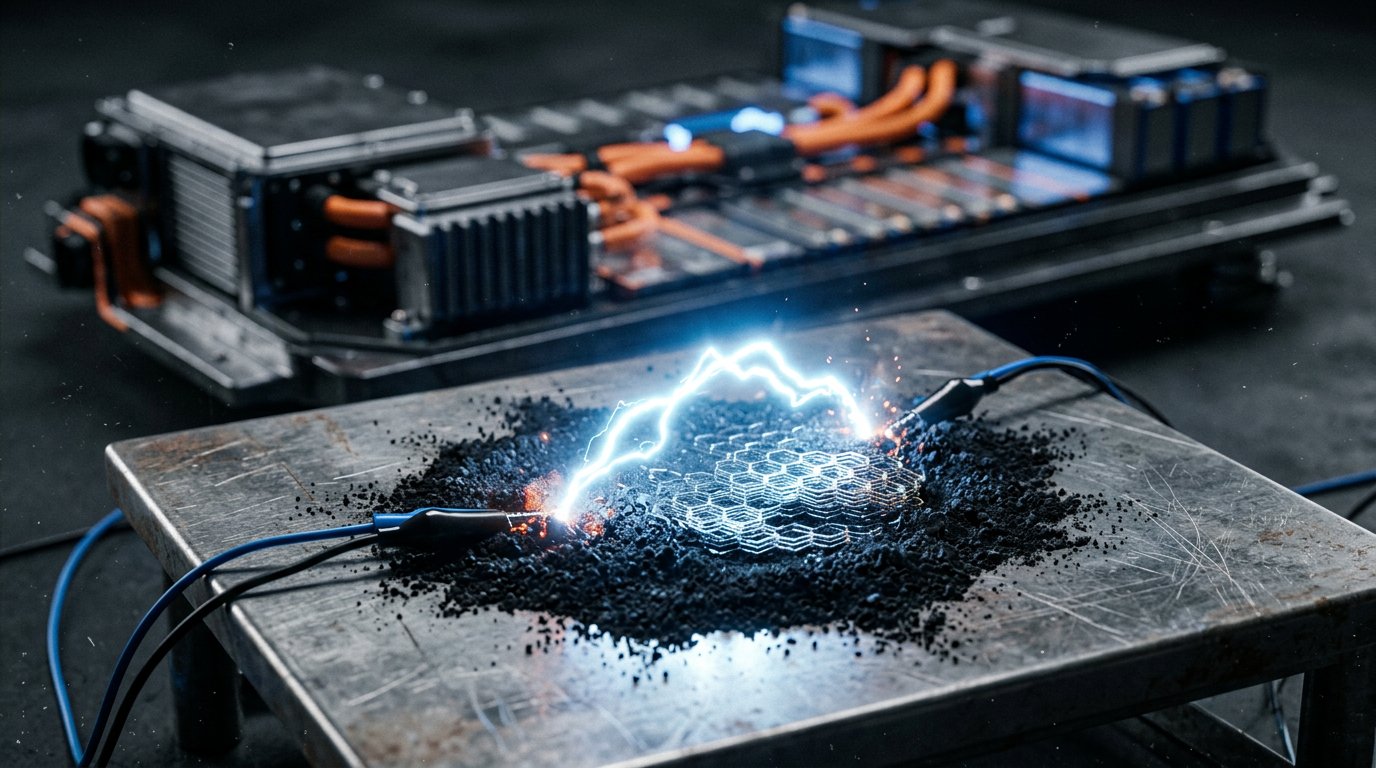
Charging an electric vehicle is still slower than filling a tank, and part of the reason sits inside the battery’s anode, where lithium ions have to squeeze into layers of graphite. A Rice University team says it has found a way to build a better graphite in a fraction of a second, and early cell tests point to a four-minute charging rate.
The work comes from the lab of chemist James Tour and was described in a Rice University news release on November 23, 2026. The study appeared in the journal Advanced Materials.
Why graphite limits fast charging
Most lithium-ion batteries, in cars, phones and cameras, use graphite anodes. When the battery charges, lithium ions move into the graphite. Rice notes that how quickly those ions can travel through the graphite is one of the key factors that limits how fast a battery can charge.
Graphite is built from stacked, one-atom-thick layers of carbon atoms arranged in hexagons. Making a highly ordered version usually takes long heating at extreme temperatures, which costs energy and adds to the environmental footprint of battery manufacturing.
A nickel helper and a half-second pulse
The Rice method starts with petroleum coke, a low-cost carbon residue left over from oil refining. The team mixes in a small amount of a nickel compound, then applies a single, extremely short and powerful electrical pulse. The mixture briefly reaches about 2,500 C and turns into graphite in roughly two-tenths of a second.
First author Haojie Zhu, a postdoctoral associate, described the nickel as a temporary construction worker that helps carbon atoms organize themselves into an ordered, layered structure. The nickel also slightly widens the spacing between the layers, which gives lithium easier access during charging.
What the battery tests showed
When the researchers tested the nickel-formed graphite in a lithium-ion battery, it clearly outperformed conventional graphite for charging. It tolerated a rate equivalent to a four-minute charge, and it kept 80% of its capacity after 1,000 full charge and discharge cycles.
One finding stands out: the benefit stayed even after more than 99% of the leftover nickel was removed. That suggests the advantage comes from how nickel helps build the graphite structure, not from nickel remaining in the finished material. The team also found a sweet spot for temperature. Pushing the heat too high drove off much of the nickel, while lower temperatures produced less ordered graphite. Tour called this the Goldilocks region.
The manufacturing angle
Tour said the team’s analysis suggests the process could cut energy use and greenhouse gas emissions by more than 80% compared with conventional graphite production. That figure is the researchers’ own estimate from their analysis, not a measured result from a factory line.
The release lists funding from the Air Force Office of Scientific Research, the U.S. Army Corps of Engineers, the Department of Energy’s NERSC program and the Welch Foundation. The research itself concerns battery materials.
What it means
Fast charging and lower-cost materials rarely arrive in the same package. This approach goes after both at once: a different anode material that accepts lithium faster, and a synthesis route that is quick and starts from an inexpensive refinery by-product.
The caveats are real. The reported results come from laboratory cells, and the release does not describe full-size automotive packs, production costs or a commercialization timeline. Cycle life of 80% after 1,000 cycles is encouraging for a lab result, but vehicle batteries are expected to last much longer. Battery makers would also need to show the pulse process can scale to the tonnage that anodes require.
Bottom line
Rice’s nickel-assisted flash graphite shows that better battery materials may come from smarter processing rather than longer, hotter processing. If it scales, it could help future EV batteries charge in minutes while trimming the footprint of making them.