
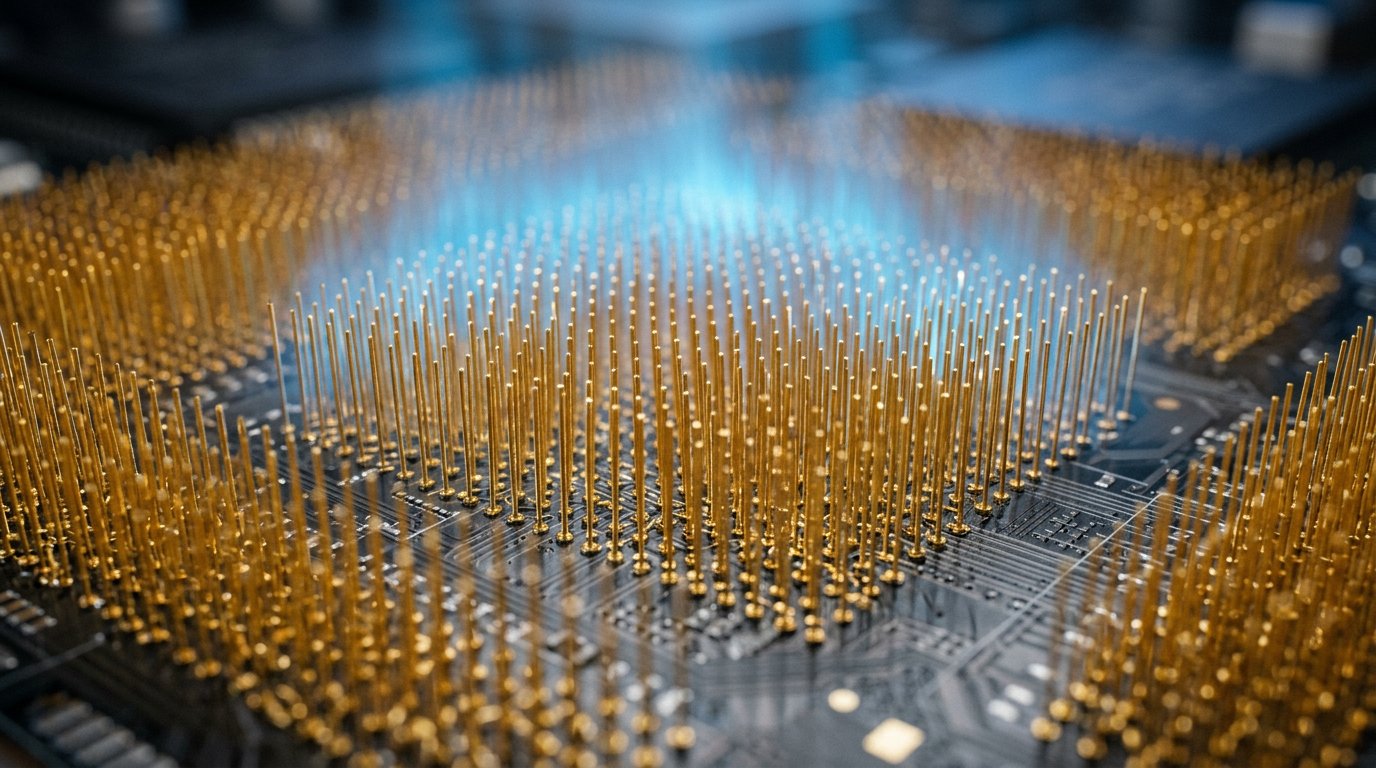
Every chip has a heat problem, and the usual fix creates a new one. Materials that carry heat well, like metals, also carry electricity, which is a risk when they sit between delicate circuits. Polymers are safe insulators but poor heat carriers. Cornell engineers now say they have found a way around that trade-off by growing what they call a “polymer fiber forest.”
What the researchers built
According to Cornell Chronicle, the work comes from the group of Zhiting Tian, a mechanical and aerospace engineering professor in the Cornell Duffield College of Engineering. The design uses thousands of microscopic polymer fibers standing upright, like trees in a dense woodland. Each fiber gives heat a direct path from a chip toward a cooling system, while the material around the fibers can be tuned to meet different mechanical needs.
The team used Zylon, a strong polymer fiber that conducts heat unusually well along its length. They packed bundles of fibers into a mold layer by layer, filled the gaps with a polymer, let it harden, and then rotated the block 90 degrees so the fibers pointed vertically. Because the block can be made in different sizes, the coverage area can be matched to a particular device.
Why aligned polymers matter
Polymers usually conduct heat poorly, but Tian explained that aligning their molecular chains can improve heat transfer dramatically. Her group’s earlier 2025 study stretched bulk polymer bars to line up those chains. Those bars, though, had cross sections of about a square millimeter, which limited the area available for moving heat. The forest idea multiplies the number of fibers, turning a strong single-fiber property into something large enough to be useful in a real device.
This matters most for thermal interface materials, the pads and pastes that fill tiny gaps between chips, heat spreaders and heat sinks. Those surfaces are never perfectly smooth, so the material has to make good contact while still moving heat quickly.
The numbers from the lab
The researchers tested two versions. One surrounded the fibers with epoxy and reached a thermal conductivity of 16.8 watts per meter-kelvin. The other used PDMS, a softer, silicone-like polymer, and reached 12.0 watts per meter-kelvin. The PDMS version was considerably softer, showing that stiffness can be adjusted without giving up the basic heat-moving structure.
In a laboratory rig that simulated heat flowing from a chip to a heat sink, at a heating power of roughly 1.2 watts, the epoxy-based forest kept the heated surface 17 degrees Celsius cooler than a commercial ceramic-filled silicone thermal pad. That is a 25 percent drop in temperature. These are bench results, not data from a finished product.
What it means
As AI accelerators and dense servers push more watts through smaller spaces, the thin layers between a chip and its cooler have become a real bottleneck. A material that is both a good heat conductor and an electrical insulator could simplify designs that now rely on compromises. The softer PDMS variant hints at options for places where a rigid pad would stress components.
Tian noted that the significance goes beyond the specific polymers tested. The forest architecture could accommodate other heat-conducting fibers and surrounding materials, so engineers could tailor it for different uses. The paper, “Polymer Fiber Forest: A Scalable and Tunable Platform for Advanced Thermal Interface Materials,” appeared November 14 in a special anniversary issue of Materials Today Physics. The study was supported by the Semiconductor Research Corporation and the Defense Advanced Research Projects Agency, and used Cornell’s shared materials facility.
It remains to be seen how the material holds up over thousands of heating cycles, how much it costs to make at volume, and how it compares with established pads in full systems. The Cornell announcement does not address those questions.
Conclusion
The polymer fiber forest turns a long-known property of aligned polymers into a scalable, tunable layer for cooling electronics. It is early, but a 17 degree improvement over a commercial pad in the lab is a result thermal engineers will watch.