
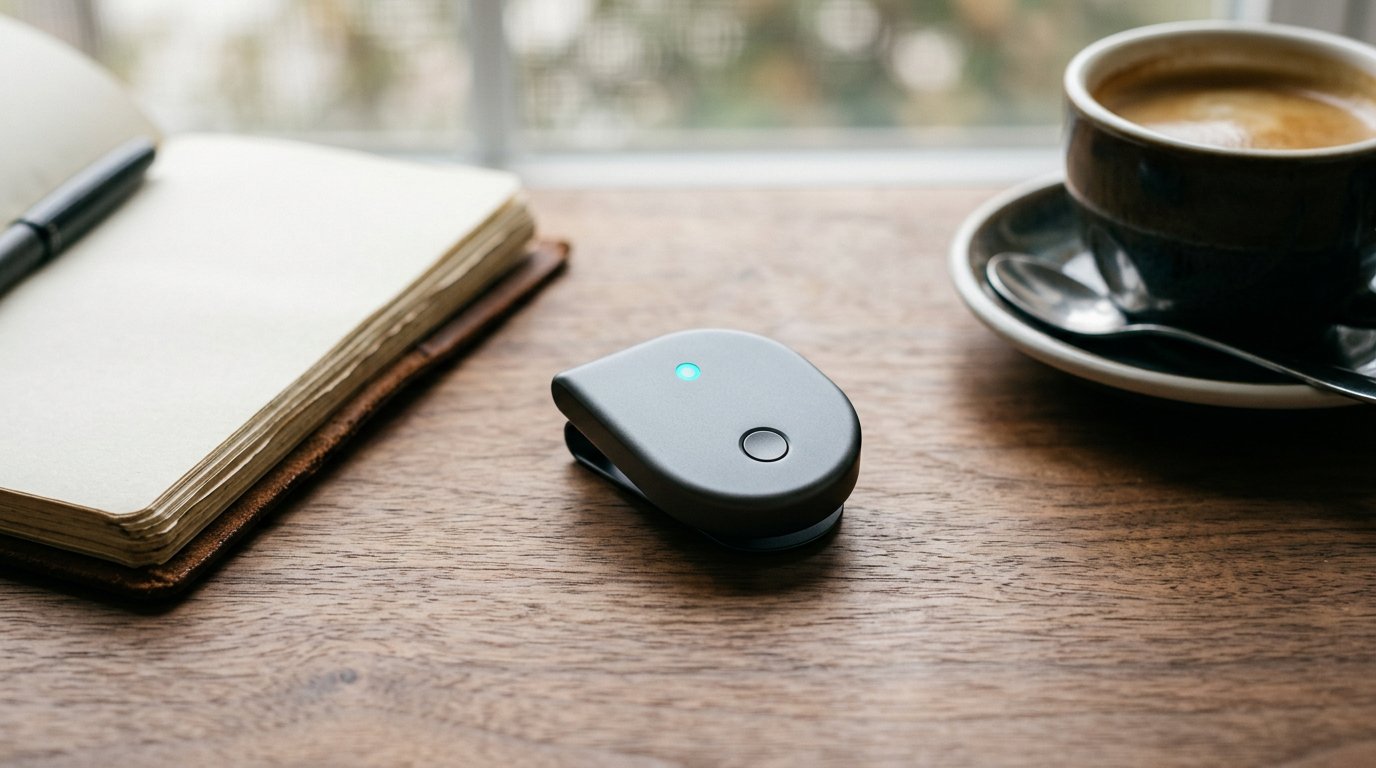
Most of what we promise in conversation never makes it into a to-do list. A new wearable from Yandex is built around that gap. On November 24, 2026, the company announced Yandex Pin, a small device you clip to your clothes or wear around your neck that listens when you tell it to, writes up what was said and then helps you act on it.
According to Yandex’s own announcement, the device is built in-house and powered by its Alice AI assistant. It is aimed at entrepreneurs, managers, content creators and anyone with a lot to keep track of. Here is what the company says it does, how it handles recordings and what it costs.
From a conversation to a task list
The core idea is simple. While you talk, a transcript appears live in the Alice AI app. When the conversation ends, the app produces a summary of what the participants agreed on and what is still unresolved. Alice AI then picks out tasks that belong to the user, offers to add them to a to-do list and reminds the user later about what is due and when.
In the evening, the system assembles a recap of the day with key events, new tasks, highlights and plans for tomorrow. Instead of scrolling through transcripts, you can also ask questions in the Yandex Pin section of the app. Yandex gives examples such as “What did I promise to do right after my vacation?” or “What medication did the vet prescribe for my cat?” The pitch is less time and mental effort spent digging for something said days ago.
Voice commands for an AI agent
Yandex Pin also works as a remote control for the company’s Do it! AI agent. An owner presses the button on the device and says what they need, for example booking a child’s haircut, drafting a contract or finding tickets to a play a coworker mentioned at lunch. Yandex says users do not have to repeat the details, because the agent retrieves them from earlier transcripts. It completes the task and sends the result to the Alice AI chat.
This is the part that separates the product from a plain voice recorder. The recording is the input, and the agent is the output. Whether the agent handles real-world errands as smoothly as the announcement example suggests will only be clear once people use it, but the design shows where wearable assistants are heading.
Recording controls and data handling
A device that listens raises obvious privacy questions, and the announcement addresses several. An indicator light stays on for the whole time the device is recording, so people nearby can see that it is active. Recording starts only when the user presses the button on the device, and Yandex states it cannot be switched on remotely.
Recordings are encrypted and stored on Yandex servers, or in the device’s memory when it is not connected to the app. They are tied to the owner’s account, so a lost Pin should not expose them to anyone else, and if someone tries to pair the device with a different account, the data stored on it is erased. Users can download or delete their data in the app, or delete it through their Yandex ID account. Anyone using a device like this in meetings should still tell the other people in the room, and follow the recording rules that apply where they live and work.
Hardware and the models behind it
Yandex Pin has three microphones, a speaker and a neural processor that separates speech from background noise. It has built-in memory for up to 32 hours of recordings and, thanks to a D-shaped battery that fills the available space, runs for 24 hours of continuous use according to Yandex. When there is no internet connection, the device saves audio to its internal memory and syncs later.
Several models work behind the scenes, according to the company. One analyzes the audio, counts how many people took part and works out who said what. Another detects where one meeting ends and the next begins. A third reviews each conversation in detail, identifying main points, summarizing outcomes, picking out the user’s tasks and noting which questions were resolved. Transcripts and summaries appear quickly because the device relies on new Yandex technology for real-time speech recognition.
Price and availability
Yandex Pin costs about $243, including all device features and 10 hours of recording a month. Heavier users can subscribe: a basic plan with 50 hours a month costs about $8, and an unlimited plan is about $14 a month. New owners get a free three-month trial with no recording limits. Yandex says the Pin will go on sale in Russia by the end of the year, and the announcement gives no timing for other markets.
It is the company’s second wearable with Alice AI, after the Yandex Drops earbuds. Yandex also plans to release an AI voice recorder next year that works with its Yandex 360 services.
What it means
Wearable AI is splitting into two camps: devices that show you things, like smart glasses, and devices that quietly listen and organize, like the Pin. The second kind competes with something every worker already has, a phone with a voice memo app. The bet is that a dedicated, always-ready button, a day’s worth of battery and an agent that can act on what it hears are worth a separate gadget and a subscription for heavy use.
For teams, the practical questions are consent, storage location and how summaries are checked for accuracy. Automatic summaries can miss nuance, so important decisions still deserve a human read-through.
Conclusion
Yandex Pin is a clear example of AI moving from chat windows into everyday objects. Its most interesting feature is not transcription but the hand-off from what you said to what gets done. Watch how Yandex handles privacy in practice and how soon the device reaches buyers outside Russia.