
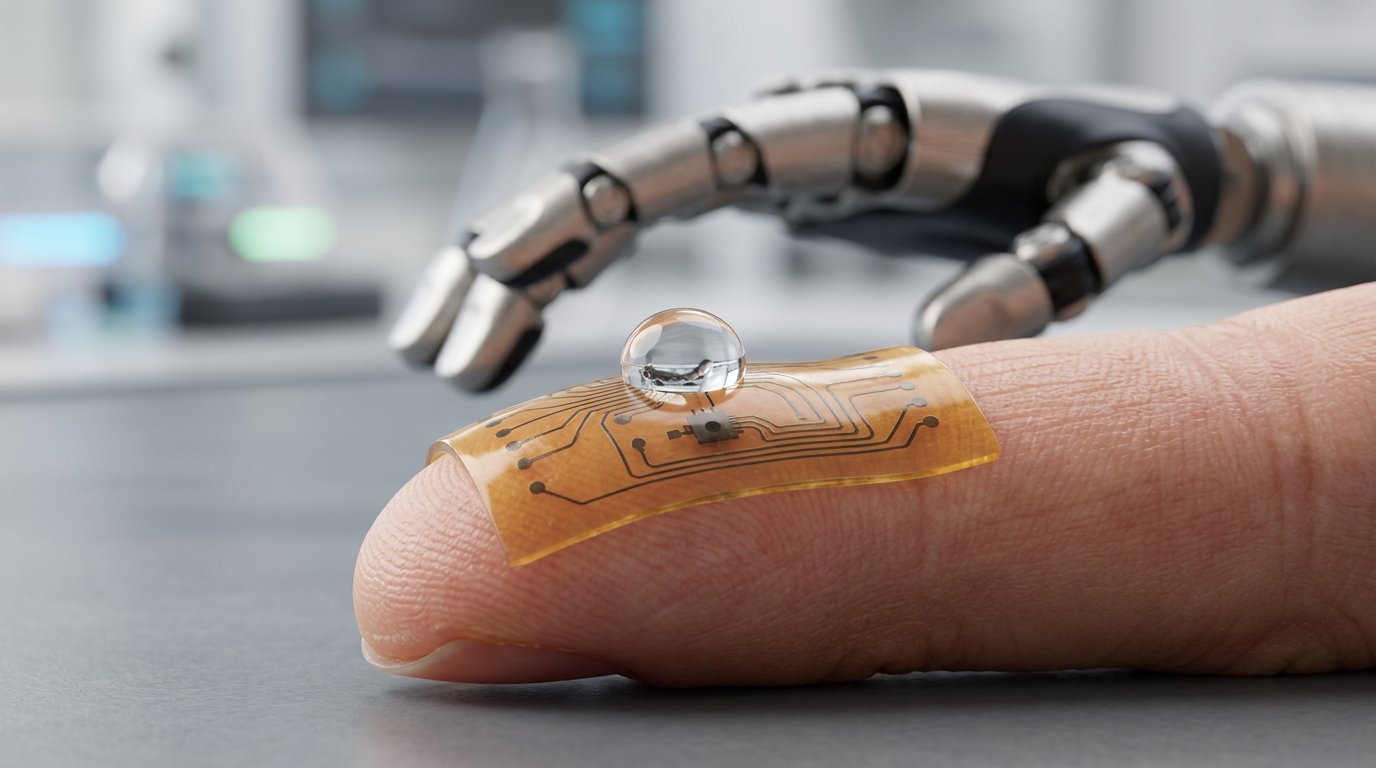
Most wearable sensors are built to last, which is part of the problem when they eventually end up in the bin. Researchers at Queen Mary University of London have taken a different route: a soft electronic patch made largely from gelatin and starch that sticks to skin with a drop of water. The team reports that it can sense movement, record electrical signals from the body and even steer a robotic hand.
The work was announced by the university’s School of Engineering and Materials Science on November 18, 2026, and described as a proof-of-concept that could inform the design of future wearable devices.
What the patch is made of
According to the Queen Mary news item, the e-patch has a soft gelatin base that carries a conductive pattern made from starch plus a small amount of MXene, a thin, electrically conductive material. The group led by Dimitrios Papageorgiou worked with collaborators at partner institutions.
The appeal of these ingredients is simple. Gelatin and starch are familiar, soft materials, and the title of the open-access paper describes the patch as degradable and skin-conformal. A small dose of MXene supplies the electrical conductivity that the soft materials lack.
No separate adhesive or gel
One practical detail stands out: a drop of water helps the patch stick to the skin, so it needs neither a separate adhesive nor a conductive gel. Many body-signal electrodes rely on sticky gels that dry out or irritate. A patch that holds on with water alone, if it proves out beyond the lab, would simplify how such sensors are applied.
What the lab tests showed
In laboratory testing, the researchers say the patch detected small movements and kept working over 10,000 mechanical cycles. They used it to track body movement and recognise hand gestures. In one demonstration, signals from patches placed on fingers were used to control a robotic hand wirelessly.
The team also used the patch to record electrical signals linked to heart activity, muscle activity and eye movement. The university says these demonstrations point to possible future uses in health monitoring, assistive technologies and human-machine interaction. These are early research demonstrations, not a clinical device, and the announcement makes no claims about medical use today.
Part of a larger research programme
The work forms part of NEED2D, an Engineering and Physical Sciences Research Council-funded Programme Grant exploring ultra-low-energy technologies based on two-dimensional materials. The research is published in Advanced Functional Materials under the title “Degradable, Skin-Conformal Nanocomposite-Based Bioelectronic Patches for High-Fidelity Electrophysiology and Gesture-Controlled Robotics,” and the paper is open access.
What it means
Wearables are multiplying, and so are the small electronic parts that become waste when a device is outgrown. A patch designed from the start to break down addresses that end-of-life question, at least in principle. Building the body of the device from food-grade-style materials such as gelatin and starch is a notable design choice for that reason.
The gesture-control demonstration is a reminder of why skin-level sensing matters for robotics too. Reading finger movements and muscle signals directly from the skin could offer another way to command prosthetics, assistive devices or remote robots.
The open questions are the usual ones for early materials research. The announcement does not say how quickly the patch degrades, how it performs over days of wear, or how it would be manufactured at scale. Those answers will decide whether the idea leaves the laboratory.
Conclusion
Queen Mary’s e-patch shows that conductive, skin-hugging electronics do not have to be permanent or sticky. With 10,000 flex cycles, gesture-controlled robotic-hand demos and body-signal recordings behind it, it is a promising proof of concept for a gentler kind of wearable.