
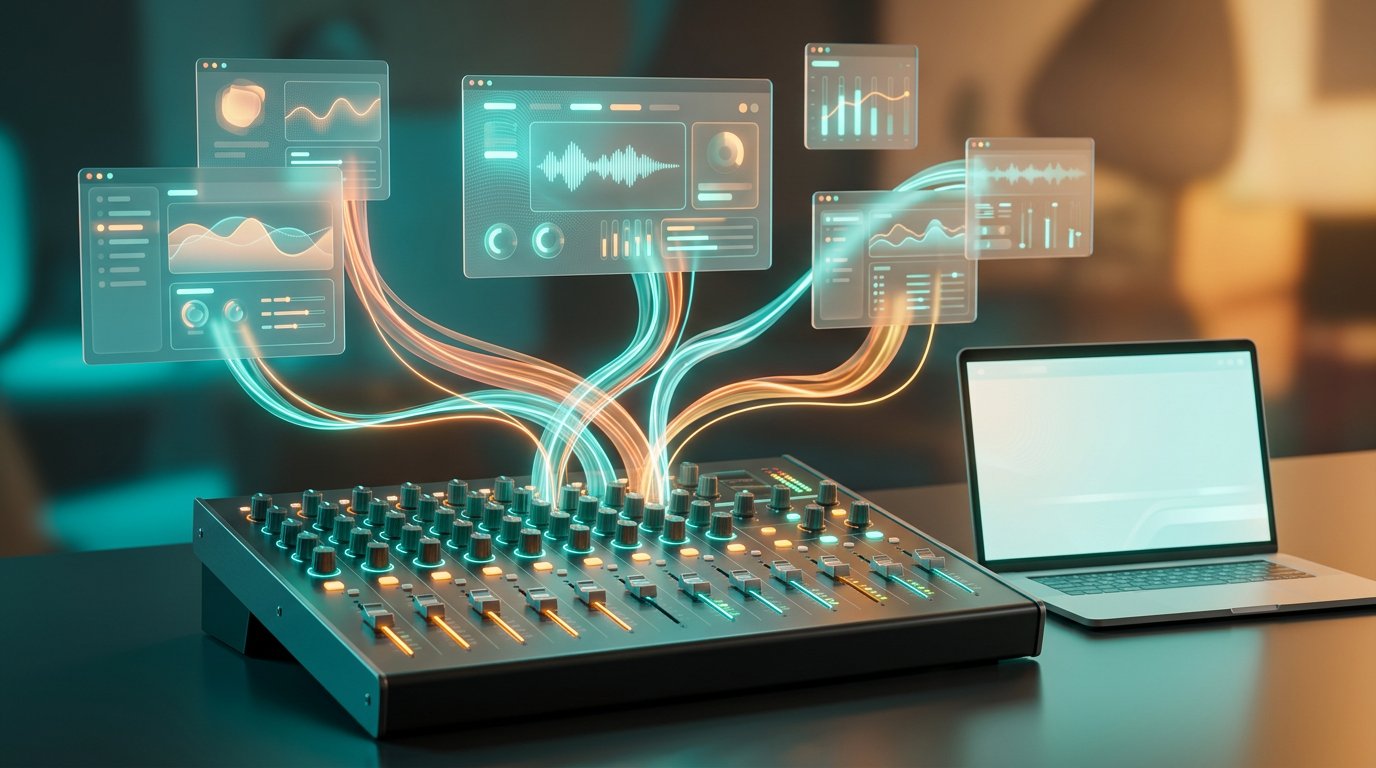
Physical buttons, knobs and sliders are easy to use without looking, and they let you adjust several things at once. The catch is that most are hard-wired to a single job. A new system from MIT, announced November 24, 2026, asks an AI agent to decide what a control should do based on the software in front of you.
What TangiMap does
The system, called TangiMap, was co-developed by Yunyi Zhu, a doctoral student in MIT’s Department of Electrical Engineering and Computer Science and a researcher at CSAIL, and Chang Xiao, an assistant professor at Boston University. According to MIT News, it personalizes the physical controls on everyday devices by mapping digital widgets onto tangible inputs. The idea is comparable to a DJ’s pads, which can switch between triggering cues, loops and samples.
How the agent works
TangiMap relies on an AI agent to gather context about the software you are using, your tendencies and the control device. The agent can draw on a program’s API, an MCP server (a standard that connects AI agents to apps), or a screenshot interpreted by a vision-language model. A large language model then compiles what it learned into a file that maps specific digital functions to physical controls.
The demos
The researchers turned a standard mixer into a photo-editing controller for Adobe Lightroom, with a matching on-screen visualization of the controls. They did the same with sound-mixing software so performers can adjust music live with knobs and faders. A simpler mixer was reprogrammed for the 3D program Blender: users typed a prompt to generate a model, then adjusted features such as shininess with physical controls. In Adobe Character Animator, specific expressions and movements were tied to buttons on a control pad so a cartoon character could be puppeteered live.
Zhu and Xiao presented the work at the ACM Symposium on User Interface Software and Technology earlier this month. The work was supported in part by Google’s Gemini Academic Program Award.
Limits and next steps
The team built a custom user interface for each application. They hope to streamline that so a designer could generate the interface for a device just by taking a picture. They are also looking at ergonomics, since people hold a mixer differently when making music than when playing a game, and the best control spacing may differ. Zhu hopes to run a user study to learn whether this kind of smart DJing improves the experience.
What it means
TangiMap is research, not a product, and MIT does not describe a release date. Still, it points at a useful idea: instead of buying a different gadget for each creative tool, one generic controller could be reassigned by an agent as your task changes. Zhu says she would like to build physical items that use an AI agent as a brain to decide what to reprogram into, such as a chemical jar that could tell you whether it is sealed correctly, though she describes that versatility as a way off.
For software makers, the reliance on APIs and MCP servers is a reminder that exposing clean, well-documented hooks may matter more as agents start acting on apps.
Conclusion
By letting an AI agent translate between software and hardware, TangiMap brings back the eyes-free, multi-setting feel of physical controls without fixing them to one purpose. Watch for the promised user study and easier interface generation.