
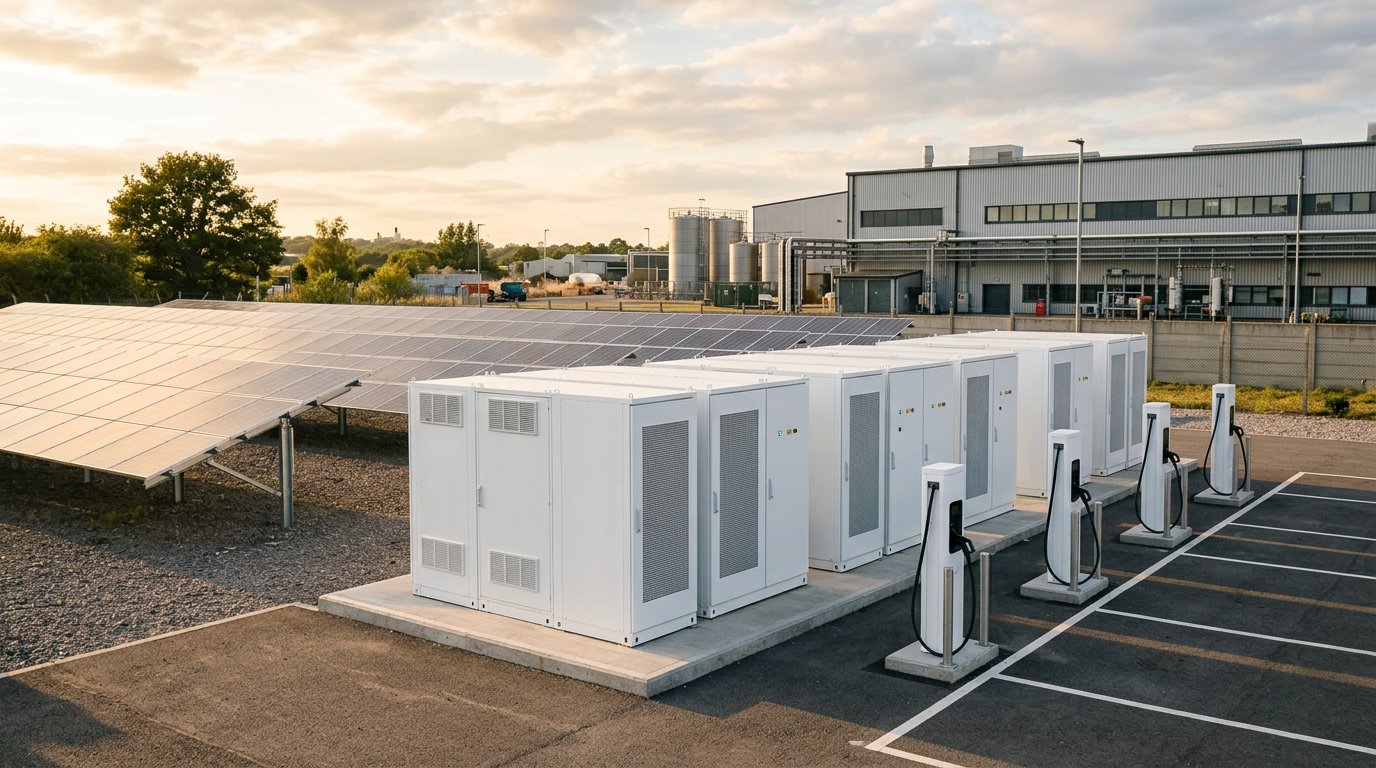
Commercial battery storage has a configuration problem. A factory that wants backup power needs one setup, a warehouse pairing storage with rooftop solar needs another, and a depot adding EV chargers needs a third. Each variation tends to mean more equipment, more wiring and more commissioning time. On November 11, 2026, Sungrow said it wants to change that with PowerStack 3.0, a commercial and industrial (C&I) storage series it describes as a move from “All-in-One” to “Scene-in-One” design.
The launch took place at the Global Energy Pioneer Summit 2026 in Hefei, China. Everything below comes from Sungrow’s own announcement, so the performance figures are the company’s claims rather than independent test results.
A dock with four swappable modules
The centerpiece is what Sungrow calls an industry-first multi-scenario dock. It takes four dedicated modules: a PCS (power conversion) module, a solar module, a charging module and a microgrid module. Instead of buying a different product for each use case, a project developer combines the modules the site needs.
Sungrow describes four typical set-ups. For standalone storage, combining PCS power modules in different ways lets one system switch between 2-hour and 4-hour discharge configurations, so fewer variants need to be stocked. With the solar module, the storage inverter also handles PV power, making the system DC-coupled with no separate solar inverter. Adding the charging module extends DC coupling across solar, storage and EV charging, which the company says cuts installation work and shortens project timelines. The microgrid module keeps critical loads running during outages, with what Sungrow calls a 0 ms switchover from grid-connected to off-grid operation and no separate static transfer switch cabinet.
An AI assistant across the project lifecycle
PowerStack 3.0 also integrates Bubbly, Sungrow’s proprietary AI assistant, positioned as support from planning through maintenance. The announcement lists four roles. A design agent combines satellite imagery with 3D modeling and, Sungrow says, produces a tailored proposal in 30 seconds, covering technical design, installation layout and financial calculations. For commissioning, Bubbly supports automated plant configuration and data validation, which the company says takes about 3 minutes and reduces manual checks and parameter errors.
During operation, Bubbly uses PV generation and load forecasts to coordinate self-consumption, demand control, arbitrage and frequency regulation. Sungrow says this optimized dispatch can raise returns by more than 12% compared with a basic self-consumption mode. A maintenance agent monitors the system around the clock, checks for more than 30 potential risks and, for a 10 MWh plant, can produce a fault diagnosis report with recommendations in about a minute.
Hardware: density, durability and efficiency
Beyond the architecture, Sungrow points to several hardware numbers. Energy density is up to 256 kWh per square meter, and up to 20 units can be paralleled. Units can be installed side by side, back to back or face to face. For a 5 MWh plant, the company says the footprint is 43% smaller than the previous generation.
The enclosure is rated IP55 for ingress protection and C5 for corrosion protection, with an operating range of -30 to 50 degrees Celsius and tolerance of up to 30% grid harmonics. A self-developed silicon carbide PCS reaches a maximum conversion efficiency of 99.2%. Combined with a 684 Ah stacked cell, Sungrow reports a round-trip efficiency above 92%. On safety, it cites a simplified architecture with fewer potential points of failure, three-level fuse protection and a four-layer fire safety design.
What it means
The interesting shift is in how the product is organized. Storage vendors have long competed on cell chemistry and headline capacity. Here the pitch is about the cost of everything around the battery: stocking fewer variants, skipping extra inverters and switchgear, and trimming the engineering hours spent on design and commissioning. For commercial buyers, those soft costs can matter as much as the price of the cells.
The AI layer is also telling. Design proposals in seconds and commissioning in minutes target the slow, manual steps that hold back many C&I projects. Buyers should still ask how those figures hold up on real sites, since a 30-second proposal is a starting point rather than a finished engineering package.
Finally, the combined solar, storage and charging approach reflects where commercial sites are heading. Facilities increasingly want to generate, store and use power on site, and a modular dock lets them add capabilities over time instead of replacing equipment.
Conclusion
PowerStack 3.0 is a bet that flexibility, not just capacity, will define the next generation of commercial storage. The claims are Sungrow’s own, so field results and independent verification will tell the real story. For now, it is a useful snapshot of how storage makers are folding power electronics and AI into a single platform.