
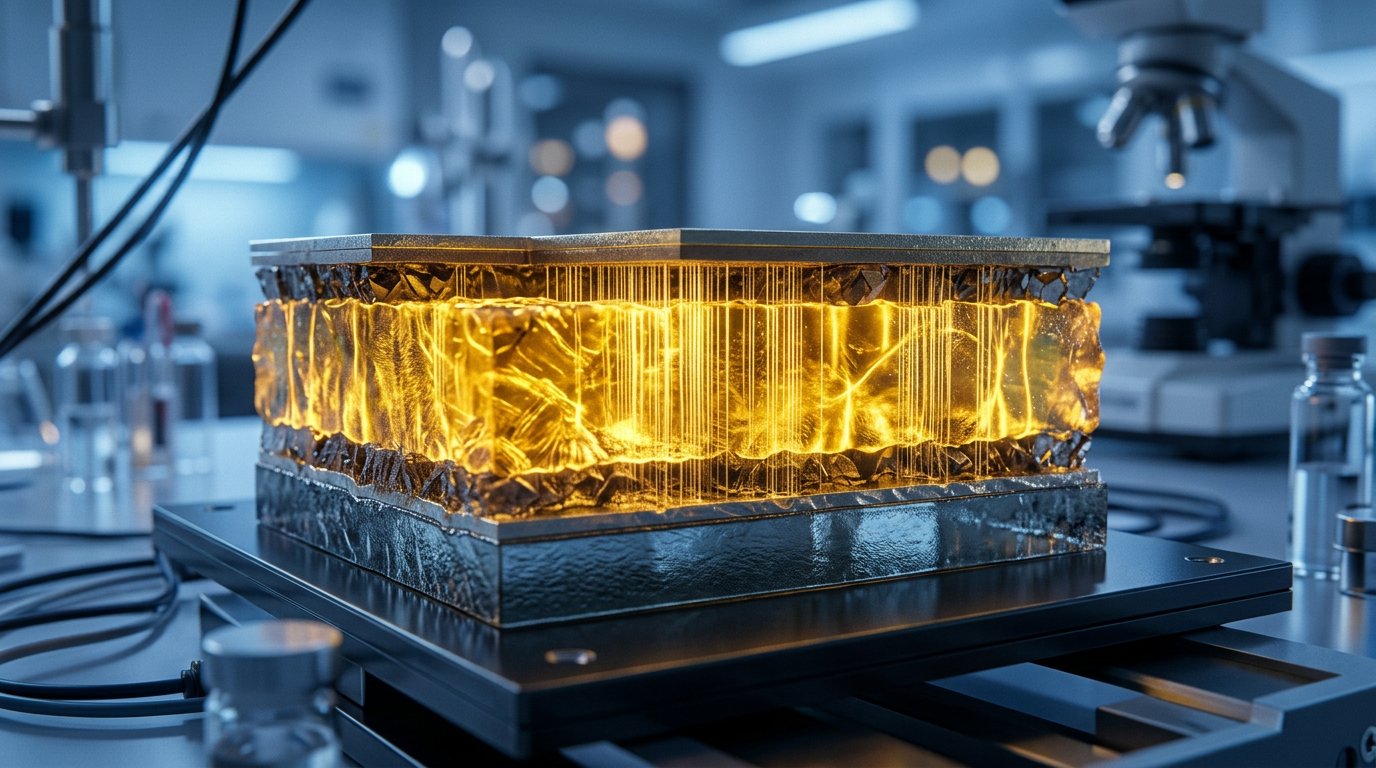
Perovskite solar cells have a reputation problem: they are cheap to make and efficient in the lab, yet they tend to wear out too fast. A research team at the Hong Kong University of Science and Technology (HKUST) now says a big part of the answer is mechanical. Their fix, called Trans-Interface Engineering (TIE), literally stitches the cell’s layers together at the molecular level.
The work was published in Nature Photonics and featured on the cover of the journal’s November 2026 issue (Volume 20, Issue 11), according to HKUST’s announcement on November 25, 2026.
The problem: layers that come apart
Perovskite solar cells are widely seen as a promising photovoltaic technology because of low-cost solution processing and flexible manufacturing. HKUST notes that lab-scale cells have already passed 27% power conversion efficiency. The barrier is long-term operational stability.
During extended operation and thermal cycling, the thin layers inside the cell can delaminate or crack at their interfaces, which speeds up degradation. Common approaches add interfacial layers to passivate defects and improve adhesion. The university says these often force a trade-off between charge transport and stability, and they do not fundamentally resolve the mechanical failure.
How Trans-Interface Engineering works
Instead of a flat, passive interlayer, the HKUST team uses vertically penetrating nano-links. They added distinct polymerizable monomers into both the perovskite layer and the electron-transport layer, then triggered thermally induced free-radical copolymerization.
The result is a network of vertically aligned, covalently bonded links that run across and within both layers. Conventional designs lean on weaker interactions such as coordination or hydrogen bonds. According to the researchers, the covalent nano-links can withstand the mechanical stress that builds up while a device runs, and they also help charge transport.
Prof. Zhou Yuanyuan, Acting Head of the Department of Materials and the study’s sole corresponding author, compared older methods to a Band-Aid. TIE, he said, is more like stitching the layers together.
What the tests showed
HKUST reports these results for TIE devices:
- Power conversion efficiency of 27.04% (26.67% certified) and an open-circuit voltage of 1.220 V.
- A nearly threefold increase in interfacial toughness.
- Maximum-power-point stability tests on more than 50 devices: 92% of TIE devices held stable performance for over 1,400 hours.
- Control devices varied widely, with lifetimes from a few dozen hours to over 1,800 hours.
- Better stability and reproducibility under accelerated aging at 85 °C and 85% relative humidity.
The consistency matters as much as the peak. A process that gives similar lifetimes from device to device is far easier to move toward manufacturing than one that occasionally produces a long-lived outlier.
What it means
For solar developers, the study reframes stability as partly a structural-engineering problem, not only a chemistry one. If layers stay bonded through heating and cooling cycles, one major failure path closes. The team says it validated TIE across different perovskite compositions, charge-transport materials and device architectures, and co-first author Yu Wenjian said this points to broad applicability. Co-first author Dr. Guo Pengfei added that the approach opens a new route for interface design in other multilayer optoelectronic devices.
It is still early. These are laboratory devices, and the announcement does not claim field lifetimes or commercial products. HKUST says it has filed a patent and secured support from China Merchants Group to advance commercialization.
Conclusion
TIE does not chase a new efficiency record so much as keep an already efficient cell from tearing itself apart. If the stitching approach holds up at larger scale and longer durations, it could help perovskites move closer to the rooftop and the factory floor.