
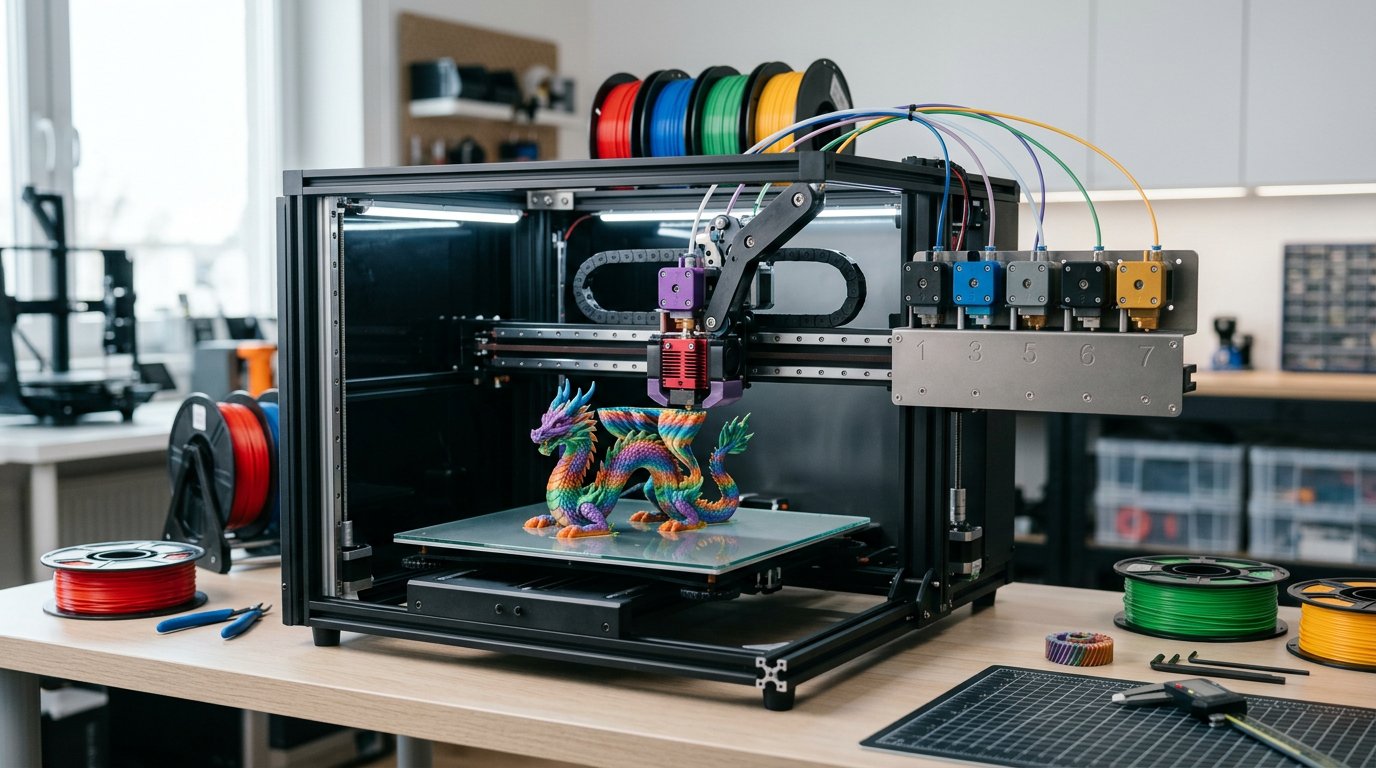
Multi-material 3D printing has long come with a catch: every color or material change means waiting, purging filament and hoping nothing jams. On November 24, 2026, Bambu Lab announced a printer that tries to make that wait nearly disappear. In its launch release, the company introduced the Bambu Lab P3C, a third-generation machine built around a seven-slot tool changer called Swaptek, with a suggested retail price of $1,149 excluding tax.
Bambu Lab describes the P3C as taking the engineering of its flagship H3C and packaging it at a more approachable price. Here is what the company says is inside, and what it could mean for people who print for a living or for fun.
A tool changer in a desktop frame
The headline feature is the Swaptek 7-Tool Changing System. Instead of one print head that pulls different filaments through a single nozzle, the P3C carries up to seven independent PrintTools. Each tool has its own filament path, power and data connection. According to the release, the system reads ahead in the job, pre-heats the incoming nozzle and completes a material change in 6 seconds with minimal purge.
Five PrintTools come pre-installed, leaving two open slots for the tools a user wants most. Bambu Lab also says the same mount accepts a CutTool, DrawTool and DebossTool, plus future CraftTools, so one G-code file could cut, draw and emboss without manual swaps.
Filament storage and a flexible extruder
The printer integrates the AMS 3P, a sealed storage system for seven spools, each on an independent feed path. Bambu Lab says this frees desk space, reduces filament clutter and keeps material dry even in humid rooms. An optional two-slot 75 °C drying module is offered for moisture-sensitive filaments such as TPU and PETG. For larger jobs, an optional buffer on PrintTool No. 1 can connect up to four external AMS units, enabling up to 22 colors.
The dual-diameter FlexFeed extruder accepts both 1.75 mm and 2.85 mm filament. The thicker filament lets the machine print soft TPU, down to 75A hardness, at up to five times the flow rate, which the company says reduces jams and speeds up flexible-material prints. Users can also mix hardened-steel nozzle sizes of 0.2, 0.4, 0.6 and 0.8 mm in a single job, using a large nozzle for bulk fill and a fine one for detail.
What it could print
Bambu Lab points to four example uses:
- Full-color figurines: fast tool changes make five-color CMYKW mixing practical, so a detailed figure can print in one piece without gluing parts.
- Multi-flex wearables: ultra-soft TPU combined with firmer structural material in one part, for items like shoes and bags.
- Speed-and-detail hybrids: a watch printed in one job with a fine dial, a carbon-fiber-reinforced body and a soft strap.
- One machine, many skills: cutting, drawing and embossing from the same file.
The company adds that model files and print profiles for the H3C and P3C are preconfigured in its MakerWorld library, so beginners can start printing multi-material designs without CAD skills.
Automation and workspace extras
The release lists several features meant to keep long multi-tool jobs reliable. Full-auto calibration aligns the tool changer and nozzle offsets before printing. An AI vision system cross-checks the build chamber against slicer settings and, during a print, watches for problems such as spaghetti failures, purge-bin jams and nozzle clogs. An updated health management system explains errors in plain language, with step-by-step guidance on the touchscreen.
For the workspace, an optional Bambu Station raises the printer to a comfortable working height and adds storage, while the optional E1 Air Purifier filters VOCs, fine particles and micro-plastics once a print starts. Listed specifications include a 256 × 256 × 260 mm build volume, a 300 °C maximum nozzle temperature, a 110 °C heat bed, toolhead speed up to 1,400 mm/s and a built-in 1920 × 1080 live-view camera.
Price and availability
The P3C went on sale worldwide on November 24, 2026. The P3C AMS Combo, which includes the printer, AMS 3P and five 0.4 mm standard PrintTools, has a suggested retail price of $1,149 excluding tax with free shipping. Prices for other markets will be announced on Bambu Lab’s regional storefronts. Note that these figures and performance claims come from the company itself and have not been independently tested here.
What it means
Tool changers have mostly lived in higher-priced machines because of their mechanical complexity. If the P3C delivers the 6-second swaps and low purge waste Bambu Lab describes, the practical gain is less wasted filament and less time per multi-color part. That matters most to small studios, product designers and educators who want colorful or mixed-material prototypes without outsourcing them.
The soft-and-rigid printing angle is also notable: a single print that combines flexible and structural parts could cut assembly steps for wearables and fit-sensitive products. The real test will be independent reviews of print quality, reliability and running costs once units reach customers.
Conclusion
The P3C is Bambu Lab’s bid to make multi-tool 3D printing a mainstream desktop feature rather than a premium extra. With a seven-slot changer, integrated filament storage and an announced price of $1,149, it signals where consumer fabrication hardware is heading: faster changes, fewer manual steps and more automation.