
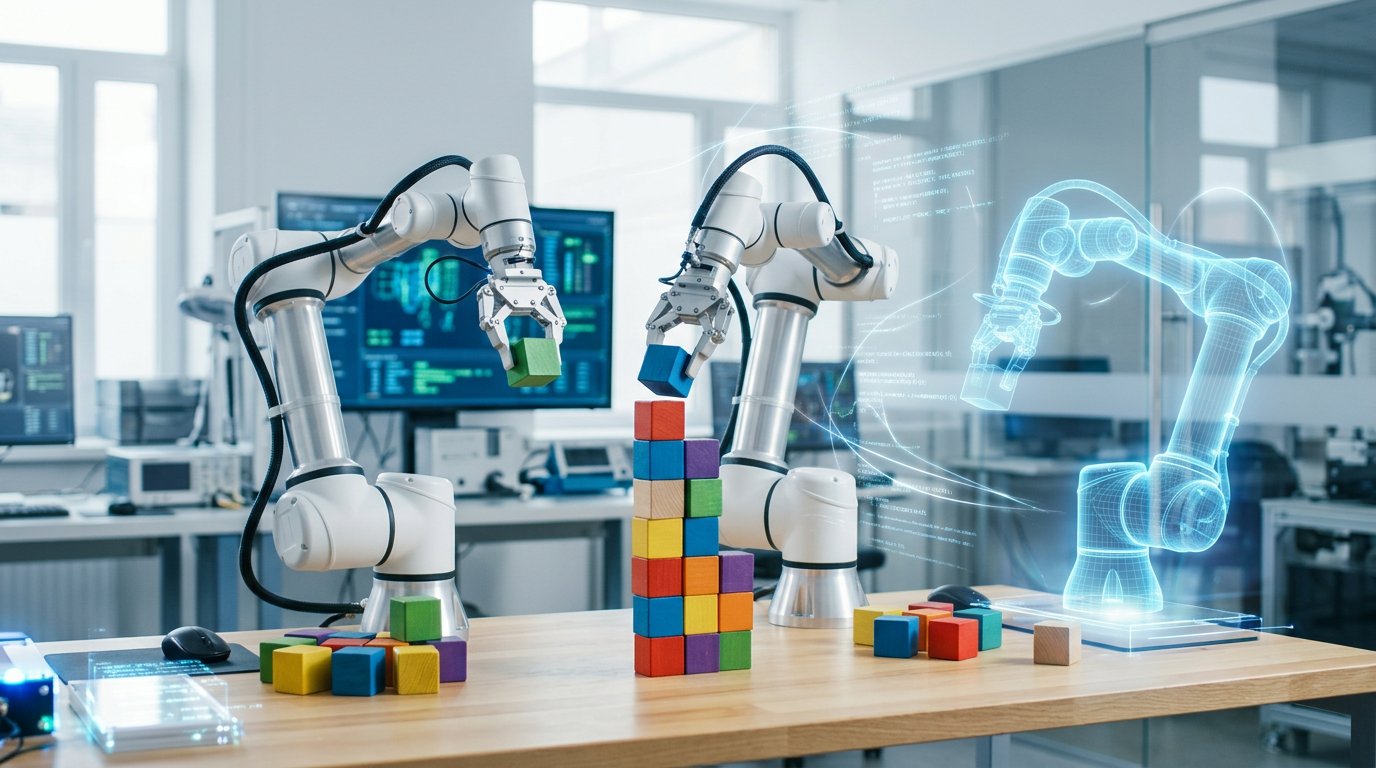
Teaching a robot arm to do something useful usually means collecting hours of demonstrations on that exact robot. SenseTime is testing a different route. On November 25, 2026, the company released the full version of SenseNova-RoboRSI-27B, an embodied AI model that learned its manipulation skills in simulation and then ran on two real robotic arms with the same weights and no real-robot training data, according to SenseTime’s announcement.
The results are early and small in scale, but the method behind them is worth a close look.
A model that chooses its own way to act
The earlier Preview version leaned mostly on predefined vision-language-action (VLA) skills. A VLA model looks at camera input and produces an action trajectory. The full release is given more freedom. Using one shared toolset, it decides when to call a VLA to generate a trajectory and when to write code that calculates a target position and drives the arm directly. It can also review its own plan and revise it after seeing how execution went.
SenseTime describes the two approaches as complementary. VLA suits fluid movements such as approaching an object dynamically or pouring continuously. “Code as Policy” suits tasks with explicit spatial constraints, such as stacking blocks, placing objects precisely or pressing number keys. In the full release, VLA accounts for 41.9% of executed environment steps and code for 58.1%, which the company offers as evidence that the model really does mix the two.
A stacking-bowls example shows how it plays out: the model first uses VLA to grasp a bowl, then switches to code to adjust the gripper position relative to the target before placing it. SenseTime also lists code-driven moves like orientation-aware grasping, pushing a T-shaped block sideways, aligning two corners of a garment hem with both arms, and lowering the end effector in stages into a hole.
Recursive self-improvement, in rounds
The training recipe is the other half of the story. The model and its execution framework, called the Harness, evolve together over several rounds of recursive self-improvement (RSI). In each round, a larger GPT-6 Astra teacher model runs tasks with the current toolset, uses the outcomes and feedback to find problems, and improves the Harness, which supplies the tools. Rejection sampling then keeps high-quality interaction trajectories, and the 27B model is fine-tuned on them with the updated tools.
SenseTime reports that updating the model and the Harness together worked better than updating either one alone. After three rounds, the average score on the RoboDojo simulation benchmark rose from 10.0 to 34.7, 3.47 times the Preview version. At 27 billion parameters, the model scored above the figure the RoboDojo team recorded for GPT-6-Astra, which SenseTime presents as a sign that complex manipulation might be possible at lower inference cost.
The team also tackled a known weakness: small models are imprecise at spatial localization. By deriving single-turn action supervision from existing open-source VLA training data and mixing it with long-horizon agent trajectories, the share of end-effector position predictions within 5 mm of the target rose from 4.3% to 15.5%, and the median error fell from 119.7 mm to 51.6 mm. Reusing existing data, the company says, substantially lowered the cost of building training sets.
From simulation to two real arms
The real-world test is the part that draws attention. SenseTime ran the same weights on a Piper X arm and a Piper arm, adapting only the observation, state and control interfaces. On Piper X, which combined VLA and code, the model stacked blocks successfully in 9 of 10 trials. On Piper, using code alone, it picked and placed a variety of objects in 6 of 10 trials. The Preview version managed 3 and 2 successes on the same tasks, and a control model with no robotics training failed both.
On hardware, the model can call spatial localization tools on its own, use views from several cameras to find a target, and relocate it during execution to correct course. If a trajectory proposed by the VLA conflicts with the localization results, it can reject the trajectory and write a new one before moving.
What it means
These are company-reported results on a handful of trials, so they should be read as a promising demonstration, not a settled benchmark. Still, three ideas stand out. First, mixing learned motion with generated code gives a robot a way to be precise where precision matters without needing a huge model. Second, training in simulation and transferring directly to hardware, if it holds up on more tasks, would cut one of the costliest parts of robotics development: collecting real demonstrations. Third, using a large teacher to improve the tools and then distilling the lessons into a smaller model points toward cheaper robot “brains” that can run closer to the machine.
SenseTime lists its next goals as multistep tasks that need progress tracking and recovery, testing on more robot types in open environments, and smaller open-source models that cut per-task cost and response time. The model weights are published on GitHub and Hugging Face for researchers who want to test the claims themselves.
Bottom line
RoboRSI-27B is a modest but concrete step toward robots that choose how to act instead of following a fixed skill list. The 9-in-10 block-stacking result, achieved with no real-robot training data, is the number to watch as others try to reproduce it on different arms and tasks.