
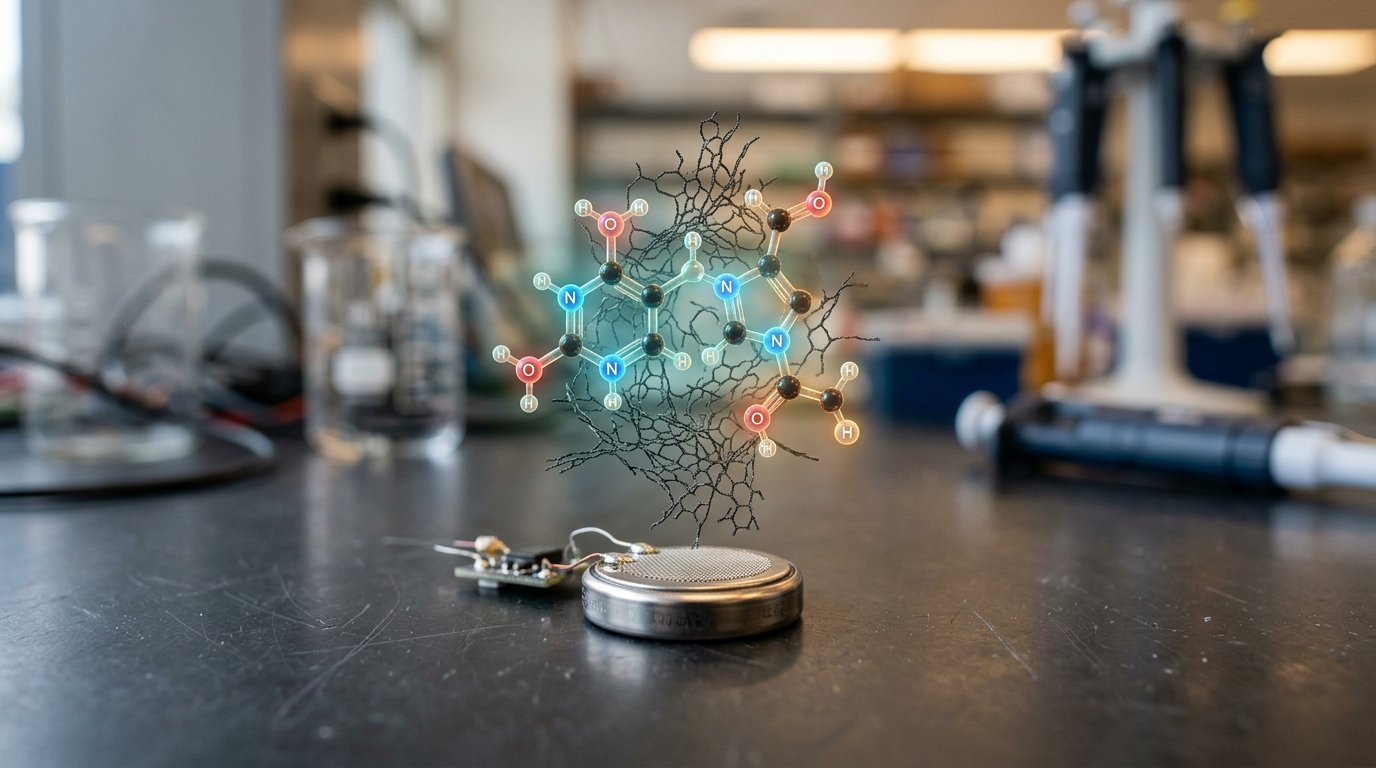
Vitamin B12 is best known from supplement shelves and nutrition labels. Researchers at Spain’s University of Córdoba have now given it a very different job: helping a rechargeable battery work. In a prototype described in a university release dated November 4, 2026, B12 acts as the catalyst in a zinc-air cell that completed up to 250 charge and discharge cycles.
It is laboratory-scale work, and the team is clear that this is a prototype. But it adds an unusual, food-industry molecule to the search for batteries that depend less on the materials inside lithium-ion cells.
What the team built
The work comes from the Physical Chemistry research group (FQM-204) at the university’s Chemical Institute for Energy and the Environment, known as IQUEMA. Their battery is a zinc-air design: a zinc electrode on one side and an air electrode on the other, which draws oxygen from the surrounding air instead of storing all its reactants inside the cell.
The new element is the air electrode. The researchers anchored vitamin B12, also called cobalamin, to single-walled carbon nanotubes. At the center of the vitamin sits cobalt (III), which helps drive the electrochemical reactions the battery depends on. The result is described in the Journal of Materials Chemistry A under the title A vitamin B12-based air electrode for high-performance rechargeable zinc–air batteries.
This is the group’s third attempt at using a biological molecule as a battery catalyst. Earlier prototypes used hemoglobin and catalase, which contain iron (II) and iron (III). According to the release, B12 is the one that finally made the battery rechargeable, reaching as many as 250 cycles.
Keeping a water-loving vitamin in place
B12 dissolves readily in water, and zinc-air cells like this one use water-based electrolytes. That created the central engineering problem: how do you stop the catalyst from washing out of the electrode?
The team’s answer was to fix the vitamin onto carbon nanotubes with a chemical linkage, an approach they say imitates the way amino acids bind together to form proteins. Study author Manuel Cano Luna said the group set out to look at “the properties we can find in naturally occurring materials” for use in new batteries.
Why it works in both directions
A rechargeable battery needs a catalyst that works in both directions. During discharge, oxygen from the air is reduced; during charging, oxygen is produced again. Many materials favor one reaction over the other.
Researcher Antonio Jesús Fernández Romero explained that B12 “has proven to meet the necessary conditions” because during discharge it catalyzes the reduction of oxygen to water, and during recharging it promotes the production of oxygen. That dual role is what turns the vitamin from a curiosity into a candidate catalyst.
Why zinc-air at all
The release frames zinc-air as an attractive alternative to lithium-ion batteries, whose raw materials carry economic, social and environmental costs to extract. Zinc is abundant and recyclable, and oxygen comes free from the air. Because the cell does not need to carry all of its reactive material, it can be lighter, which is why zinc-air chemistry is already used in small devices such as hearing aids. The non-flammable, water-based electrolyte also makes the cells safer.
The B12 itself is not exotic. It is produced by bacteria grown at industrial scale for the food and pharmaceutical industries, so the catalyst is a commercially available compound.
What it means
The significance is less about the vitamin than about the approach. If a naturally occurring molecule can catalyze both halves of a rechargeable cell, designers get a new family of catalysts built from abundant, well-understood materials. The authors point to the longer-term goal of storage that could soak up surplus electricity from renewable sources.
The caveats matter, though. The result is a prototype tested for up to 250 cycles, which is far below what grid storage or consumer products expect. The release does not report cost, lifetime beyond those cycles or energy density in practical packs, so none of those should be assumed. Scaling the electrode, proving long-term stability and showing competitive performance are all still ahead.
Bottom line
A vitamin that most people associate with breakfast cereal can help a battery recharge. The University of Córdoba team has shown that idea works in the lab, with up to 250 cycles. The next test is whether it holds up when it leaves the bench.