
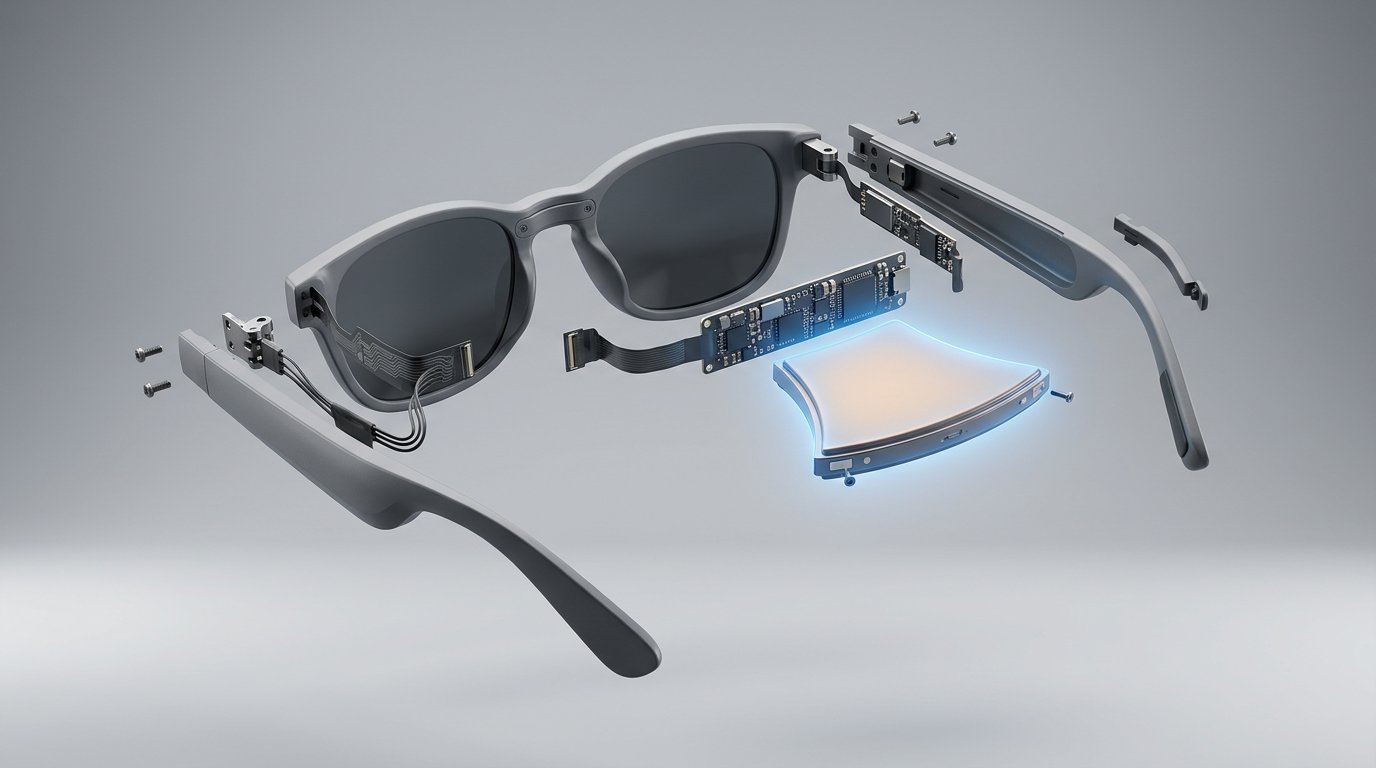
In wearables, the battery often decides what the product can look like. Eyewear is the extreme case: there is very little room in a temple arm, and every gram sits on your face. On November 23, 2026, Enovix announced a design win aimed at that problem, according to its press release.
An unnamed “leading global technology company” has issued a purchase order for engineering services to develop a custom battery cell for an upcoming smart eyewear product. The company’s name and the product are not disclosed.
What was announced
Enovix, a Nasdaq-listed maker of silicon and silicon-carbon (Si-C) blend anode lithium-ion batteries, says the customer has funded the development of a custom cell. The cell is a curved trapezoid with an anode containing Si-C, shaped for the customer’s device instead of the standard rectangle.
The timeline is specific: production is expected to begin in the third quarter of 2027, and the device is currently targeted for a fourth-quarter 2027 launch. The company also notes that the order covers non-recurring engineering work, not production volumes, which would require a separate purchase order. That is an important distinction for anyone reading the news as a volume win.
Designed around the device
Enovix argues that in wearables, the battery is often the component that dictates size, shape and weight. Conventional cells come in a limited set of standard formats, which can force designers to compromise on industrial design, comfort or run time.
Its approach is to offer custom dimensions and form factors, including curved and non-rectangular geometries, tailored to the product’s electronics. The release lists three benefits it expects for wearables:
- Better fit and comfort: cells that follow a device’s contours help make slimmer, lighter products.
- Longer run time: using the full available internal space, together with a high-energy-density Si-C anode, can pack more energy into a small volume.
- Small, lightweight form factors: higher energy per unit of volume and weight can shrink the battery footprint or add capability without bulk.
These are the company’s own expectations, not independent test results, and the release gives no capacity, weight or battery-life figures for the cell.
Why the anode matters
Silicon-carbon blend anodes are a well-known way to raise the energy density of lithium-ion cells compared with graphite alone. Enovix pairs that chemistry with its manufacturing process, which it says enables shapes that are difficult to produce with conventional methods. For smart glasses, where a few hundred milliamp-hours might need to fit in a thin temple, both shape and density count.
Steven Bakos, the company’s Chief Revenue Officer and General Manager, said that “every fraction of a millimeter and every gram matters” in wearables, adding that battery design directly affects how a product looks, feels and performs.
What it means
For smart eyewear makers, the announcement is a reminder that the next design gains may come from the cell as much as from the chip or display. A battery built to follow the frame could let designers keep glasses looking like ordinary glasses while adding sensors, cameras or AI features that draw power.
For Enovix, the program is described as a step in expanding its presence in wearable consumer electronics. The release is careful, though: this is a funded development contract, with production roughly a year out and no volume commitment yet. Whether it grows into shipments will depend on the customer’s product plans and on a follow-on order.
Bottom line
A custom, curved Si-C cell for a still-secret pair of smart glasses is a small announcement with a clear idea behind it: build the battery around the product. Watch for the production order in 2027 to see whether the design win becomes a product.