
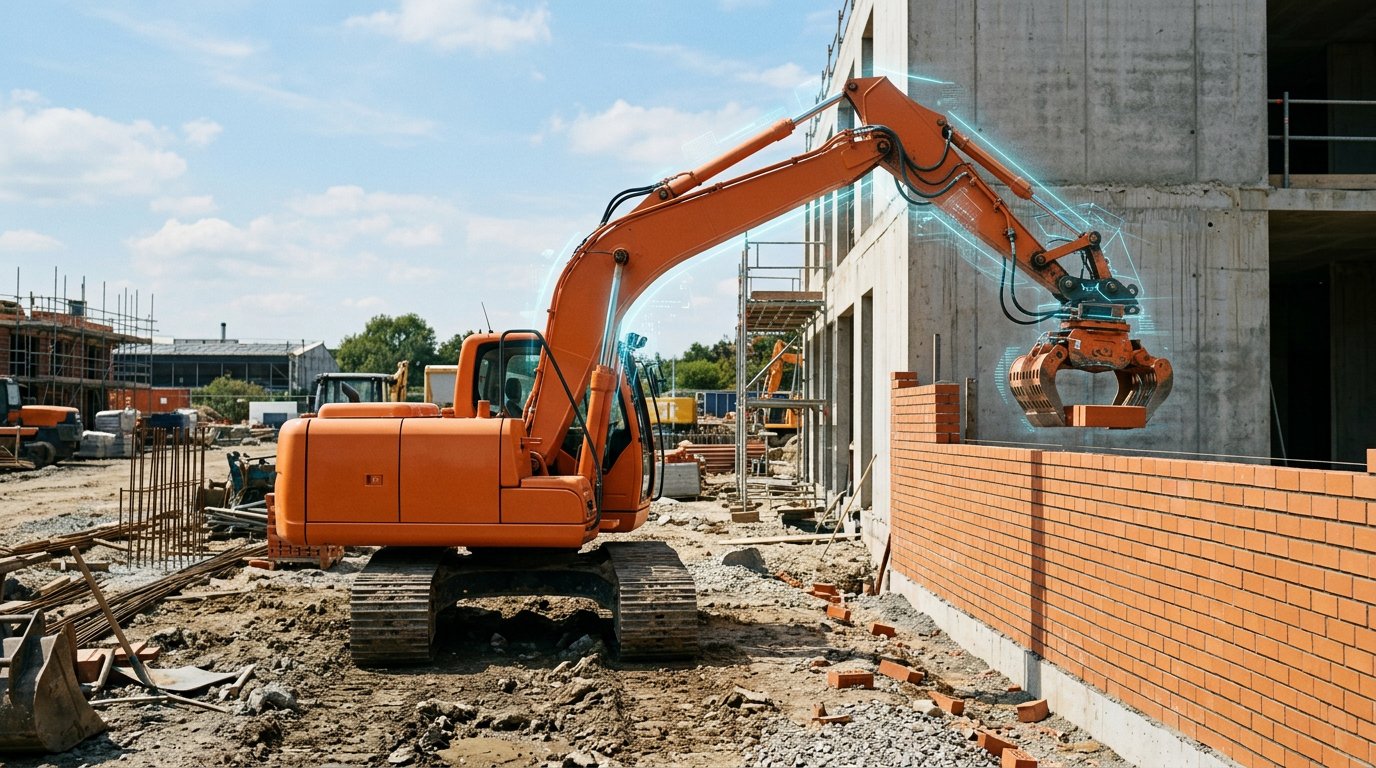
Excavators are built to move earth, not to lay a neat course of bricks. Yet a machine shown in Shanghai this week did something close to that. On November 24, 2026, Zoomlion launched what it calls the industry’s first AI excavation robot powered by embodied intelligence at bauma CHINA 2026, and announced the launch on November 26. Live demonstrations included automated loading and other assisted construction work.
How the excavator sees and acts
At the center is a vision-language-action (VLA) model, a type of AI that links what a camera sees with language instructions and physical actions. Zoomlion says the model identifies objects along with their positions, orientations and dimensions. Paired with a Steelwrist hydraulic attachment and real-time visual feedback, it gives the machine centimeter-level placement accuracy. That is what lets it carry out tasks such as autonomous wall building and pipe alignment.
The cab is meant to be smart as well. Operators can use voice commands to check equipment status, look up technical knowledge and control windows, lighting and air conditioning. For situational awareness, Zoomlion lists a 360-degree panoramic view, a 540-degree 3D view, collision warnings and electronic geofence alerts.
One brain for machines and robots
The more interesting idea may be underneath. Zoomlion’s Zbrain industrial embodied intelligence system uses a unified data pipeline to move technology both ways between heavy equipment and humanoid robots. Perception and navigation methods proven on construction machinery strengthen the robots, while advances in robotics can flow back into the machines. Its in-house RobotOps operating system covers the whole development chain: data collection, model training, simulation and validation, deployment and operational maintenance.
This sits on top of an AI-native industrial internet platform that Zoomlion says connects more than 1.8 million machines in over 170 countries. The company reports that it has gathered more than five petabytes of industrial data and about 10,000 industrial models, which it describes as the foundation for continued AI refinement.
Humanoids on the show floor
Zoomlion also showed two humanoid robots. The Z03, a wheeled humanoid, demonstrated millimeter-level precision while picking and sorting randomly arranged items of different shapes, sizes and materials, using 3D visual perception and motion control. The Z01 bipedal humanoid performed coordinated movement, greeted visitors and guided exhibition tours, and the company says it will enter mass production soon. Zoomlion says it has developed 10 robot models, validated them across almost 20 application scenarios, and already uses humanoids for factory inspection and logistics sorting at Zoomlion Smart City.
What it means
Construction is one of the hardest places for automation. Sites are muddy, vibrating and different every day, which is why most progress so far has been in assisted functions rather than full autonomy. A VLA model that can read a scene and place an object precisely suggests the field is edging toward tasks that once needed a skilled operator’s feel for the machine. If it scales, contractors could gain help with operator shortages and with hazardous earthmoving work.
Some caution is due. The release reports demonstrations, and it does not give pricing, availability dates or performance numbers under varied weather and soil conditions. How reliably the machine behaves on real jobsites will decide how far this goes.
Bottom line
Zoomlion is treating the excavator as another kind of robot and sharing one AI stack across heavy machines and humanoids. The bauma CHINA demo is a first look; the real test is steady work on messy, real-world construction sites.