
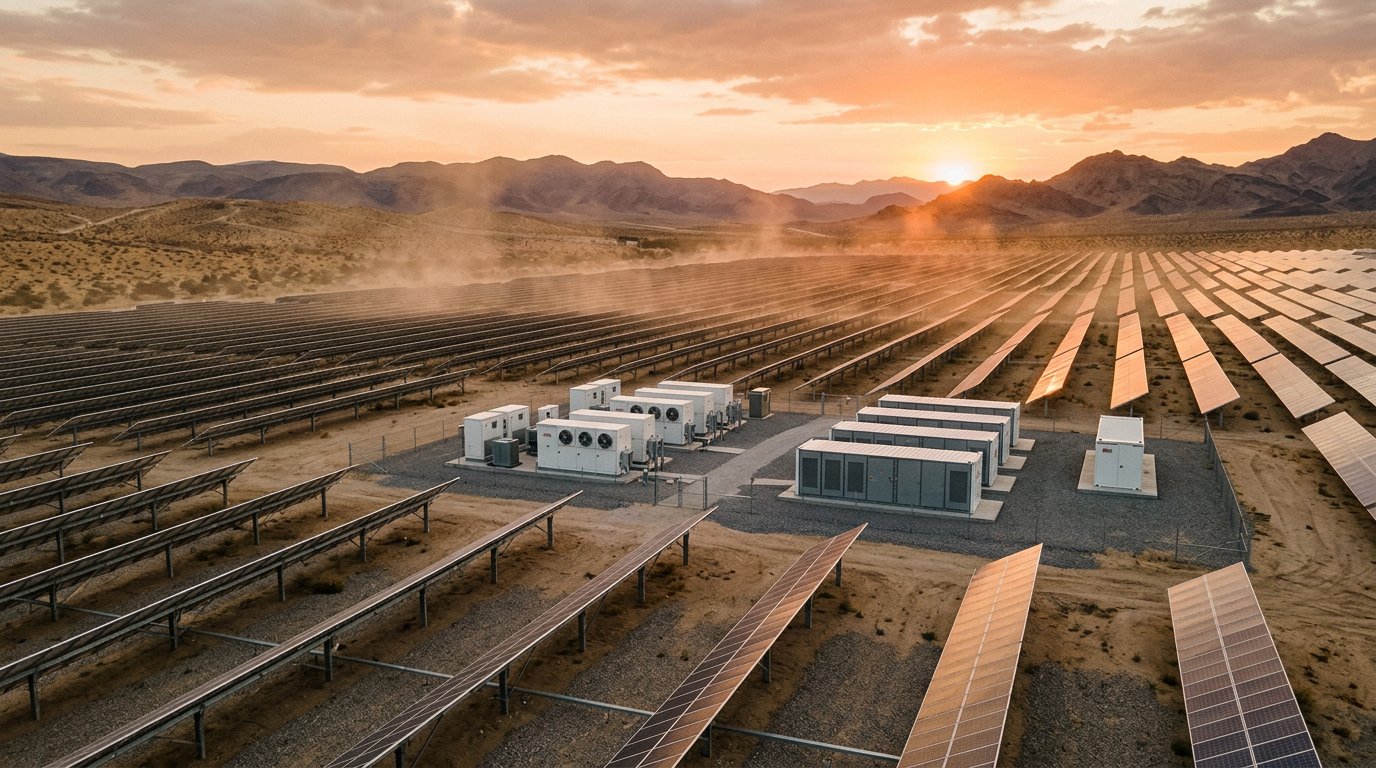
Solar plants in the Middle East face a harsh mix: air that can reach 52°C, blowing sand, falling power prices and grid operators who now want plants to help steady the grid. On November 26, 2026, Sungrow launched PowerMatrix, a new PV-storage system for the Middle East and Africa, at a summit in Abu Dhabi attended by more than 200 industry partners. The company also released a white paper on next-generation PV and storage architecture for the region.
What PowerMatrix is
The system combines a 415 kW MPPT Booster, 9.6 MW of PowerMatrix inverters and 7.14 MWh of PowerTitan 3.0 energy storage. Sungrow says it rests on five ideas: a multi-port topology, native integration of solar and storage, distributed control, reconfigurable energy paths and grid-forming control at the source. In plain terms, the batteries and panels are designed as one system rather than two products joined by extra conversion equipment.
According to Sungrow, that design supports a DC-to-AC ratio of up to 260% on the solar side and 200% on the storage side, which it ties to more than 3,700 full-load hours a year. It also describes more than 40 operating modes that route energy and isolate local faults so the rest of the plant keeps delivering power.
Built for heat and sand
Sungrow says individual inverters can run at full power at up to 55°C, and the overall system at 52°C. The inverter’s IGBT power modules use automotive-grade silicon nitride substrates, which the company says conduct heat 196% better than the alumina commonly used. Cooling is designed so hot air does not flow back into the unit or onto neighbors, whatever the wind direction.
The company describes two ways it tested this: full-load operation at 55°C under 1,120 W/m² irradiance with more than 300 key points monitored, and nine-direction wind tests on what it calls the industry’s first 15 MW-class monsoon simulation platform. For sand, the inverters and the MPPT Booster are rated IP66, and AI-based control reverses fan rotation to clear dust from the air inlets. Sungrow reports more than 70 days of continuous operation in a heavy sand and dust environment.
Grid-forming at the source
Grid-forming means a plant can set voltage and frequency itself instead of only following the grid. Sungrow says each sub-array in PowerMatrix acts as both a generation unit and a grid-forming unit, delivering system-level voltage stabilization in 10 milliseconds and an inertia response in 5 milliseconds. It adds that the system’s performance was verified by TÜV under three extreme Middle Eastern operating conditions.
The cost and yield claims
The economics are where Sungrow leans hardest. In a reference design for 1 GW of grid connection, 8 GWh of storage and 3,700 annual full-load hours, it says PowerMatrix cuts total capital cost by about $120 million compared with a conventional AC-coupled architecture, with savings across substations, cables, storage and solar equipment. Removing two transformer conversion stages and using up to 30 MPPTs per MW are credited with lifting end-to-end energy yield by more than 5%. In solar-only projects, the company says PV balance-of-system cost drops by 0.49 US cents per watt because fewer combiner boxes and cables are needed.
Construction speed is part of the pitch too. The inverters can provide 24/7 off-grid power during construction and commissioning, so work can continue after dark without diesel generators, which Sungrow says could bring grid connection forward by 30 days on a 1 GW project. A DC protection set it calls Ten-Fold, including a pyro fuse that interrupts faults within 2 milliseconds, covers every DC-side node.
What it means
As battery cells become more of a commodity, Sungrow argues, the competitive edge shifts to system architecture: how power is converted, controlled and protected. PowerMatrix is a bet on that idea, aimed at regions where solar prices are falling and grid codes are tightening. The same architecture is pitched for AI data centers, green hydrogen, desalination, mining and industrial sites that want steady power around the clock.
These figures come from the manufacturer’s own launch release and reference design, so project results will depend on site, grid code and pricing. Still, the direction is clear: plants are being designed to keep delivering through heat, dust and grid stress, not just to harvest sunlight at noon.
Bottom line
PowerMatrix packages solar, storage and grid-forming control into one architecture tuned for extreme climates. If its savings and uptime claims hold in the field, it could make large desert solar-plus-storage projects cheaper to build and easier to connect.