
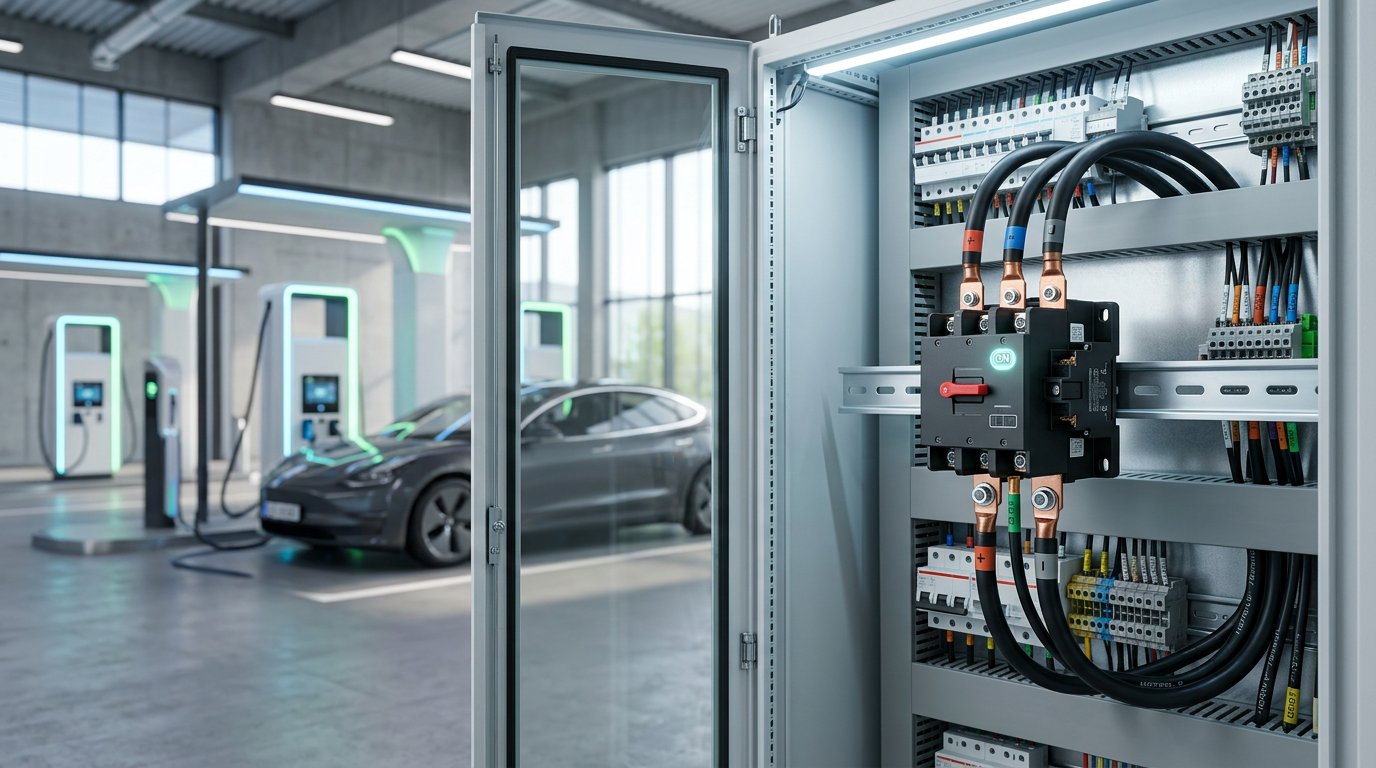
Every time a large battery connects to a grid or a truck plugs into a fast charger, a switch has to open and close under heavy direct current. Doing that without damage is hard, because DC arcs do not extinguish themselves the way AC arcs can. On November 20, 2026, Siemens announced a contactor that tackles the problem with a hybrid design, and called it the world’s first semiconductor-based heavy duty DC contactor.
What Siemens announced
In its press release, Siemens introduced the SIRIUS 3QC1 for DC currents up to 600 A and voltages up to 1,500 V. The company says it provides galvanic isolation along with reliable, wear-free switching of high DC loads. It will be offered in 300 A, 400 A, 500 A and 600 A ratings, with a 24 V DC control voltage.
How the hybrid design works
Siemens describes a split of duties. Semiconductors handle the actual switching event precisely and without wear, which prevents arcing. While the device is running, mechanical contacts stay closed to carry current with low losses. The mechanical contacts also provide the galvanic isolation that a safe interruption of the conducting path requires.
According to the company, this combination gives a durability of at least 150,000 switching cycles. It also lets customers use a familiar arrangement of a contactor plus a fuse, which Siemens calls simple, cost-effective and compact. The unit can be switched remotely, removing the need for manual on-site intervention, and has an integrated display with status and condition LEDs.
Built for two-way power flow
A key feature is bidirectionality: the SIRIUS 3QC1 switches independently of the direction of the current. That matters for systems that both charge and discharge, such as battery energy storage systems. Siemens says such facilities can use the contactor in standard 100 kW power racks and in high-power racks of up to 375 kW at 300 A and 1,500 V.
The company also lists megawatt fast-charging stations for fleets, e-trucks and e-buses with ratings up to 1,000 kW, marine applications on ships, and industrial DC microgrids that couple solar and storage to stay independent of AC grid failures.
Operating range
The device is specified to work from -25 °C to +60 °C and up to 95 percent humidity. Siemens says the wear-free switching makes it durable and maintenance-free, which it expects to lower plant maintenance costs. The contactor was shown to the public for the first time at the Smart Production Solutions trade fair in Nuremberg from November 24 to 26, 2026.
What it means
Siemens frames the product as part of a move toward DC grids. It cites claims that DC systems can save up to 8 percent energy by cutting AC-DC conversions, and up to 50 percent on materials thanks to thinner cable cross-sections and fewer conductors and components. Those are the company’s figures, not independent measurements, but they explain why switching hardware is getting attention: as storage, solar and charging converge on DC, the humble contactor becomes a limiting part.
For operators, the practical questions are cost, availability and how the device performs across real duty cycles. The release does not give pricing or a shipping date, so buyers will need to check with Siemens. Still, a switch that avoids contact wear could reduce downtime in installations that cycle constantly, such as storage racks and busy charging depots.
Conclusion
The SIRIUS 3QC1 is a quiet but meaningful piece of power electronics. By pairing semiconductors with mechanical contacts, Siemens aims to make high-voltage DC switching durable, bidirectional and easy to maintain.