
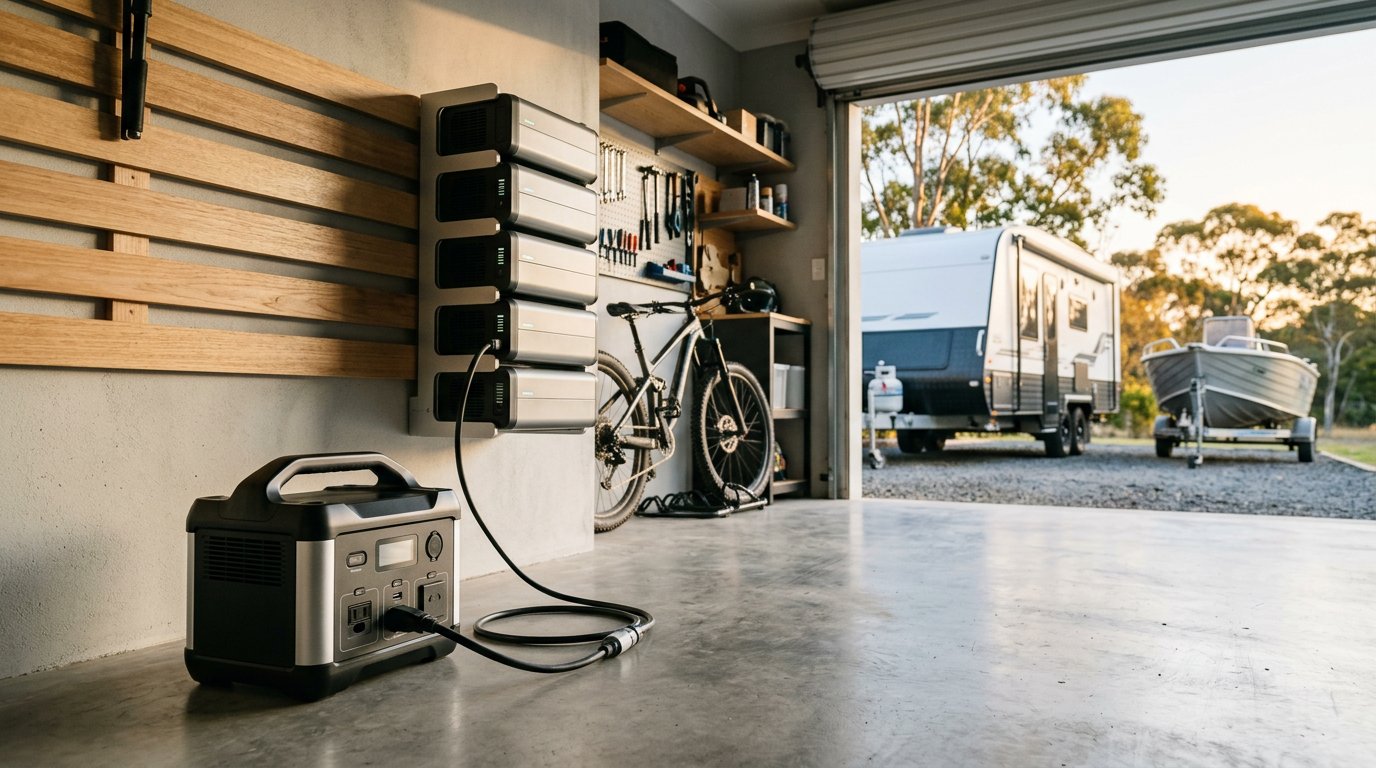
What if the battery that backs up your house could be unplugged on Friday and run a caravan or a boat on Saturday? That is the idea behind PowerNet, a modular battery from Melbourne’s Clutch Industries, and it just got a major push toward factory production. In a news release, the Australian Renewable Energy Agency (ARENA) said it is providing $6.77 million toward a $19.35 million project to build a scalable manufacturing line for it in Coburg North, Victoria.
ARENA first announced the support on October 30, 2026, and the project’s start date is listed as September 8, 2026. It is a useful snapshot of a young battery technology trying to cross the gap between a promising product and something that can be made repeatedly.
What PowerNet is
According to ARENA, PowerNet is a modular energy platform built around a 4 kWh battery that uses solid-state cells. The agency says the solid-state design gives a safer, lighter and more compact pack that holds more energy in less space, which suits both a home and life on the move.
The units are meant to be flexible. They can be combined into a household energy storage system, or used one at a time to power caravans, 4WDs, boats and other off-grid setups. ARENA’s project page describes PowerNet as a “modular mobile energy asset” that stores electrical energy and moves it between applications, unlike a battery that stays tied to a single vehicle, building or appliance.
What the money pays for
The project page spells out the plan. Clutch Industries will set up a scalable pilot line at its Coburg North facility. The line will assemble pre-conditioned solid-state cells into complete PowerNet systems that include battery management, power electronics, mechanical protection and integrated energy interfaces. Finished units then go through end-of-line testing and validation.
ARENA’s news release adds that the line will include semi-automated assembly, testing, quality assurance and product traceability. In other words, the grant is less about inventing a new cell and more about proving the surrounding manufacturing system works consistently and can grow.
The funding comes through ARENA’s Battery Breakthrough Initiative. The project is listed with an end date of December 13, 2029, and a partner list that includes Senhang New Energy Technology, Victron Energy, GPC Asia Pacific, Bunnings, the University of Melbourne and Salic Shenzhen.
Why real-world testing matters
ARENA’s project page notes that solid-state batteries could offer higher energy density and improved safety characteristics, but that emerging battery technologies must show they can be made consistently, integrated into full energy systems and validated in real use. The release says testing will give practical evidence of how PowerNet performs in different settings.
ARENA CEO Darren Miller said the project is a chance to turn promising battery technology into Australian manufacturing capability. Clutch Industries CEO Brad Davis said the company is building on a long manufacturing history through its Density battery business, and noted that Density products are already sold through major Australian retailers.
What it means
For households and travelers, the headline is flexibility: one battery format that could serve a home, a campsite and a boat. ARENA says the technology could offer an alternative to petrol and gas-powered generators and fuel canisters in suitable applications, and lists uses from household storage to marine and recreational vehicles, industrial and mining equipment, off-grid power and light electric mobility.
For industry, it is a test of whether solid-state cells can move from lab-style development into practical factory output. ARENA frames the work as building local manufacturing skills, technical capability and supply-chain resilience, and says the pilot should help prepare PowerNet for broader commercial uptake.
It is worth keeping expectations measured. This is a pilot manufacturing line and a validation program, running through 2029, not a finished mass-market rollout. The real answers will come from the performance data the testing produces.
Bottom line
PowerNet shows where portable storage is heading: modular, safer by design and usable in more than one place. ARENA’s backing gives Clutch Industries a path to find out whether that idea can be built at scale in Australia.