
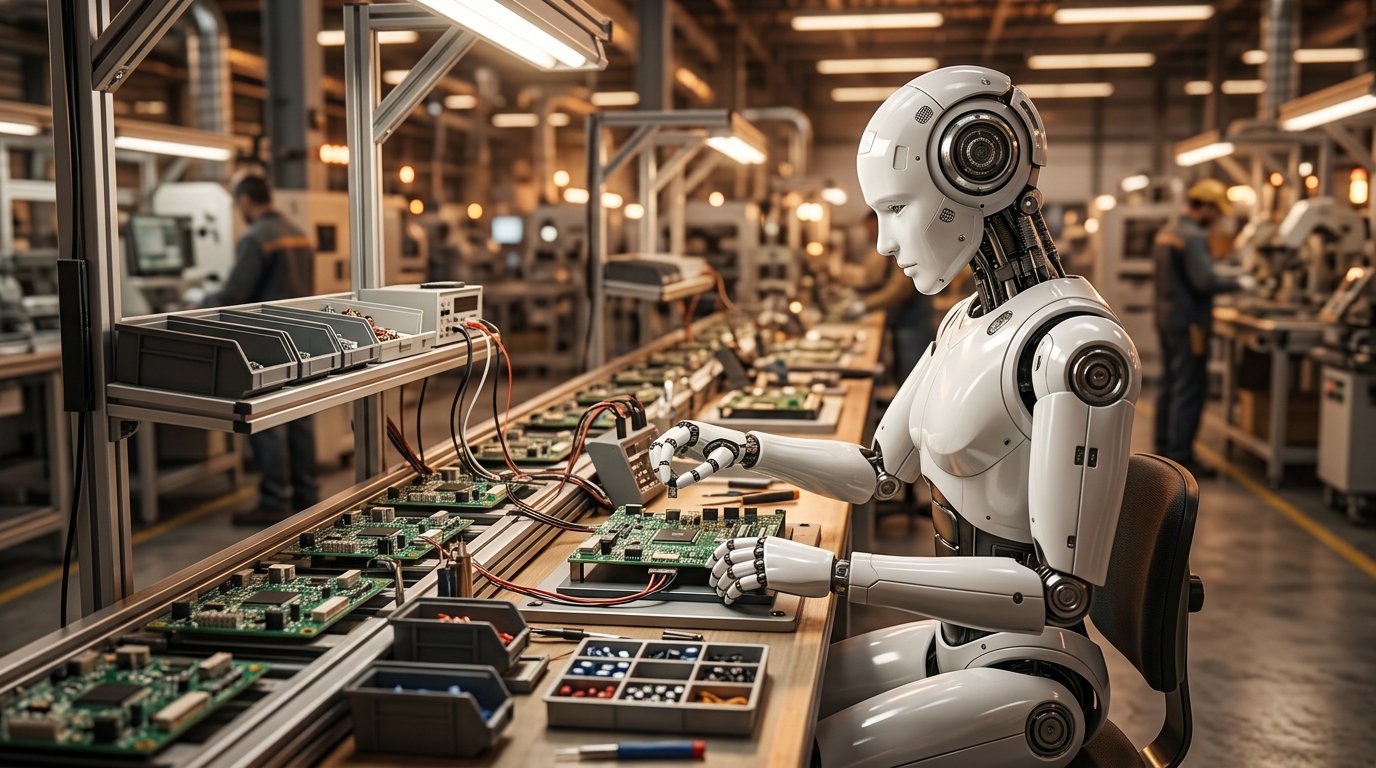
Humanoid robot videos are everywhere, and most show a machine doing something impressive once. ASUS is trying to answer a plainer question: can a humanoid do one specific factory job, every shift, to the same quality bar as a person? On November 13, 2026, Dr. Albert Chang of ASUS laid out how the company’s first humanoid, Gallop, is being built to do exactly that, according to the ASUS Pressroom blog.
A real station, not a staged demo
Gallop’s first job is at an ASUS group electronics manufacturing plant, where it packs motherboard accessories. ASUS describes the station as hard on purpose: 15 small parts, many in thin, clear bags, handled in roughly 20 seconds per board. The target is 99.5% success within 20 seconds, the same standard the company holds a human worker to.
The choice matters because small, thin and soft items defeat simple grippers. ASUS also set a practical test for itself: a robot must take on most of a job. If a person has to stand beside it the whole time, the company says, nobody gains anything. According to ASUS, the full loop now works. A person shows the task, the robot learns it, and the team tests it on the line.
How Gallop learns
ASUS compares teaching Gallop to training a new colleague, and it lists five ingredients:
- General knowledge. Rather than build its own giant model, ASUS starts from leading open models that already understand how hands and objects behave.
- Watching people. Experienced workers wear a small head camera, with their consent, so the robot can see how the job is really done.
- Practice variations. Simulation generates variations of each example, so small changes on the line do not surprise the robot.
- Hands-on practice. An operator in a VR headset and gloves guides the robot through the task on the same parts and cameras as the real station.
- On-the-job learning. Once deployed, what the robot records feeds back into training.
The company’s stated lesson is that its edge is not more data but the right data: a real station, real parts and real quality rules.
A layered design built to be upgraded
Inside, ASUS says Gallop works in four layers. A planner looks at the scene, understands the job and breaks it into steps. A supervisor, a second AI, checks every step and re-plans when something goes wrong. A skills layer handles reaching, grasping and placing. A control layer moves the arms and hands precisely and stops instantly if anything is wrong.
The layers communicate through fixed interfaces. Since new AI models arrive every few months, ASUS says this lets it swap in a better one without rebuilding the robot. Everything runs on a single NVIDIA Jetson AGX Thor computer inside the robot, using standard robotics software. ASUS designs the body and the hand itself. It calls the hand the hardest part of any humanoid and says it is building its own, with a sense of touch. Motors and other standard parts come from established partners.
Today Gallop works from a fixed base with two arms, and its strength is pick-and-place work at a station. A wheeled version is next.
Timeline and where it goes next
The Gallop program began in early 2026. Over the coming year ASUS plans to bring its own dexterous hand into the robot, put Gallop on wheels and show it to customers at Computex 2027. Customer pilots are planned for 2027, and the company is targeting the second half of 2028 for market availability. Electronics manufacturing comes first because it is the industry ASUS knows best. Because many jobs share the same pick-and-place skills, the company expects what the robot learns in one place to carry over, and it sees hospitals and service sites as later destinations.
ASUS also addresses the replacement question directly. It says Gallop is meant for repetitive, physically demanding stations that are hardest to staff, and that the workers who teach it move into setting up, supervising and improving the robots.
What it means
Gallop is a roadmap and a design philosophy more than a product you can buy, and ASUS is clear about the dates. Still, a few ideas stand out for anyone watching factory automation.
- Start with one measurable job. A 99.5% success rate in 20 seconds is a clear acceptance test that a plant manager can evaluate.
- Let experts teach. Using consenting workers’ own first-person footage turns shop-floor know-how into training data.
- Keep the brain swappable. Fixed interfaces between planner, supervisor, skills and control are meant to protect the investment as models improve.
- Owning a factory helps. ASUS notes that its own plants give it real parts and real quality rules to test against, something many robotics firms must rent.
These are the company’s own claims in a blog post, not independent test results, so the real proof will come from the 2027 pilots.
The bottom line
ASUS is betting that humanoids will earn trust one boring station at a time. If Gallop can hit its packing target on a real line, the same approach could extend to other pick-and-place work. Until pilots begin, treat the timeline as a plan rather than a promise.