
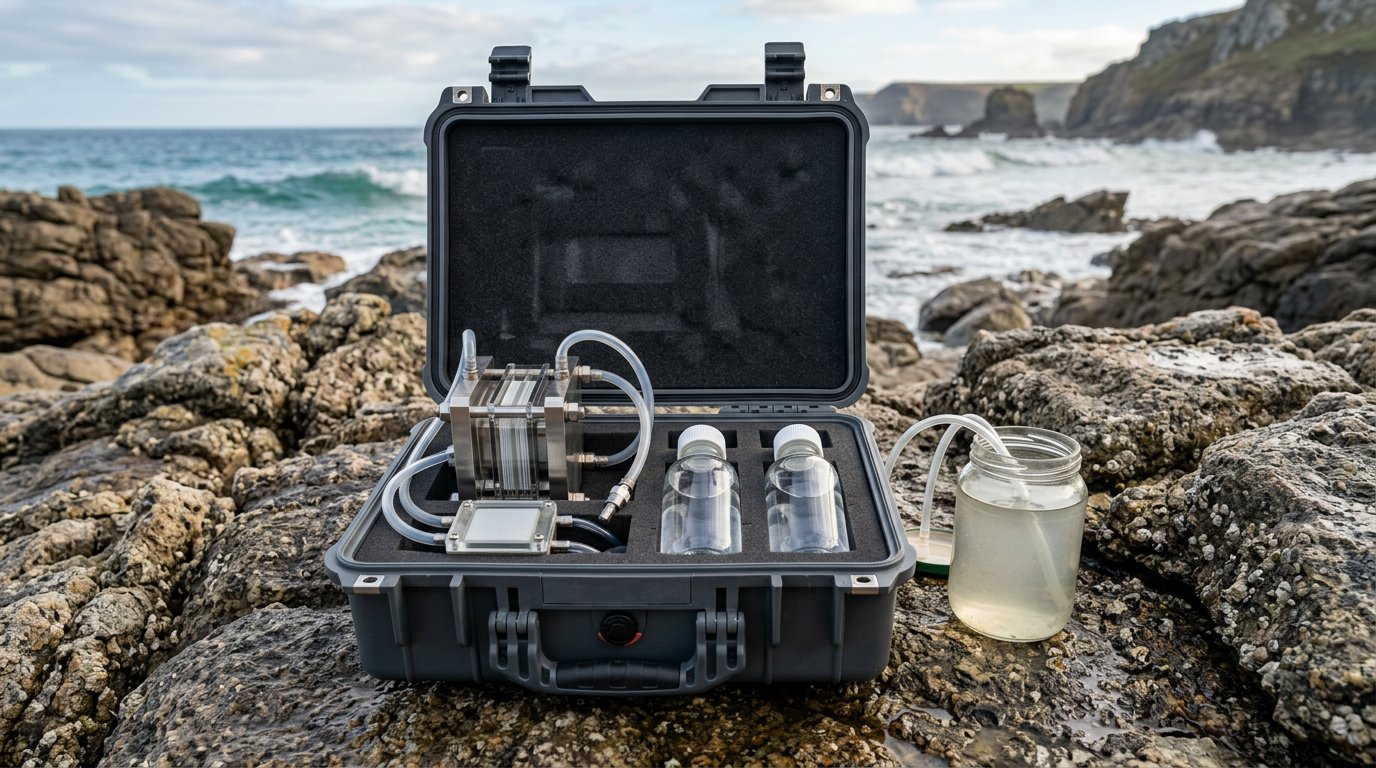
Hydrogen is light for the energy it carries, which is why it keeps coming up as a fuel for drones and remote industrial sites. The catch is the equipment needed to make it. Researchers in Shawn Litster’s lab at Carnegie Mellon University are asking whether that equipment can shrink until it fits in a suitcase, and in a November 25, 2026 university story they describe a lab demonstration that points that way.
It is early, bench-scale work. But the idea behind it is neat: let the electrolyzer’s own waste heat clean the water it needs.
The problem: electrolyzers are picky about water
The team works with proton exchange membrane (PEM) electrolysis, a well-established method that uses electricity to split water into hydrogen and oxygen. According to the university, PEM electrolyzers scale well but are highly sensitive to impurities in the water. That makes them hard to deploy without extra water treatment equipment.
A conventional electrolysis facility therefore has two big parts: a water purification system and an electrolyzer stack. For seawater, which is full of dissolved salt, the purification step is especially bulky. That is the main obstacle to making hydrogen in remote locations.
The idea: one device instead of a plant
“The idea is to integrate what would be a large plant into one single device,” Litster said in the release. The design uses a membrane to separate water vapor from saltwater. The purified vapor feeds straight into the electrolyzer, while the dissolved salt stays behind.
The heat does the work. “We are actually using the wasted heat from the electrolyzer to do the deionization,” Litster explained, adding that harnessing it removes the need for separate purification equipment. In other words, heat that would normally be a by-product becomes part of the water treatment.
What the team showed
Mary Anna Ebbert, a 2026 graduate of Carnegie Mellon’s Department of Mechanical Engineering, fed simulated seawater into the integrated cell and successfully produced hydrogen. The university says the system used less water than conventional electrolyzers while achieving promising electrochemical performance. The release gives no efficiency or output figures, so those details are best checked in the paper.
The results appear in Cell Reports Physical Science and build on earlier work in Scientific Reports, which showed that PEM electrolyzers can run on water vapor instead of liquid water. That earlier result is what makes the new design possible: if the cell accepts vapor, a membrane that passes only vapor can protect it from salt.
What it means
Several things stand out for anyone tracking clean energy and field equipment:
- Remote production: Hydrogen made close to where it is used avoids hauling fuel to places such as remote industrial operations.
- Fewer parts: Combining purification and electrolysis in one unit cuts hardware, which matters most when weight and space are limited.
- Seawater as a feedstock: Using salty water rather than purified water widens where such a system could, in principle, operate.
- Storage angle: Ebbert noted that a big challenge with renewable energy is storing it, and that hydrogen is a promising answer.
The caveats are real. The test used simulated seawater in the lab, not the open ocean, and the “suitcase-sized” system is a concept the researchers demonstrated rather than a finished product. The team is now developing a larger-scale version and exploring commercialization opportunities, according to the university.
Conclusion
Carnegie Mellon’s approach turns a waste product, electrolyzer heat, into the purification step that usually needs its own equipment. If the larger version holds up, portable hydrogen generators that drink seawater could become a practical option for places far from a grid or a fuel depot. For now, it is a promising lab result worth watching.