
Teaching a robot to tie a bow on a gift box sounds like a party trick. Teaching it to do that, pipette a liquid, and then sort metal brackets on a car assembly line without falling apart is something else. On November 10, 2026, Google DeepMind introduced Gemini Robotics 2.5, which it calls its most capable vision-language-action (VLA) model to date, and put numbers on that ambition.
According to DeepMind’s announcement, the model widens the range of skills a robot can pick up and shortens the time needed to learn them. It is rolling out to the company’s robotics partners rather than to the general public.
What Gemini Robotics 2.5 actually is
A vision-language-action model takes in camera views and a plain-language instruction, then outputs the physical actions a robot should take. Gemini Robotics 2.5 is the newest in that family, following Gemini Robotics 2, which DeepMind said earlier this year brought whole-body intelligence to many robot types, including humanoids.
DeepMind frames the release around three gains: dexterity, reliability and safety. It also says the work was accelerated by Gemini 4 Argon, a frontier model whose robotics research capabilities helped the team move faster. The model works natively with several robot bodies, including Apptronik’s Apollo 2 humanoid, which has a five-finger, 22 degree-of-freedom hand, and the Franka Duo platform with two-fingered parallel grippers.
Dexterity: 200 tasks and bigger success gains
DeepMind evaluated the model on more than 200 distinct tasks, including serving food with tongs, tying a bow on a gift box and pipetting a liquid. These combine tool use, handling soft or flexible objects and delicate touch. Compared with earlier baselines, DeepMind reports a 30% to 100% higher success rate depending on task type, with tasks finished 20% to 30% faster.
The company’s charts show how uneven past results were. Closing the lid of a toolbox went from 0% to 93%, packing pastries with tongs from 5% to 100%, and untying a ribbon bow from 0% to 70%. Folding pants reached 40% from 0%, a reminder that hard cloth tasks remain far from solved. Those are DeepMind’s own figures, so treat them as vendor-reported until independent tests appear.
A real factory pilot with Mercedes-Benz
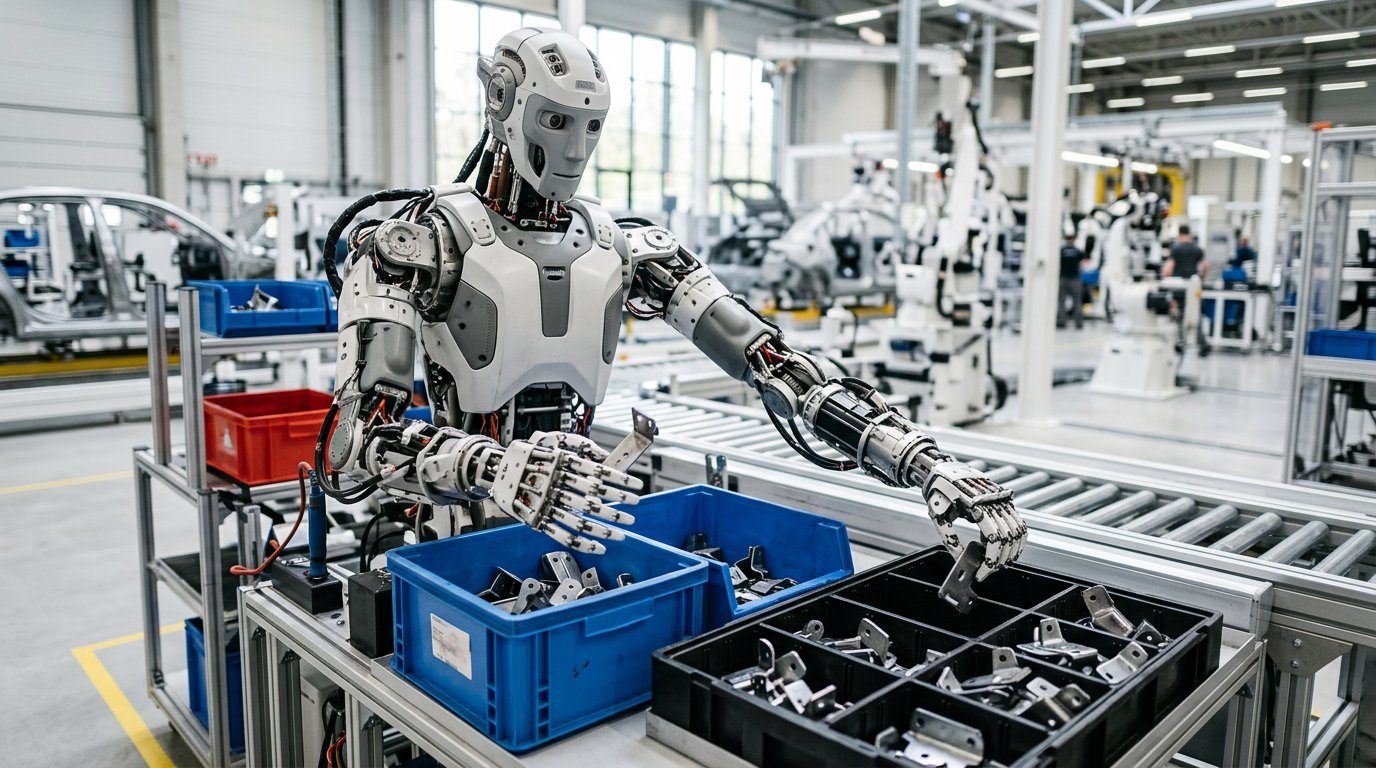
The headline reliability result comes from a proof-of-concept with Apptronik and Mercedes-Benz. Apollo 2 humanoids worked on active production lines in Kecskemet, Hungary, and Sindelfingen, Germany. The job was automotive kitting: pulling individual parts from bulk bins and arranging them in trays in the exact order each vehicle needs.
One model, Gemini Robotics ER, tracked the workflow, while the 2.5 action model controlled the hands and arms. The robot reached into supply bins, picked up metal brackets and placed them in sequencing containers while correcting for gaps. DeepMind reports a 96% success rate. Apptronik CEO Jeff Cardenas said the models improved dramatically within a few weeks of post-training and carried over to Mercedes-Benz production with very little drop-off.
Safety and steerability
As robots move closer to people, DeepMind says it improved physical safety steerability. The model uses inference-time reasoning guidance to steer around hazards in real time. In the company’s evaluations this raised safe task completion around obstacles by 33% and around nearby people by 43%.
DeepMind also released ASIMOV-Jailbreak, an open-source benchmark of hundreds of prompts that disguise unsafe requests across dozens of scenes. It reports Gemini 4 Argon reaching 99.5% jailbreak resistance, against 82% for the earlier Gemini Robotics ER 2 baseline.
Simulation as the training shortcut
Robots need huge amounts of physical data. DeepMind says Argon helped by acting as a simulation engine: it can generate thousands of varied practice runs from one real camera scene and build a realistic digital twin. Combined with real demonstrations, that helps a robot generalize to new scenes and objects. Argon can also form hypotheses about why a task failed from video footage and test fixes in simulation and on real robots.
What it means
For manufacturers, the signal is the Mercedes-Benz pilot: a general model, post-trained for a few weeks, doing repetitive prep work that frees technicians for complex builds. For robotics teams, faster skill acquisition lowers the cost of each new task. For safety teams, a public jailbreak benchmark gives a shared yardstick.
Caveats matter. The 96% figure is from a pilot on one kitting task, not a full deployment, and the results come from DeepMind and its partners. Wide availability has not been announced.
Conclusion
Gemini Robotics 2.5 is less about a single trick than about breadth, speed and a credible factory test. If independent results hold up, the gap between lab demos and daily shift work may narrow faster than expected.