
Spotting an AI-generated photo, song or paragraph by eye is getting close to impossible. Google DeepMind’s answer is not a better guessing machine but a signature baked in at the moment of creation: SynthID, an invisible watermark now stamped on a remarkable volume of content. In October 2026 Google opened its SynthID Detector to everyone, and the company says it has already watermarked more than 180 billion images and videos, plus the equivalent of 240,000 years of audio (Google, October 2026).
That scale makes SynthID one of the most widely deployed AI provenance systems in the world. Here is how it works across each type of media, what the new Detector can and cannot tell you, and what it means for businesses, creators and everyday readers.
What SynthID Is and Why It Matters
SynthID is Google DeepMind’s watermarking technology for AI-generated content. Rather than adding a visible logo or a metadata tag that can be stripped away in seconds, it embeds a signal directly into the content itself, one that people cannot perceive but that Google’s software can detect (Google DeepMind). Google first launched SynthID in 2023 for images and has since extended it to text, audio and video, covering output from its Gemini, Imagen, Lyria and Veo models (Google, May 2025).
The timing is not accidental. Regulators are pushing for machine-readable labels on AI output; The Independent notes that the European Union’s AI Act requires generative AI products to make their outputs identifiable by automated systems, and that OpenAI and Anthropic have recently announced text watermarks of their own (The Independent, October 2026). SynthID gives Google a head start in that emerging norm.
How the Watermark Works, Medium by Medium
SynthID is really a family of techniques, each tuned to the format it protects.
- Images and video. The watermark is woven into the pixels when the content is generated. Google says it does not change visual quality and is designed to survive cropping, filters, frame-rate changes and lossy compression (Google DeepMind). A 2025 technical paper describes SynthID-Image as a deep-learning system that had watermarked more than ten billion images and video frames across Google services at the time of writing (Gowal et al., arXiv, 2025).
- Audio. Music from Lyria and podcasts from NotebookLM’s audio feature carry an inaudible mark that Google says holds up against added noise, MP3 compression and speed changes (Google DeepMind).
- Text. Text is the hardest case, because there are no pixels to hide anything in. Language models write one token at a time, picking each from a list of probable next words. SynthID-Text subtly nudges those choices using a secret key, leaving a statistical pattern that a detector can later measure without needing access to the model itself (Dathathri et al., Nature, 2024).
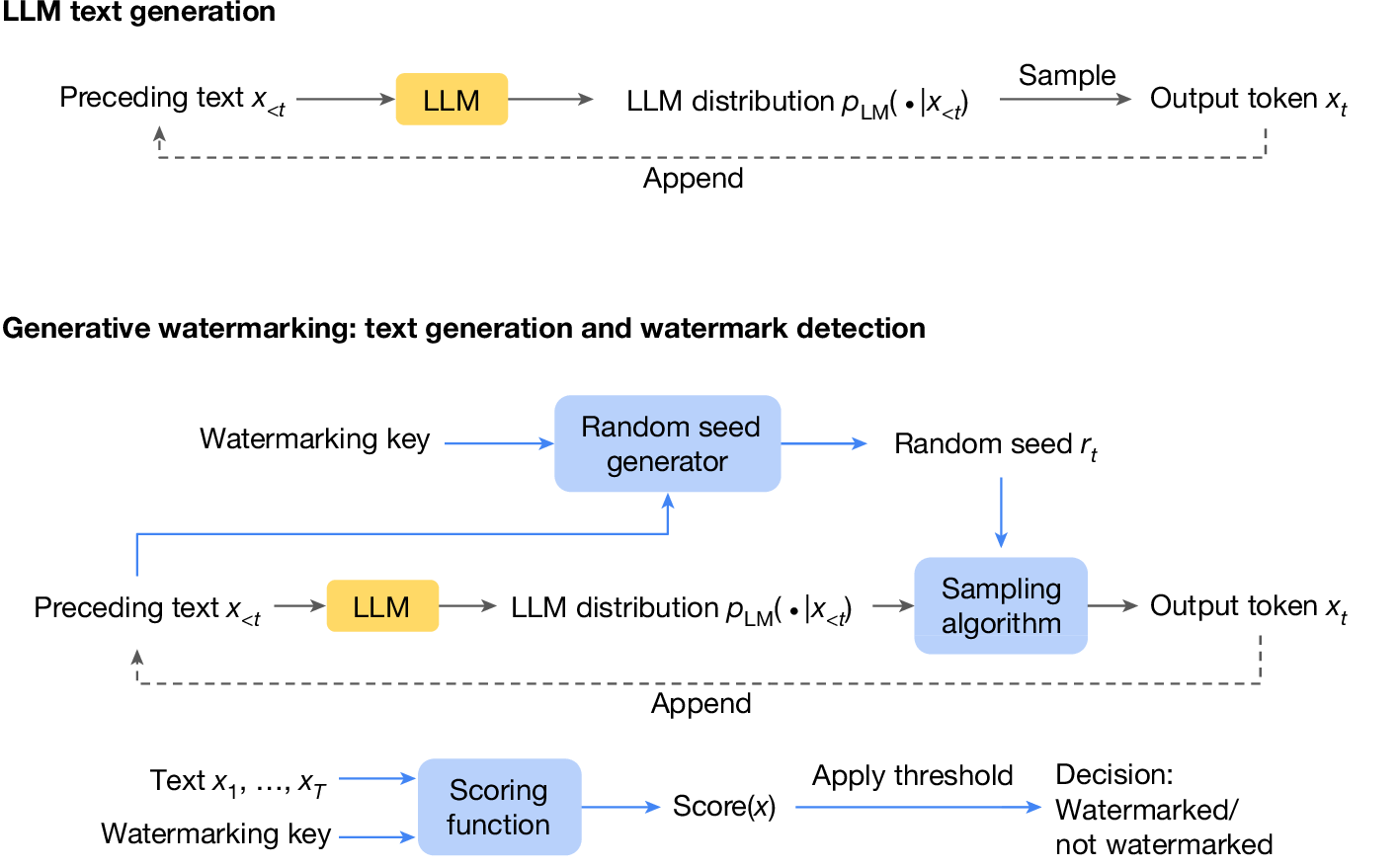
The text method was peer-reviewed in Nature in October 2024. Its core innovation, called Tournament sampling, runs candidate words through a knockout-style contest scored by pseudorandom functions. To test whether watermarking hurt quality, Google ran a live experiment on nearly 20 million Gemini responses and found the differences in users’ thumbs-up and thumbs-down ratings were statistically insignificant. The added processing cost was small too: about 0.57% extra latency per token in one benchmark on Gemma 7B (Nature, 2024).
Open Source and a Growing Partner Ecosystem
Google has not kept the text technique to itself. SynthID Text is open source, with a production-grade implementation in Hugging Face Transformers (version 4.46.0 and later) and a reference implementation on GitHub (Google AI for Developers). Developers can watermark their own models without retraining them: they pass a watermarking configuration to the model’s generate step. Google’s documentation stresses that those configuration keys must be kept private, otherwise others could copy the watermark. Teams can also choose whether to keep their detector fully private, expose it through an API or release it publicly.
On the media side, SynthID is spreading through partnerships. Google partnered with NVIDIA to watermark videos from its Cosmos preview service and with GetReal Security on detection (Google, May 2025). The October 2026 relaunch goes further: the Detector now recognises content from OpenAI, NVIDIA and Kakao, with Apple named as coming soon (Google, October 2026).
The SynthID Detector: From Waitlist to Public Tool
Google unveiled the SynthID Detector at I/O in May 2025 as a portal for journalists, media professionals and researchers on a waitlist. Upload a file and it scans for the watermark, then highlights the parts most likely to carry it, such as specific segments of an audio track or regions of an image (Google, May 2025).
On October 7, 2026, Google opened the tool to everyone at synthid.com, available globally in English, for checking images, video and audio. It sits alongside verification built into Search, the Gemini app and Chrome, which Google says now handle more than one million verification requests a day (Google, October 2026). In Gemini, for example, you can upload a file and simply ask whether it was created or edited with Google AI (Google DeepMind).
The Limits You Need to Know
SynthID is a strong signal, not a lie detector, and Google is candid about the gaps.
- A missing watermark proves nothing. The system only flags content from tools that apply it. As the Nature authors note, watermarking needs the companies running AI models to opt in, and it is hard to enforce on open-source models running on people’s own machines.
- Text is fragile under heavy editing. Google’s developer documentation says SynthID Text survives cropping, a few word swaps and light paraphrasing, but detection confidence drops sharply when text is thoroughly rewritten or translated. It also works less well on short factual answers, where there are fewer plausible word choices to nudge (Google AI for Developers).
- Attackers are part of the picture. The Nature paper lists stealing, spoofing and scrubbing attacks as open research problems, and Google says plainly that SynthID Text is not designed to stop determined bad actors on its own.
- Detection is probabilistic. The open-source text detector returns one of three answers (watermarked, not watermarked or uncertain), and its thresholds can be tuned to trade false positives against false negatives.
Practical Takeaways
- For newsrooms and fact-checkers: Add synthid.com or Gemini’s built-in check to your verification workflow, but treat a positive result as one piece of evidence, and never treat a negative result as proof that something is authentic.
- For businesses using generative AI: Expect disclosure rules like the EU AI Act to make machine-readable labels the norm. Know which of your vendors watermark their output, and keep records of what you generate.
- For developers shipping language models: SynthID Text in Hugging Face Transformers offers a low-overhead way to mark your outputs. Guard your watermark keys like credentials and decide early how public your detector should be.
- For creators and marketers: Assume content from major AI tools is traceable. Being upfront about AI assistance builds more trust than hoping nobody checks.
- For everyone: Combine signals. Watermarks, source checks and common sense together beat any single tool.
Conclusion
SynthID shows that invisible watermarking can work at internet scale without hurting quality, and the public Detector, together with partners like OpenAI and NVIDIA, moves it from a Google-only feature toward shared infrastructure. Its blind spots are real: unwatermarked models, heavy rewriting and determined adversaries. Still, as AI content becomes harder to tell apart from the real thing, a reliable “made by AI” signal from the biggest generators is a meaningful step toward an internet where it is easier to know what you are looking at.
Sources
- We’re making it easier to identify AI-generated content globally (Google, Oct 7, 2026)
- SynthID Detector: a new portal to help identify AI-generated content (Google, May 20, 2025)
- Google SynthID: A tool to watermark and identify content generated through AI (Google DeepMind)
- Scalable watermarking for identifying large language model outputs (Dathathri et al., Nature, Oct 23, 2024)
- SynthID: Tools for watermarking and detecting LLM-generated text (Google AI for Developers)
- SynthID-Image: Image watermarking at internet scale (Gowal et al., arXiv, Oct 2025)
- Google finds 240,000 years’ worth of AI music with new detector tool (The Independent, Oct 8, 2026)