
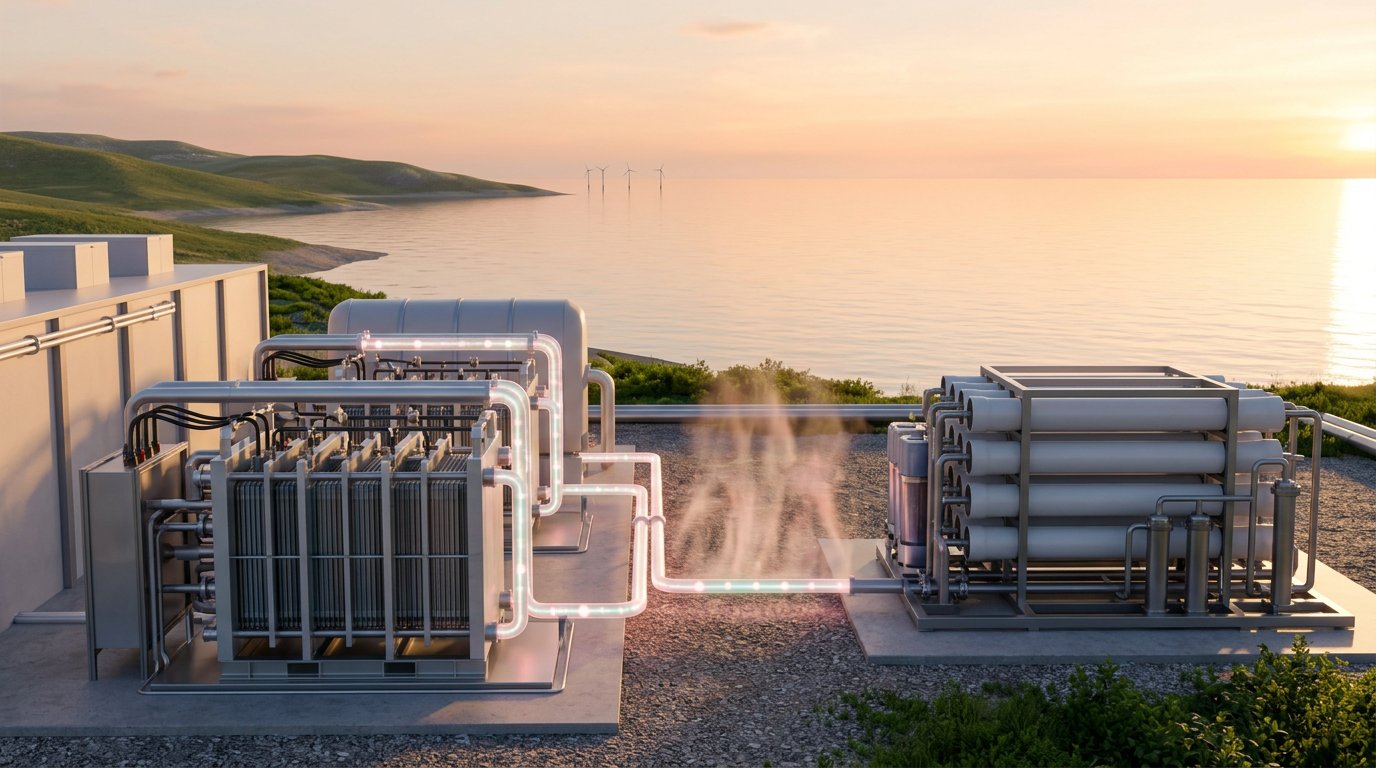
Green hydrogen has an awkward catch: making it takes large volumes of purified freshwater. A team from Hong Kong and Arizona says it has a workaround that uses seawater and turns the electrolyzer’s own waste heat into the purification power.
The freshwater paradox
As described in a HKUST Boundless article dated November 23, 2026, hydrogen is seen as a cornerstone of a low-carbon future, yet producing it depends on clean water, which is increasingly scarce. Seawater is abundant, but its salt can corrode and contaminate equipment and degrade it. On top of that, electrolysis gives off a lot of waste heat.
The research team asked a simple question: instead of treating salty water and waste heat as obstacles, could both be put to work?
What the team built
The collaboration includes HKUST, Arizona State University and the Hong Kong Polytechnic University. Their study, published in Nature Communications, introduces what they call a thermal symbiosis design. It integrates osmotic membrane distillation with alkaline water electrolysis.
The membrane step draws purified water out of seawater while blocking harmful salts. The key twist is that the heat released during electrolysis is captured and reused to drive that purification, so water production and thermal management support each other in a self-sustaining cycle.
Prof. Shang Chii of HKUST’s Department of Civil and Environmental Engineering, who co-led the study, says hydrogen needs not only renewable electricity but also a sustainable water supply. His group’s approach uses heat from the electrolysis process itself to make the purified water the system needs, turning what would otherwise be waste heat into a resource. The team also includes Dr. Gabriela Scheibel Cassol, Dr. Song Yinghao and Prof. Paul Westerhoff of ASU.
What the results show
HKUST reports that the integrated system achieved over 99% rejection of seawater constituents and kept performing stably for 500 continuous hours. The researchers also say the work shows it is feasible to combine seawater hydrogen production, desalination and thermal management on a single platform.
Those are laboratory results. The university’s summary does not give figures for cost, production scale or energy efficiency, so it is too early to say how the design would compare with conventional electrolysis plants.
What it means
The appeal is in the coupling. Desalination normally needs its own energy input, and electrolysis normally needs heat managed and discarded. Linking the two means one process’s loss becomes the other’s input, which could improve overall use of both energy and water.
For coastal and water-stressed regions, the idea points to a way to build green hydrogen capacity without competing with drinking water or agriculture. Prof. Shang says the hope is to offer valuable insights for the future development of green hydrogen technologies in exactly those places.
Bottom line
This is a promising design principle rather than a commercial system. A 500-hour stable run and more than 99% rejection of seawater constituents are encouraging first signs. The next questions are scale, cost and durability outside the lab.