
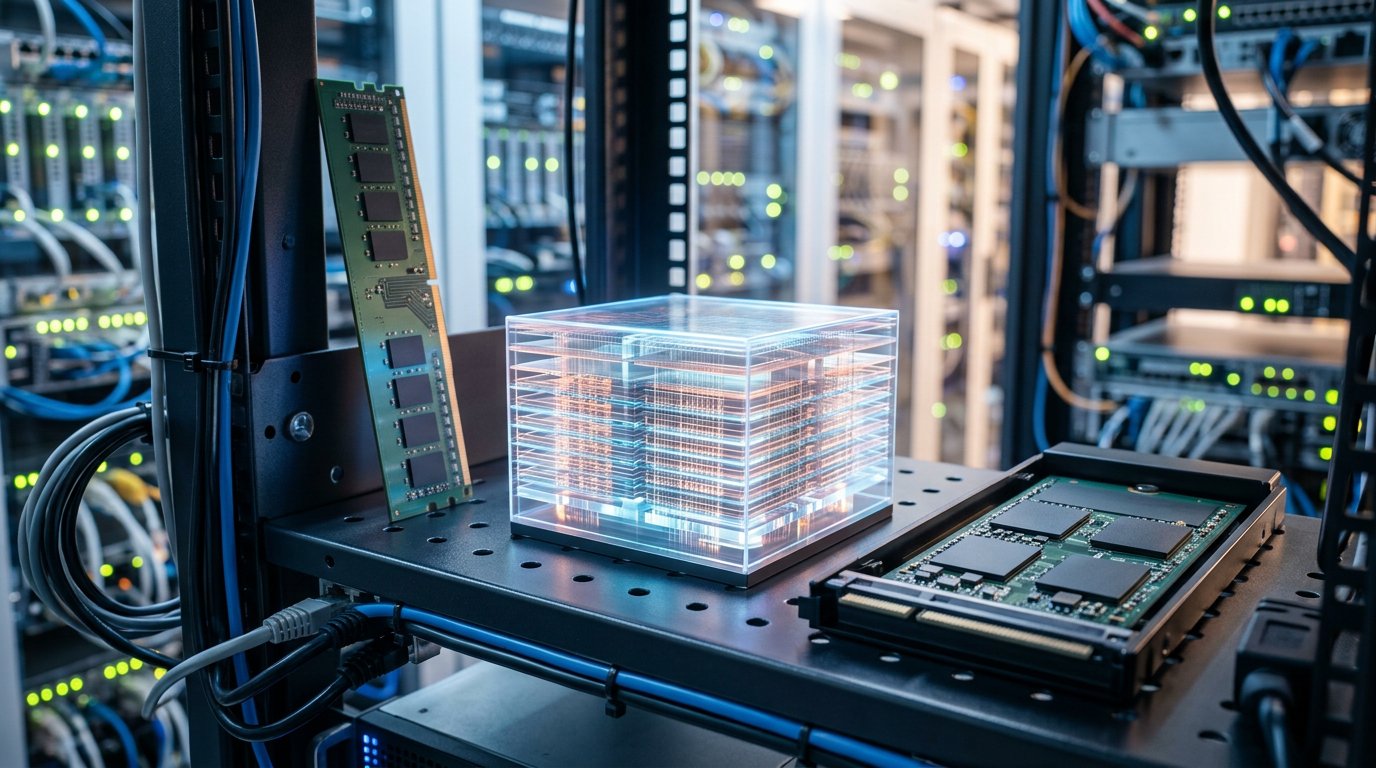
Every AI server runs into the same awkward choice. Memory that is fast enough, DRAM, is expensive and power hungry. Storage that is cheap and roomy, NAND flash, is slow by comparison. On 25 November 2026, Kioxia said it will show a prototype that tries to sit in the middle: XL-FLASH generation 3, a low-latency flash memory with an average read latency of 3 microseconds. According to the company’s announcement, the prototype was due to appear at the KIOXIA Forum in Tokyo on 26 November.
This is a prototype showing, not a shipping product. Still, the numbers say a lot about where data center memory design is heading, and they are worth unpacking.
What Kioxia announced
XL-FLASH is Kioxia’s family of flash memory tuned for speed and endurance rather than raw capacity. Kioxia describes it as having significantly lower read latency and higher write endurance than typical NAND flash. The goal is to create a new tier of memory that bridges the gap in performance, capacity and cost between storage and DRAM.
Generation 3 builds on a feature of Kioxia’s BiCS FLASH 3D memory called CBA, short for CMOS directly Bonded to Array. In this approach the logic circuitry and the memory cell array are made separately and then bonded together. Kioxia says the technique lets generation 3 reach about 70 percent higher bit density than generation 2 while keeping high performance.
The numbers behind the prototype
Kioxia gives three headline figures. First, the prototype reaches an average read latency of 3 microseconds, which the company says is less than one-tenth of the latency of its BiCS FLASH generation 8 TLC products. Second, bit density is roughly 70 percent higher than XL-FLASH generation 2. Third, read power efficiency for 512-byte units has improved by approximately 135 percent compared with generation 2.
The company notes that these comparisons come from its own internal testing on a generation 8 1Tb TLC product and the new prototype, so they should be read as vendor measurements. Samples for functional evaluation are scheduled to ship to select customers in March 2027, which gives a rough idea of when outside testers may be able to confirm the claims.
Why a new memory tier matters for AI
Generative AI has pushed demand for high-capacity memory in computing systems sharply upward. Kioxia points out that keeping most data in DRAM creates problems of capacity, cost and power consumption. The idea behind XL-FLASH is that not all data needs DRAM speed. Data that is read often but changes rarely, such as embeddings, model parameters or lookup tables, might live in a faster flash tier instead.
Kioxia says system designers could use this approach to complement DRAM, or to replace a portion of it with flash. The company expects the result to be more memory capacity and lower total cost of ownership in AI servers, data centers and similar applications.
Where it could show up
Kioxia says it will keep pursuing XL-FLASH in a range of applications, including Super High IOPS SSDs and memory expansion modules that use Compute Express Link, or CXL. CXL is an interconnect standard that lets servers attach extra memory through a fast link rather than only through the limited DRAM slots on the board. Flash with microsecond reads is a natural fit for that kind of expansion, because it can add capacity at a lower cost per gigabyte than DRAM.
What it means
The memory hierarchy is being redrawn. For years it was a simple ladder of cache, DRAM and storage. AI workloads are adding rungs, and companies are racing to fill them. Kioxia’s prototype suggests flash can climb higher up that ladder than most people assumed, if latency can be brought down to single-digit microseconds while density keeps rising.
For IT teams, the practical takeaway is to watch how software handles tiered memory. A faster flash tier only helps if operating systems, databases and AI frameworks place data on it intelligently. Buyers should also wait for independent test results from the 2027 sample program before planning around the figures.
Conclusion
XL-FLASH generation 3 is an early look at a possible middle layer for AI infrastructure: faster than ordinary flash, cheaper and larger than DRAM. If the March 2027 samples hold up, it could give server designers a new lever for balancing speed, capacity and power.