
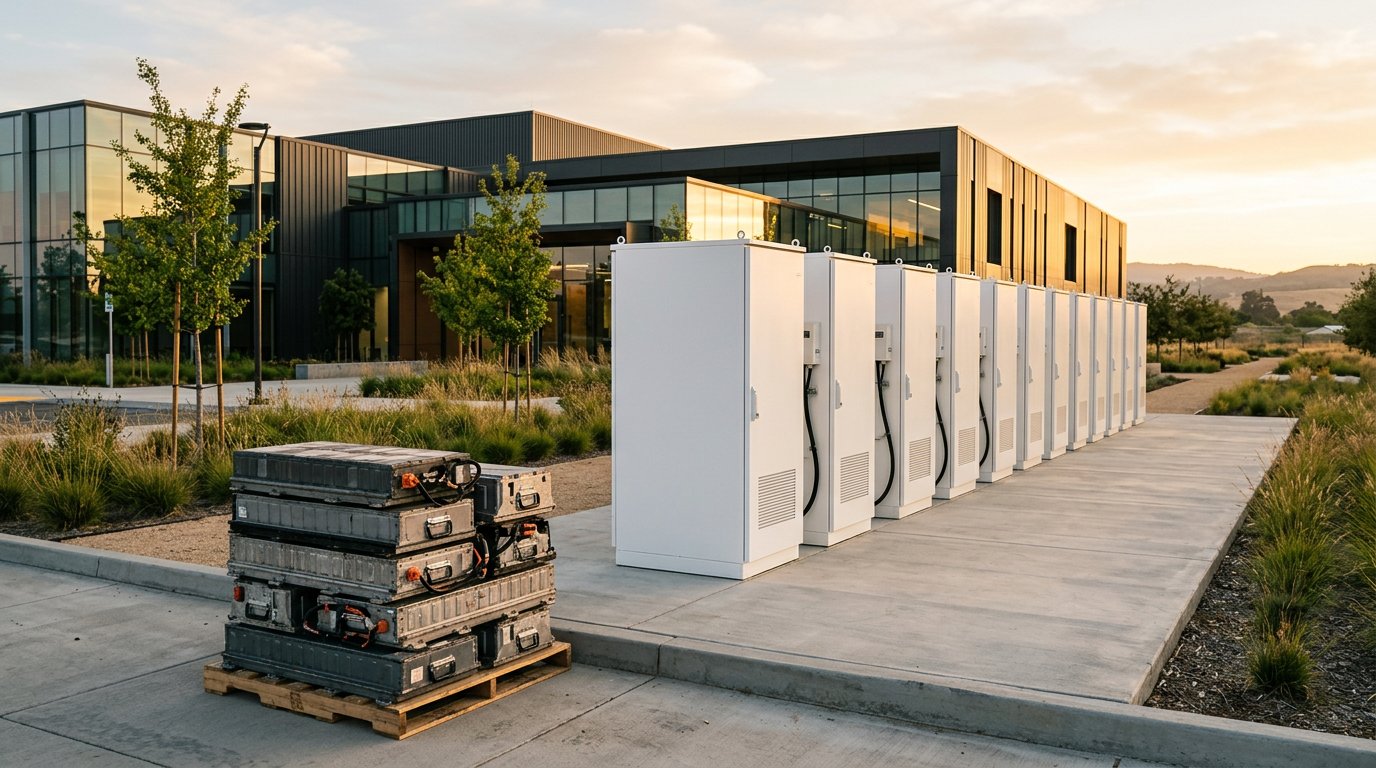
Most grid batteries start life as new cells. Moment Energy is betting that the better source is already on the road. On November 17, 2026, the company unveiled Nova, a commercial battery energy storage system (BESS) built from repurposed electric vehicle batteries, and said it is the first of its kind to earn both UL 1973 and UL 9540 certification. Those two safety listings matter because they are what lets a stationary battery sit next to a hospital, an airport or a factory.
What Moment Energy announced
According to Moment Energy’s press release, Nova is already in production at the company’s Megafactory 1, with units destined for commercial, industrial and larger installations across North America. Orders are open now and first deliveries are planned for the first quarter of 2027. The system was set to be shown at the RE+ trade show in Las Vegas, with an unveiling ceremony on the morning of the announcement.
The company says it has already put earlier systems to work at airports, hospitals, agricultural sites and manufacturing plants. Nova is the next-generation version meant to scale that business.
How Nova is built
Each Nova block delivers 200 kW of power and 500 kWh of energy in a footprint of 2.94 by 1.80 meters, roughly 9.65 by 5.9 feet. Blocks can be combined for large installations in the tens of megawatt-hours. The platform is designed to take batteries from several kinds of EVs rather than one model, and a proprietary AI-powered battery management system continuously evaluates packs at different states of health so that older and newer packs can work together.
Servicing is a notable design choice. Nova uses a swappable architecture, so individual battery packs can be replaced as they age while the enclosure and concrete pad stay in place. Moment says this approach extends system life to more than 20 years when paired with its capacity augmentation service.
On the electrical side, the release says Nova is designed to work with U.S.-made power conversion systems and supports grid-tied, grid-forming and virtual synchronous generator operating modes. Customers can use it for utility bill savings, grid services and backup power during outages.
Safety certification is the headline
Reusing EV batteries creates technical questions that new cells do not, such as uneven wear between packs. That is why the certifications carry weight. Nova holds UL 1973 and UL 9540 and has been tested to UL 9540A, the method for evaluating thermal runaway fire propagation. The company’s Megafactory 1 is also certified to UL 1974, the standard for sorting, grading and repurposing EV batteries.
In the release, Jeff Smidt of UL Solutions said certification shows the evaluated system met applicable safety requirements and provides third-party evidence supporting responsible use of repurposed batteries in commercial and industrial storage. Moment lists several built-in protections:
- Liquid cooling with smoke, heat and flammable gas detection plus an integrated deflagration prevention system.
- A Type 3R enclosure with an ISO 12944 C4 coating.
- Operation from minus 25 to 50 degrees Celsius, altitudes up to 2,000 meters and an IEEE 693 high seismic rating.
Supply chain and circular economy angle
Moment frames Nova as a domestic supply chain play. It says Nova is made in North America, independently verified as compliant with Foreign Entity of Concern requirements, and the only third-party verified BESS eligible for the U.S. federal Investment Tax Credit in 2027 and beyond. Those are the company’s claims and eligibility will depend on each buyer’s circumstances.
The environmental pitch is that a retired EV battery still holds years or even decades of useful capacity. Giving it a second job in stationary storage keeps it out of landfills and keeps critical minerals in North America.
What it means
If the model holds up in the field, second-life batteries could become a practical option for businesses facing power capacity limits, especially where space and fire codes are tight. The certifications address the biggest barrier, which was proving safety to inspectors and insurers. Open questions remain: the release gives no pricing, cycle-life data or performance guarantees, and real-world results from first deliveries will not arrive until 2027. Buyers should treat the 20-year figure as a design goal tied to a service plan.
Conclusion
Nova turns a growing pile of retiring EV packs into a certified, serviceable storage product. It is a clear example of circular-economy thinking meeting commercial energy needs, and its first deployments will show whether repurposed batteries can match the reliability of new ones.