
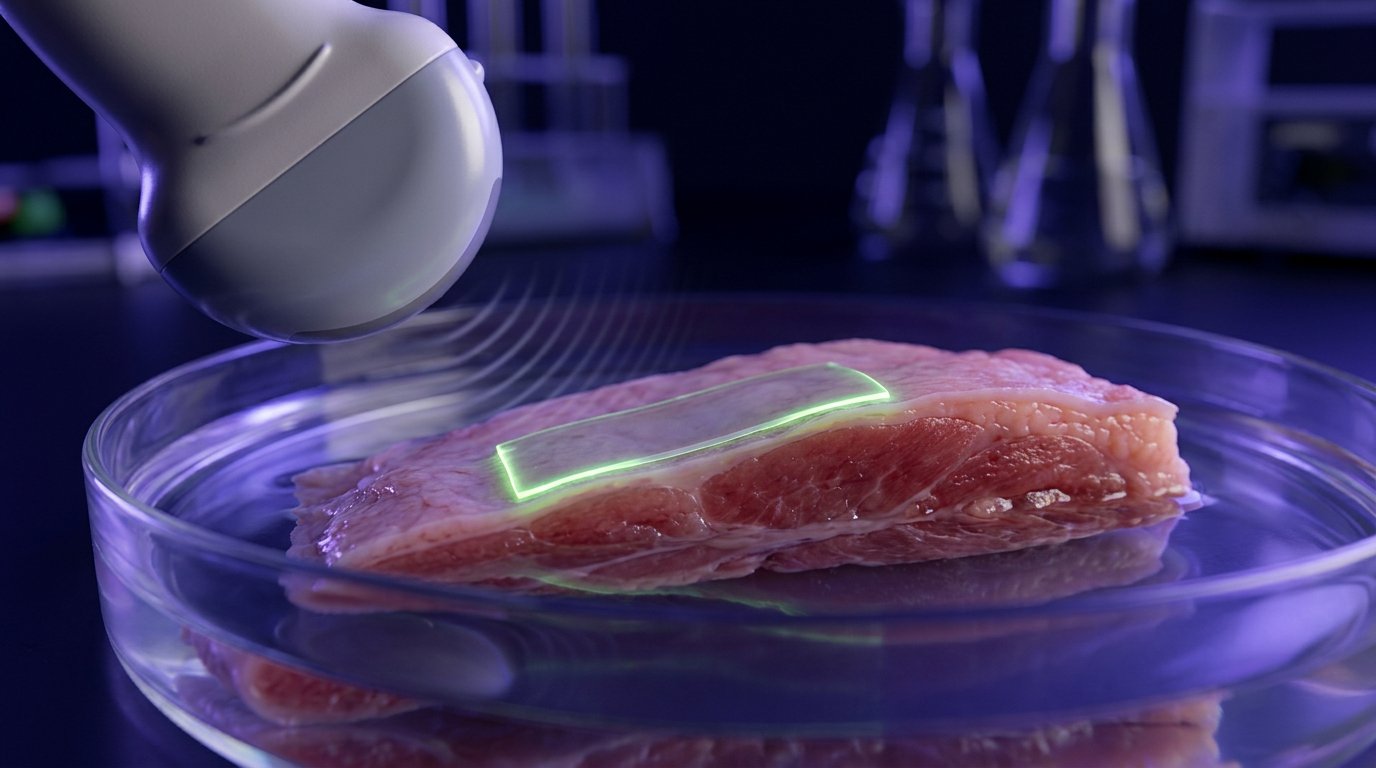
Implanted electronics have a visibility problem. Once a device is under the skin, nobody can easily tell whether it is intact, powered or breaking down, and a battery adds its own limits and leakage risks. A team at The Hong Kong Polytechnic University (PolyU), working with Yonsei University in South Korea, has demonstrated a different approach: an implant with no battery that powers itself from ultrasound and glows so its condition can be seen from outside the body. The group describes it in a PolyU release dated November 27, 2026, and in a paper in Nature Nanotechnology.
Fuel from ultrasound, a gauge made of light
The device harvests energy through triboelectric energy harvesting, which turns mechanical stimulation into electricity. Here the stimulation comes from ultrasound applied from outside the body. Team leader Prof. Raymond Wong, Dean of PolyU’s Faculty of Science, summed it up with an analogy: ultrasound is the fuel, and the glow is the fuel gauge.
The key ingredient is nanoscale iridium(III) phosphors, light-emitting complexes embedded in a biodegradable polymer matrix. According to PolyU, they do two jobs. Under a handheld UV lamp they glow and outline the implant beneath the skin, so a clinician can locate it and judge its shape. A clear, complete outline suggests the device is intact; a fragmented one may signal damage or degradation. The phosphors also boost the ultrasound-driven electrical output.
What was tested
The researchers validated the idea in a subcutaneous mouse model. Intact implants could be located optically from outside the body and generated electricity under ultrasound. The team also tracked bioresorption over 38 weeks, watching the device boundaries gradually recede as the body absorbed the material. In lab images, damaged films showed fragmented outlines and no detectable voltage under ultrasound, while intact ones showed a defined outline and an output.
These are animal results, and the release frames the work as a step toward future applications rather than a clinical product. Potential uses it names include temporary biosensors for post-surgical monitoring, on-demand drug-delivery systems, and neurostimulators for pain management or tissue regeneration.
Machine learning picked the glowing molecules
A second contribution is how the team found suitable materials. Searching for a molecule that both emits light well and helps harvest energy would normally mean synthesizing and testing thousands of candidates over years. Instead, the researchers built PhosIrDB, a database of 1,667 iridium(III) complexes, and trained machine-learning models to screen a virtual library of more than 270,000 candidate molecules. The models predicted two key properties, emission wavelength and photoluminescent quantum yield, which measures how efficiently a material re-emits absorbed light. That let the team choose the most promising molecules to synthesize and test, cutting trial and error.
What it means
If the approach holds up beyond mice, it targets two practical headaches. A battery-free implant removes a part that can limit lifespan and, in some designs, force a second surgery. A glowing outline offers a simple, low-cost way to check a temporary device without imaging equipment. Because the material is bioresorbable, it is also meant to disappear after its job is done.
The wider lesson is about method. Pairing a physical design with an AI-assisted materials search shortens the path from idea to a working candidate, a pattern showing up across materials research.
Caution is warranted: this is early research, long-term safety and performance in people have not been shown, and the release does not describe a clinical timeline. It is a technology story, not medical guidance.
Bottom line
PolyU’s implant turns a hidden device into one you can see working. Prof. Wong says the team will keep expanding AI-driven materials design and add sensing and stimulation functions, aiming for autonomous implants whose condition can be observed from outside the body.