
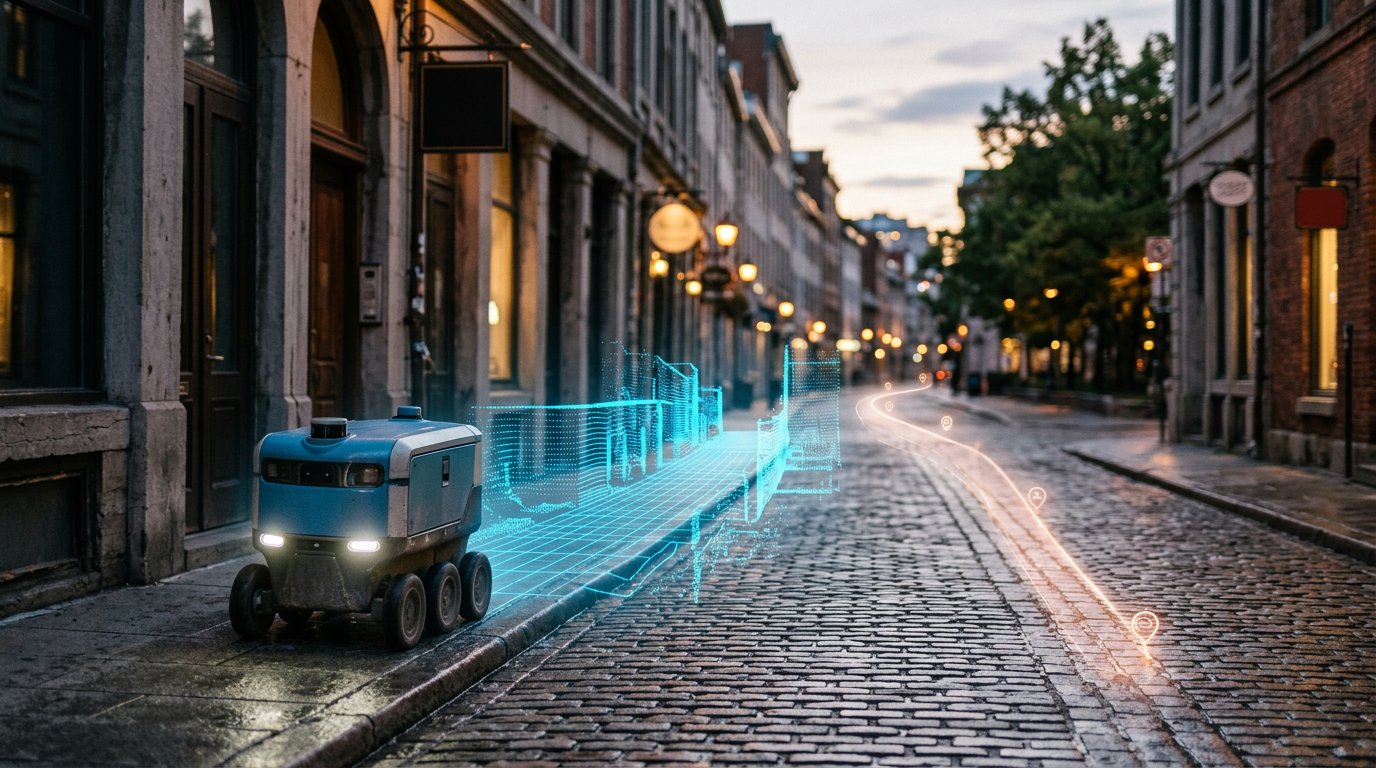
A robot that wanders a city for several kilometers builds up small mistakes, and by the end its map no longer matches the street. Then, once the job is done, it forgets everything and starts from scratch next time. On November 27, 2026, Robbyant, the embodied AI company within Ant Group, announced the open-source release of two models aimed at exactly those two problems: LingBot-Map 2.0 and LingBot-Navi.
Fixing the map from the inside
LingBot-Map 2.0 is a streaming 3D reconstruction model, meaning it builds a map as a robot moves rather than after the fact. It builds on version 1.0, released in April 2026. According to Robbyant, the key change is native error correction during inference, which removes the need for external place-recognition modules or pose-graph optimization backends that earlier systems used to patch drift after the fact.
The mechanism is called Geometric Context Reshaping. Robbyant says it is inspired by memory reconsolidation in the human brain: the model reuses local geometry it has already extracted and realigns its high-level historical memory without re-encoding the images. Because the correction updates the model’s internal memory rather than only nudging the output trajectory, each fix becomes a more reliable reference for later movement. The release also leans on LingBot-Vision, Robbyant’s visual foundation model, which supplies sub-pixel boundary detection to reduce geometric errors at the source.
The numbers Robbyant reports
On a long-distance urban trajectory test from the VBR benchmark, covering 5.2 km and nearly 19,000 frames, average trajectory error fell from 31.12 meters in version 1.0 to 4.72 meters, a reduction of nearly 85%. Robbyant says that is more than twice as accurate as the best external loop-closure approach it compared against, at 9.98 meters. The model runs at 27.51 frames per second on a single NVIDIA RTX 5090 GPU.
On the Oxford Spires and KITTI benchmarks the error dropped to 3.92 and 9.42 meters, and the company reports first place on three dense 3D reconstruction benchmarks: CroCoDL, EuRoC and Oxford. These are Robbyant’s own reported results, so independent replication will be the real test.
LingBot-Navi: a robot that remembers
LingBot-Navi sits on top of the map model and adds persistent spatial memory that carries over between missions. Instead of discarding the map after each action, it keeps object and location data and retrieves relevant context when given a natural-language command, planning more direct routes without redundant exploration. Robbyant says the model refines its understanding of an environment with each operation and supports on-device deployment, which keeps commands and scene data local for lower latency and privacy.
In simulations where the model chooses targets and a simulator executes the movement, LingBot-Navi reached a 68.60% success rate on a GOAT-Bench subset, 10.36 percentage points above the best of six comparison methods. In fully end-to-end tests, where it plans paths and drives movement itself, it scored 56.09% on GOAT-Bench and 32.36% on a proprietary dataset reconstructed from 36 real-world sites. Swapping the mapping engine from 1.0 to 2.0, with no retraining, lifted success rates by 4.15 and 2.35 points on the two sets, which suggests better maps translate directly into better navigation.
What it means
Navigation is a bottleneck for warehouse logistics and last-mile delivery, the settings Robbyant names. A robot that corrects its own map and reuses what it has learned could spend less time re-exploring and more time working. Open weights, code, technical reports and a dataset of 511 real-world scenes also give researchers a ready base to test and build on, rather than a closed demo. The caution: most navigation results here come from simulation and benchmark tests, so real-world fleets will need their own validation.
Bottom line
Robbyant is betting that robots need memory as much as eyes. If LingBot-Map 2.0’s drift reduction holds up outside the lab, and if LingBot-Navi’s remembered spaces speed up repeat jobs, open-sourcing both gives the wider robotics community a useful head start.