
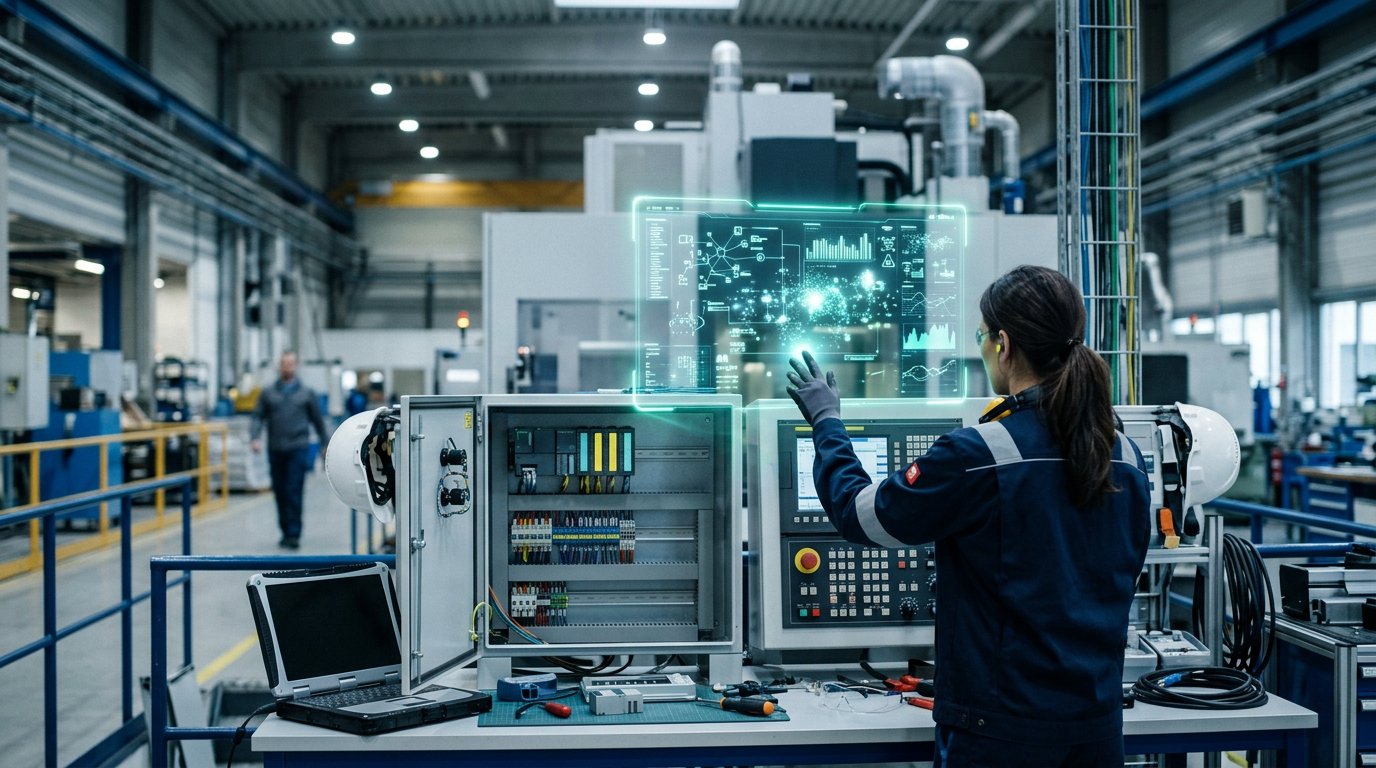
Most AI tools in engineering stop at a suggestion: they draft a snippet and leave a person to check it, paste it and fix it. Siemens is betting on something different for factory automation. On November 18, 2026, the company announced the launch of its Eigen Engineering Agent in India, describing it as a purpose-built AI that carries out automation engineering tasks from start to finish rather than just proposing them.
What Siemens announced
According to Siemens’ press release, the Eigen Engineering Agent is a new class of industrial AI product. It uses multi-step reasoning and self-correction to carry out tasks on its own, and it works inside real engineering systems with full awareness of each project’s context and constraints.
The tasks named in the release are the everyday substance of automation work: PLC coding, human-machine-interface (HMI) visualization and device configuration. Siemens says the agent does this while meeting industrial standards for correctness, safety and reliability, which is the hard part. A wrong line in a controller program is not a typo; it can stop a production line.
The numbers Siemens cites
Siemens says AI-powered workflows with the agent finish two to five times faster than manual alternatives, with up to 80 percent higher solution quality and 50 percent greater engineering efficiency. Those are vendor figures drawn from the company’s own release, and the release does not detail how they were measured, so they are best read as the company’s claims rather than independent benchmarks.
The agent has already been piloted with more than 16 customers across India. It was one of more than 40 industrial AI innovations shown at the 7th Transform, Siemens India Innovation Day, held in New Delhi under the theme “AI for the Real World.” The event drew around 500 industry leaders, customers, partners, policymakers and technology experts.
How customers are using it
Two pilot users are described. Pelican Rotoflex, a maker of printing and converting machinery for flexible packaging, uses the agent to speed up automation software for its next-generation machines. Integrated with Siemens’ TIA Portal, it supports code generation, documentation, code interpretation and targeted issue resolution, and it is combined with the company’s own expertise in control-panel engineering and programming.
Z System Intelligent Controls, an industrial automation and solutions provider, used AI-assisted PLC code understanding, logic generation, validation and automated documentation. Siemens says that can cut repetitive engineering effort by more than 50 percent, improve productivity by 20 to 30 percent and shorten development and commissioning cycles.
Notice what those uses have in common: they are not about replacing the control engineer. Documentation, reading someone else’s legacy logic and chasing a specific fault are the chores that eat schedules.
What it means
For machine builders and system integrators, the interesting shift is from assistant to agent. An assistant helps a person type faster. An agent takes a task, plans the steps, checks its own work and returns a result inside the engineering tool. If that holds up in production, the bottleneck on many projects moves from writing logic to reviewing it.
Siemens Limited’s chief executive, Sunil Mathur, framed the opportunity around small and medium enterprises and skill gaps, arguing that automation needs to reach the whole value chain. Lean teams without deep bench strength are exactly where a capable engineering agent could matter most.
Questions remain that the release does not answer, including pricing, which controller families and languages are supported in depth, and how reviewers should validate agent output before commissioning. Teams considering it will want to pilot on non-critical machines first.
Bottom line
Siemens’ Eigen Engineering Agent is a concrete example of agentic AI moving into operational technology, with named customers and specific tasks rather than a vague promise. The headline gains are Siemens’ own numbers, but the direction is clear: industrial AI is being built to do the work inside engineering tools, not just talk about it.