
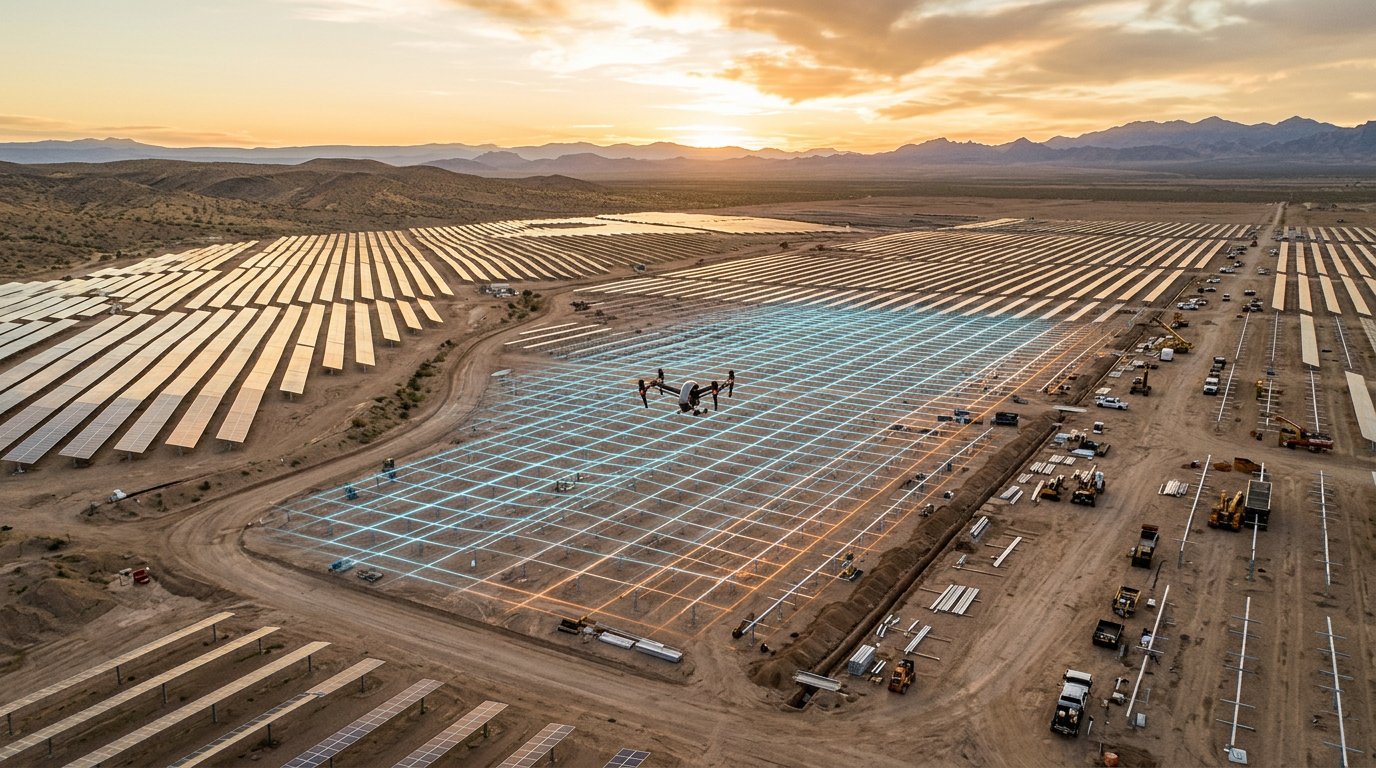
A single 300 MW solar site can sprawl across 1,500 to 2,500 acres, roughly two to three times the size of Central Park. Keeping a build that large on schedule is hard, and progress is often still stitched together from daily reports and spreadsheets. On November 16, 2026, Terabase Energy announced a next-generation release of its Construct software that tries to change this, calling it the first AI construction execution system for utility-scale solar. The details below come from Terabase’s company announcement.
From reporting to acting
Terabase draws a line between two kinds of software. Construction management tools report what has been built. A construction execution system, it says, helps teams act on what is happening now. Construct’s built-in AI agent works inside the platform, drawing on daily drone imagery, crew field data and equipment tracking. Users ask questions in plain language, and the agent answers, flags deviations from plan, builds custom reports and sets up views such as flight comparisons or filtered quality-control lists. In the company’s words, work that took an afternoon now takes a sentence.
The platform builds on software already used on more than 35 GW of solar, storage and wind projects, and a fleet of autonomous drone-in-a-box units flies more than 3 GW of active construction every day.
Finding problems while they are cheap to fix
Terabase co-founder Pierre Gousseland puts the logic simply: a defect fixed on the row takes minutes, while the same defect found at commissioning means a crew, a truck and lost days. Several features aim to move discovery earlier. Construct compares what has been built with the design and flags deviations, such as a misrouted medium-voltage feeder trench, before it is buried. Infrared drone flights and robotic array inspections flag defects automatically, and each finding is pinned to the exact element in the project’s digital twin, which handles hundreds of element types from individual piles and modules to inverters and foundations.
A day-by-day view shows progress against plan, and forecasting sets the daily rate needed to hit a finish date. A redesigned map-first screen brings progress, quality control and drawings together, with each project shown green or red against plan.
Tracking equipment and energy
Two additions go beyond software on a screen. A small magnetic beacon can be attached to nearly anything, from pile drivers to portable toilets, so teams can see location, idle time and utilization on the digital twin. Terabase says this gives crews faster access to tools across thousands of acres and lets rentals go off-rent sooner. A dedicated mesh network reserved for Terabase drones and devices keeps data flowing even far from a cell tower.
The second addition, Energy Intelligence, starts once the first medium-voltage circuit is energized. Using PlantPredict, Terabase’s energy model, Construct calculates what the as-built plant should produce and compares it with measured output, loss by loss, down to the tracker. The aim is to pinpoint the cause of underperformance instead of leaving it in an “unknown losses” bucket. The same model sets the baseline for the capacity test. Substations, battery storage, wind turbines and gen-tie lines are tracked in the same twin as the PV array, so hybrid sites sit in one view.
Who is using it
The announcement quotes MasTec’s director of construction, Joshua Hauger, saying Construct gives field teams and leadership real-time visibility into project performance and helps identify constraints earlier. Doral Renewables’ COO, Amit Nadkarni, describes managing more projects from one portfolio view without adding layers of reporting. These are customer endorsements supplied with the release, not independent evaluations. At handover, owners receive the digital twin as a structured record of how each project was built. Terabase demonstrated the release at RE+ 2026 in Las Vegas on November 17 to 19.
What it means
Demand for new power, especially from data centers, is pushing developers to finish solar and storage faster, and construction is a place where small delays multiply. Tools that turn daily drone and field data into early warnings could shave time without adding crews. The energy comparison is equally notable: measuring a plant against its model from the first energized circuit could surface problems months before commissioning.
Readers should note that the “first” label and the time savings are Terabase’s own claims, and the release publishes no measured schedule results. How well the agent’s answers hold up across messy real-world projects is the open question.
Conclusion
Terabase is betting that the next gain in solar deployment comes from knowing sooner, not building harder. If the agent, beacons and energy model deliver, a construction site becomes something owners can read as clearly as a dashboard.